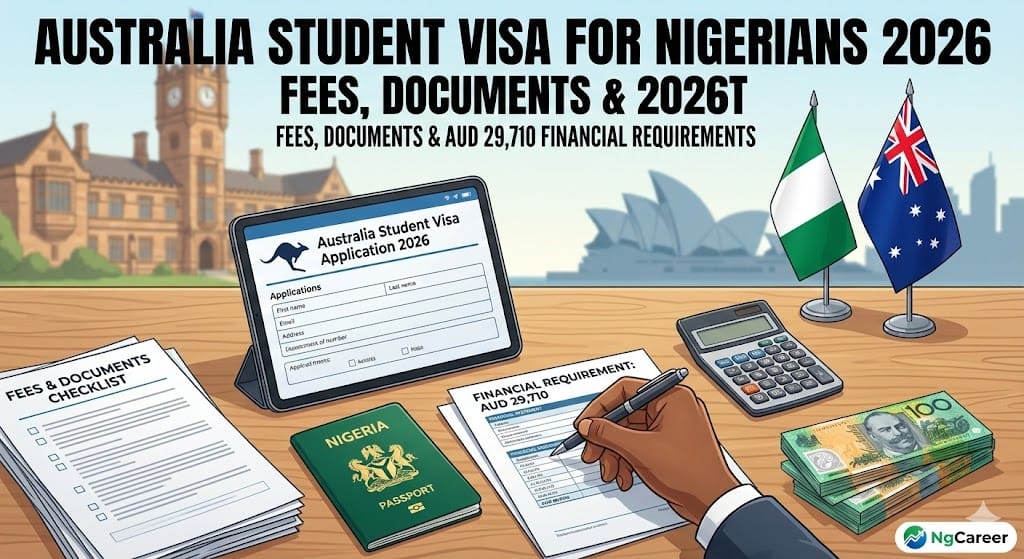
The Australia student visa (Subclass 500) allows Nigerian students to study full-time at Australian institutions for up to five years. As of 2026, applicants must demonstrate a minimum of AUD 29,710 (approximately ₦29 million) in living expenses alone, plus tuition fees and travel costs. This represents a significant increase from the previous AUD 24,505 requirement.
The Australian government has also replaced the Genuine Temporary Entrant (GTE) requirement with the new Genuine Student (GS) requirement, which focuses on your academic intent and career alignment rather than simply stating you intend to leave after studies. This shift means Nigerian applicants must now provide more detailed explanations of their course choices and how they connect to career goals.
My name is Babatunde Oladepo, and since 2019, I have been helping Nigerian students navigate international education opportunities. Australia remains one of the most popular destinations for Nigerian students, but the 2026 requirements demand careful preparation. I have seen applications rejected because applicants submitted generic GS statements that could apply to any course at any institution. One student wrote “I want to study business because it is a good career,” which tells the case officer nothing about genuine intent. Contrast this with a successful applicant who explained how her three years working in Nigerian fintech connected to her choice of a Master’s in Financial Technology at a specific Australian university. The difference in outcome was predictable.
This guide covers everything you need to know about the application process, from financial proof to the new Genuine Student statement.
Key Requirements at a Glance
| Requirement | Details |
|---|---|
| Visa type | Subclass 500 (Student Visa) |
| Living cost requirement | AUD 29,710 per year (~₦29 million) |
| Visa application fee | AUD 2,000 (~₦2 million) |
| Visa duration | Up to 5 years |
| Work rights | 48 hours per fortnight during study; unlimited during breaks |
| English requirement | IELTS 6.0 overall (no band below 5.5) |
| Processing time | Priority 1: 1-4 weeks; Priority 2: 5-8 weeks |
| 2026 National Planning Level | 295,000 student places |
| Application method | Online via ImmiAccount |
How Much Bank Balance Is Required for Australia Student Visa 2026?
This is the most common question I receive from Nigerian students, and the answer depends on your specific circumstances.
According to the Australian Department of Home Affairs and multiple verified sources, the financial capacity requirements as of 2026 are:
Single Student (No Dependents)
| Category | Amount (AUD) | Approximate Naira |
|---|---|---|
| Living expenses (mandatory) | 29,710/year | ~₦29 million |
| Tuition fees | Varies by course | 12 months required |
| Travel expenses | 2,500-3,000 | ~₦2.5-3 million |
| OSHC insurance | 600-1,000/year | ~₦600,000-1 million |
With Dependents
| Category | Additional Amount (AUD) | Approximate Naira |
|---|---|---|
| Spouse/de facto partner | +10,394/year | ~₦10 million |
| Each dependent child | +4,449/year | ~₦4.4 million |
| School-aged children | Additional schooling costs | Varies |
What This Means in Practice
For a single Nigerian student applying to a university with AUD 30,000 annual tuition fees, you would need to demonstrate approximately:
| Component | Amount (AUD) |
|---|---|
| Living expenses | 29,710 |
| One year tuition | 30,000 |
| Travel | 2,500 |
| OSHC | 700 |
| Total | ~AUD 62,910 |
At current exchange rates, this equals approximately ₦60-65 million. This is a substantial sum, and you must demonstrate genuine access to these funds, not just a one-time balance.
Critical Points About Financial Evidence
According to multiple immigration sources and official guidance:
The funds must be genuinely available. Immigration officers are trained to identify accounts where large sums were deposited shortly before application. Your bank statements should show a consistent savings pattern over 3-6 months, not sudden deposits. According to AECC Global, unverified or last-minute deposits may raise questions.
Show income sources. If you are being sponsored by parents or relatives, include their employment letters, tax returns, and income proof. The source of funds matters as much as the amount.
Fixed deposits count. If you have funds in fixed deposits or term deposits, include certificates showing the maturity value and your ability to access the funds.
Loan sanction letters are accepted. If you are taking an education loan, a sanction letter from a recognized financial institution can serve as proof of funds.
Is 3 Months Bank Statement Enough for Australia Student Visa?
This is another question I receive frequently. The short answer is: 3 months is the minimum, but 6 months is recommended.
According to immigration guidance, bank statements showing a steady balance over at least 3-6 months demonstrate genuine access to funds. A 3-month statement may be accepted, but a 6-month statement provides stronger evidence of your financial stability.
Requirements for bank statements:
- Must be recent (within 15 days of submission)
- Must show consistent balance throughout the period
- Must be on official bank letterhead with stamp/seal
- Online printouts may not be accepted by all case officers
- Should show regular income deposits if employed
Red flags that can cause rejection:
- Large deposits appearing suddenly before application
- Balances that do not match stated income
- Missing pages or inconsistent dates
- Funds from unverifiable sources
Australia Student Visa Fees 2026
According to AECC Global, the visa fees for 2026 are:
| Fee Type | Amount (AUD) | Approximate Naira |
|---|---|---|
| Visa Application Charge (VAC) | AUD 2,000 | ~₦2 million |
| Additional family members | Additional fees apply | Varies |
| OSHC (health insurance) | AUD 600-1,000 per year | ~₦600,000-1 million |
| Medical examination | Varies by provider | Varies |
| Police clearance | Varies | Varies |
Important: The visa application charge is payable online through ImmiAccount and is non-refundable regardless of the application outcome. Always verify the current fee on the Department of Home Affairs website before applying, as fees can change.
Australia Student Visa Document Checklist for Nigerian Students
Based on official requirements and AECC Global guidance, Nigerian students must prepare the following documents:
Identity Documents
- Valid passport (minimum 6 months validity beyond course end date)
- Recent passport-size photographs (white background, 35mm x 45mm)
- Birth certificate
- National ID card (optional but helpful)
Academic Documents
- Confirmation of Enrolment (CoE) from CRICOS-registered institution
- Academic transcripts from all previous institutions (secondary and tertiary)
- Degree certificates/diplomas
- WAEC/NECO certificates
- Curriculum Vitae (CV) or Resume (required if you have gaps in study or work experience)
Genuine Student (GS) Statement
According to the Department of Home Affairs, you must address four mandatory questions in your online application form (maximum 150 words each):
- Why did you choose this course and education provider?
- How does your course relate to your background and future plans?
- How will this course help your future career?
- What are your plans after completing your studies?
Important: The Department prefers responses entered directly into the application form rather than separate attached statements. All responses must be in English.
Financial Documents
- Bank statements (3-6 months, showing AUD 29,710+ available)
- Proof of tuition payment or loan sanction letter
- Scholarship award letters (if applicable)
- Sponsor’s financial documents (if sponsored):
- Sponsor’s bank statements
- Sponsor’s employment letter
- Sponsor’s tax returns/salary slips
- Affidavit of support
- Fixed deposit certificates (if applicable)
English Proficiency
According to AECC Global, the common requirements are:
| English Test | Minimum Score |
|---|---|
| IELTS Academic | 6.0 overall (no band less than 5.5) |
| TOEFL iBT | 60 (or higher, depending on course) |
| PTE Academic | 50 (or higher, depending on course) |
| Cambridge English: Advanced | 169 (or higher, depending on course) |
Note: Required scores can vary based on your education provider and course level. Always verify with your institution.
Results must be within 12 months of application.
Health and Character
- Overseas Student Health Cover (OSHC) proof covering entire visa duration
- Medical examination results (HAP ID required after lodgement if requested)
- Police clearance certificate from Nigeria
- Police clearance from any country where you lived 12+ months in the last 10 years
For Minors (Under 18)
- Verification of housing and welfare arrangements (CAAW form)
- Form 157N if a student guardian is designated
- Form 956A (Appointment of a recipient of correspondence)
For more detailed guidance on document preparation, see our guide on documents needed for studying abroad.
Understanding the Genuine Student (GS) Requirement
The Genuine Student requirement is one of the most significant changes affecting 2026 applicants. According to the Department of Home Affairs, “The GS requirement applies to student visa applications lodged on or after 23 March 2024.”
What Changed from GTE to GS?
| Previous GTE Requirement | New GS Requirement |
|---|---|
| Focused on proving you would leave Australia | Focuses on genuine academic intent |
| Emphasized temporary stay intentions | Acknowledges students may later apply for permanent residence |
| Required explaining ties to home country | Requires explaining course choice and career alignment |
Key Statement from the Department
The official guidance states: “The GS requirement recognises that genuine students may develop skills Australia needs and may later choose to apply for permanent residence. Future intentions of this kind do not count against an applicant under GS.”
This is important: you can mention interest in post-study pathways without it being held against you, as long as your primary purpose is genuine education.
What the Department Assesses
According to official guidance and Ministerial Direction No. 106, case officers consider:
- Circumstances in your home country (economic, political, social factors, family ties)
- Your potential circumstances in Australia
- Value of the course to your future (career progression logic)
- Your immigration history (previous visas, compliance record)
- Course relevance (does it make sense given your background?)
How to Write a Strong GS Statement
1. Explain why you chose this specific course:
- What attracted you to this field of study?
- Why this level of qualification (diploma, bachelor’s, master’s)?
- Why now in your career?
2. Connect it to your background:
- How does your previous education relate?
- How does your work experience connect?
- What skills or knowledge gap does this course fill?
3. Explain your career goals:
- What do you plan to do with this qualification?
- How will it advance your career?
- Are there specific industries or roles you are targeting?
4. Address your plans after completion:
- Be honest about your intentions
- You can mention interest in post-study work opportunities
- Explain how the qualification will be valuable regardless of where you work
According to Aussizz Group, “Your Genuine Student (GS) statement is more than a visa formality; it is your chance to tell your authentic story backed by facts. When your academic intent, financial readiness, and documentation align, your visa prospects improve significantly.”
Tip: Every statement should be supported by evidence. Do not make claims you cannot back up with documents. Generic claims without proof weaken your credibility.
Australian Student Visa New Rules 2026
According to IDP, ImmiLawGlobal, and NomadCredit, several significant changes affect 2026 applicants:
1. Genuine Student (GS) Requirement
Effective March 23, 2024, the GS requirement replaced the GTE requirement. The new framework focuses on:
- Clear explanation of why you chose your specific course
- How the course aligns with your background and career objectives
- Your understanding of visa conditions
- Assessment guided by Ministerial Direction No. 106
2. Increased Financial Requirements
The living cost requirement increased from AUD 24,505 to AUD 29,710 effective May 2024. This represents a 21% increase and reflects Australia’s higher cost of living.
3. Priority Processing System
According to AECC Global, visa processing now follows a priority system:
| Priority Level | Institution Status | Target Processing Time |
|---|---|---|
| Priority 1 (High) | Providers under their allocation | 1-4 weeks (7-28 days) |
| Priority 2 (Standard) | Providers at/above allocation | 5-8 weeks (35-56 days) |
What this means: If you apply to a university that has nearly filled its allocation, your visa may take longer to process. Popular institutions may reach their allocations faster.
4. National Planning Level (NPL)
Australia has set a 295,000 student places National Planning Level for 2026. According to NomadCredit, “There’s a 2026 overall student visa cap of 295,000 places—setting a national benchmark for allocations and planning, although it does not limit genuine applicants.”
Key points:
- The NPL is a prioritization system, not a strict cap
- Scholarship holders and pathway students to public universities receive priority processing
- After a provider reaches its NPL quota, applications are still accepted but processed slower
5. Onshore Switching Restricted
According to Study Australia, “Holders of certain visas, including Visitor, Temporary Graduate, and Maritime Crew visas, cannot apply for Student visas while in Australia.”
If you are in Australia on a visitor visa and want to study: You must leave Australia and apply for your student visa from offshore.
6. Age Limit for Graduate Visa
Students over 35 years old at time of application are now ineligible for the Temporary Graduate Visa (Subclass 485).
What this means for Nigerian students: If you are over 35 when you apply for the Subclass 485 Graduate Visa after completing your studies, you will not be eligible. Plan accordingly if post-study work rights are important to your decision.
7. Work Hours
According to Study Australia, students can work “up to 48 hours a fortnight while your course of study is in session. Students who have started a master’s degree by research or Doctoral degree have no work hour limits.”
During scheduled breaks, you can work unlimited hours.
How Long Does Australia Student Visa Take from Nigeria?
According to AECC Global, processing times can vary from 7-85 days depending on the priority level and completeness of your application.
Processing Times by Priority Level
| Priority | Target Processing |
|---|---|
| Priority 1 (High) | 1-4 weeks (7-28 days) |
| Priority 2 (Standard) | 5-8 weeks (35-56 days) |
Factors Affecting Processing Time
Faster processing:
- Complete, accurate documentation
- Applying to institutions under their allocation (Priority 1)
- Clear, well-supported GS statement
- Clean immigration history
- Front-loading biometrics, medicals, and police clearances
Slower processing:
- Incomplete applications requiring additional documents
- Applying during peak seasons
- Institutions at or above allocation (Priority 2)
- Complex cases requiring verification
- Health or character concerns requiring additional checks
When to Apply
Recommendation: Apply at least 3-4 months before your course start date. While many Priority 1 applications are processed within 1-4 weeks, allowing buffer time protects you from unexpected delays.
How to Apply for Australia Student Visa from Nigeria
Step 1: Receive Confirmation of Enrolment (CoE)
Before you can apply for a visa, you need:
- Acceptance from a CRICOS-registered institution
- Payment of initial tuition deposit (usually one semester)
- Your Confirmation of Enrolment (CoE) document
The CoE contains important information including your student ID, course details, and start date that you will need for the visa application.
Step 2: Purchase Overseas Student Health Cover (OSHC)
OSHC is mandatory for all student visa holders. You must have coverage for the entire duration of your visa.
Key requirements:
- Must be with an approved OSHC provider
- Must cover your entire visa period
- Must be arranged before visa application
Step 3: Prepare Financial Evidence
Gather your bank statements, loan sanction letters, scholarship letters, or sponsor documents showing you can cover:
- AUD 29,710 for living expenses
- 12 months of tuition fees
- Travel costs
- OSHC costs
Step 4: Complete English Test
Take IELTS, TOEFL, or PTE and achieve the required score:
- IELTS 6.0 overall (no band below 5.5) for most courses
- Results must be within 12 months of application
For test comparison and preparation guidance, see our guide on IELTS vs TOEFL.
Step 5: Write Your Genuine Student Statement
Prepare thoughtful answers to the four GS questions. Support your statements with evidence from your academic and work history. Remember the 150-word limit per question.
Step 6: Create ImmiAccount
Register on the Department of Home Affairs ImmiAccount portal. This is where you will complete and submit your application.
Step 7: Complete Online Application
Fill out the Subclass 500 application form, providing:
- Personal details
- Passport information
- Course and CoE details
- GS statement responses
- Employment history
- Family information
Step 8: Upload Documents
Attach all required documents in the correct format (PDF preferred, clear scans).
Step 9: Pay Visa Fee
Pay the AUD 2,000 application fee online. Keep the receipt as proof of payment.
Step 10: Complete Biometrics (If Required)
Some applicants are required to provide biometrics (fingerprints and photo). You will be notified if this applies to you.
Step 11: Attend Medical Examination (If Required)
Some applicants must complete a health examination with an approved panel physician.
Step 12: Await Decision
Track your application through ImmiAccount. Respond promptly to any requests for additional information.
Common Reasons for Australia Student Visa Rejection
According to AECC Global, the main reasons applications fail:
1. Failing the Genuine Student Requirement
If the case officer is not convinced of your genuine intent to study, your application will be refused. Common issues include:
- Course choice that does not align with background
- Generic or AI-generated GS statements
- Career goals that do not make sense given the course
- Inconsistencies between documents and statements
- Excessive focus on migration outcomes rather than education
2. Insufficient Financial Capability
Failing to demonstrate the required AUD 29,710+ in living expenses plus tuition and travel costs. Funds must also be genuinely accessible, not last-minute deposits.
3. Inadequate English Language Proficiency
Not meeting the IELTS 6.0 (or equivalent) requirement for your course level.
4. Incomplete or Inaccurate Documentation
Missing documents or errors in forms are common causes of rejection. Application documents that are incomplete or submitted incorrectly can cause delay or outright rejection.
5. Health or Character Issues
Negative health assessments or criminal backgrounds can lead to refusal.
6. Mismatch in Application Details
Inconsistencies between your application form, supporting documents, and GS statement raise red flags. Every detail must align.
Working While Studying in Australia
One of Australia’s attractions is the ability to work during your studies.
Work Rights for Subclass 500 Holders
| Period | Work Limit |
|---|---|
| During study periods | Up to 48 hours per fortnight |
| Scheduled breaks | Unlimited hours |
| Master’s by research/Doctoral | No work hour limits |
What Counts as a Scheduled Break?
Scheduled breaks are official vacation periods between semesters or terms as defined by your educational institution. Working unlimited hours during exam periods or study weeks is not permitted.
Post-Study Work Options
After completing your studies, you may be eligible for the Temporary Graduate Visa (Subclass 485), which allows you to work in Australia temporarily.
Key Requirements for Graduate Visa (2026)
| Requirement | Details |
|---|---|
| Age limit | 35 years maximum at time of application |
| English | IELTS 6.5 overall (minimum 5.5 in each band) |
| Study requirement | CRICOS course completed on student visa |
| Duration | Varies by qualification level |
Important: If you are over 35 at the time of applying for the Graduate Visa, you will not be eligible. Consider this when planning your study timeline.
Frequently Asked Questions
How much bank balance is required for Australia student visa 2026?
You must demonstrate enough funds to cover AUD 29,710 for living expenses, 12 months of tuition fees, and AUD 2,500-3,000 for travel. The total typically ranges from AUD 50,000 to AUD 65,000 depending on your course fees, equivalent to approximately ₦50-65 million.
Is 3 months bank statement enough for Australia student visa?
Three months is the minimum, but 6 months is recommended for stronger evidence. Statements must show consistent balances and legitimate income sources, not sudden large deposits.
What is the IELTS requirement for Australia student visa 2026?
The common requirement is IELTS 6.0 overall with no band less than 5.5 for the Subclass 500 student visa. However, required scores can vary based on your education provider and course level. Always verify with your institution.
How long does Australia student visa take from Nigeria?
Processing times vary by priority level. Priority 1 applications (institutions under allocation) target 1-4 weeks. Priority 2 applications (institutions at/above allocation) target 5-8 weeks. Complex cases may take longer.
What is the Genuine Student (GS) requirement?
The GS requirement replaced the old Genuine Temporary Entrant (GTE) rule on March 23, 2024. You must demonstrate genuine academic intent by answering four questions (150 words each) explaining why you chose your course, how it aligns with your career goals, and your understanding of visa conditions. The GS requirement acknowledges that students may later apply for permanent residence without this counting against them.
Can I work while studying in Australia?
Yes. Students on Subclass 500 visas can work up to 48 hours per fortnight during study periods and unlimited hours during scheduled breaks. Master’s by research and Doctoral students have no work hour limits.
What is the 2026 student intake cap?
Australia has set a National Planning Level of 295,000 places for 2026. This is a planning benchmark that affects how institutions manage enrolments and influences visa processing times through the priority system. It does not limit genuine applicants.
Can I bring my family on a student visa?
Yes, you can include dependents in your application. You must demonstrate additional funds: AUD 10,394 for a spouse/partner and AUD 4,449 per dependent child annually.
What happens if my visa is rejected?
You will receive a refusal letter explaining the reasons. You can reapply, but you must address the specific issues that caused the rejection. The AUD 2,000 application fee is not refunded.
Can I switch to a student visa while in Australia on a tourist visa?
No. Holders of Visitor, Temporary Graduate, and Maritime Crew visas cannot apply for Student visas while in Australia. You must apply offshore.
How much is the Australia student visa fee?
The visa application charge is AUD 2,000 (approximately ₦2 million) for the primary applicant. Additional fees apply for accompanying family members. This fee is non-refundable regardless of the outcome.
Related Resources
If you are exploring study opportunities in multiple countries, these guides may help:
- Canada Student Visa for Nigerians covers the Canadian study permit process
- UK Student Visa Nigeria Application Guide explains UK student visa requirements
- Germany Student Visa for Nigerians covers the blocked account and application process
- How to Apply for Scholarships provides strategies for funding your education
- IELTS vs TOEFL helps you choose the right English test
Final Thoughts
The Australia student visa process in 2026 requires careful preparation, particularly around the Genuine Student statement and financial evidence. With the increased living cost requirement of AUD 29,710 and the new priority processing system, Nigerian applicants need to plan well in advance.
The key factors for a successful application are:
- Genuine, accessible funds demonstrated through 3-6 months of bank statements
- A clear, logical course choice that connects to your background and career goals
- Meeting the English proficiency requirements for your specific course
- Complete, consistent documentation with no gaps or contradictions
- A compelling Genuine Student statement supported by evidence and entered directly into the application form
Apply early to avoid processing delays, especially during peak periods. Choose your institution carefully, as the priority processing system means some universities process visas faster than others.
For the most current information, always verify requirements on the official Department of Home Affairs website before submitting your application.
This article reflects information verified as of January 2026. Visa requirements, fees, and processing times can change. Always confirm current requirements through official Australian government sources before applying.
I’ve read some good stuff here. Definitely worth bookmarking for revisiting. I wonder how much effort you put to make such a great informative website.