If you have been following Canadian immigration news, you have probably noticed the dramatic shift in tone and numbers over the past two years. After years of aggressive growth that pushed Canada’s temporary resident population to unprecedented levels, the federal government has reversed course with what officials call a return to “sustainable immigration levels.”
I have been tracking these changes closely because they directly affect the Nigerians and other international applicants I work with through NG Career. The questions flooding my inbox have shifted from “How do I maximize my CRS score?” to “Is Canada even accepting immigrants anymore?” and “Should I still pursue Canada or look elsewhere?”
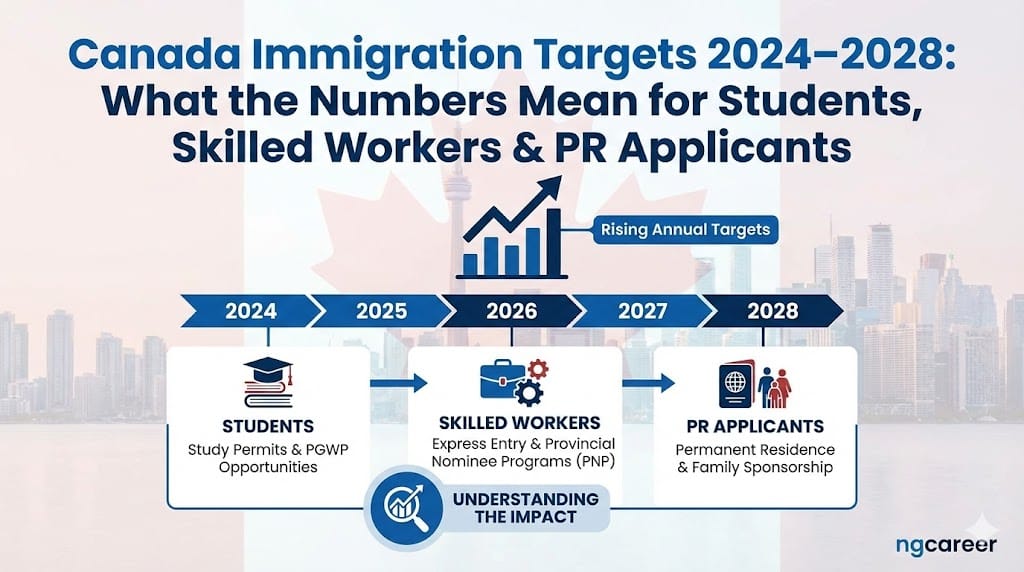
Let me be clear from the start: Canada is not closing its doors to immigration. What is happening is a significant recalibration, a shift from rapid growth to stabilization. According to the official 2026-2028 Immigration Levels Plan released by Immigration, Refugees and Citizenship Canada (IRCC), permanent resident targets are now set at 380,000 annually for 2026, 2027, and 2028.
This guide breaks down exactly what these numbers mean, who will be most affected, and how to position yourself for success in this new immigration landscape.
Canada Immigration Targets by Year: Complete Breakdown (2024-2028)
Understanding where Canada has been helps explain where it is going. Here is the complete picture of immigration targets from 2024 through 2028.
Immigration Targets 2024
The 2024 targets represented the peak of Canada’s aggressive immigration expansion:
| Category | 2024 Target |
|---|---|
| Total Permanent Residents | 465,000 |
| Economic Class | ~270,000 |
| Express Entry | ~110,000 |
| Provincial Nominee Program | ~110,000 |
| Family Class | ~114,000 |
According to various reports, actual PR admissions reached approximately 85% of the 2024 target by October 2024, suggesting Canada welcomed roughly 395,000 permanent residents that year.
Immigration Targets 2025
The 2025 targets marked the beginning of the reduction:
| Category | 2025 Target | Change from 2024 |
|---|---|---|
| Total Permanent Residents | 395,000 | -15% (70,000 fewer) |
| Economic Class | ~232,000 | Reduced |
| Family Class | ~94,500 | Reduced |
| Refugees/Humanitarian | ~68,350 | Reduced |
| Provincial Nominee Program | 55,000 | -50% |
The 50% cut to Provincial Nominee Program allocations was particularly significant, dramatically increasing competition for provincial nominations across all provinces.
Immigration Targets 2026-2028
According to the Supplementary Information for the 2026-2028 Immigration Levels Plan, here are the detailed targets:
| Category | 2026 | 2027 | 2028 |
|---|---|---|---|
| Total Permanent Residents | 380,000 | 380,000 | 380,000 |
| Economic Class Total | 239,800 | 244,700 | 244,700 |
| Federal High Skilled | 109,000 | 111,000 | 111,000 |
| Provincial Nominee Program | 91,500 | 92,500 | 92,500 |
| Atlantic Immigration Program | 4,000 | 4,000 | 4,000 |
| Federal Business | 500 | 500 | 500 |
| Economic Pilots (Caregivers, Agri-Food, etc.) | 8,175 | 8,775 | 8,775 |
| Family Class Total | 84,000 | 81,000 | 81,000 |
| Spouses, Partners, Children | 69,000 | 66,000 | 66,000 |
| Parents and Grandparents | 15,000 | 15,000 | 15,000 |
| Refugees and Protected Persons | 49,300 | 49,300 | 49,300 |
| Humanitarian & Compassionate | 6,900 | 5,000 | 5,000 |
| French-speaking (outside Quebec) | 9% (30,267) | 9.5% (31,825) | 10.5% (35,175) |
Key observation: According to the official IRCC supplementary information, economic immigration will account for 64% of all admissions by 2027 and 2028, the highest proportion in decades. This signals that Canada is prioritizing skilled workers who can contribute to the economy.
Temporary Resident Targets 2026-2028
According to IRCC, targets for new temporary resident arrivals are set as follows:
| Category | 2026 | 2027 | 2028 |
|---|---|---|---|
| Overall Arrivals | 385,000 | 370,000 | 370,000 |
| Workers Total | 230,000 | 220,000 | 220,000 |
| International Mobility Program (IMP) | 170,000 | 170,000 | 170,000 |
| Temporary Foreign Worker Program (TFWP) | 60,000 | 50,000 | 50,000 |
| Students | 155,000 | 150,000 | 150,000 |
This represents a dramatic reduction from the 673,650 temporary resident target in 2025.
The Big Picture: Target Comparison
| Year | PR Target | Change |
|---|---|---|
| 2024 | 465,000 | Baseline (peak) |
| 2025 | 395,000 | -15% |
| 2026 | 380,000 | -18% from 2024 |
| 2027 | 380,000 | Stabilized |
| 2028 | 380,000 | Stabilized |
From 2024 to 2026, Canada reduced its permanent resident target by 85,000 spots, representing an 18% decrease.
Is Canada Going to Stop Immigration After 2025?
This is the question I receive most frequently, and I understand the concern. Headlines about “immigration cuts” and “reduced targets” can feel alarming, especially if you have been planning your Canada immigration journey for years.
The short answer: No, Canada is not stopping immigration.
According to official IRCC communications, Canada will continue welcoming 380,000 permanent residents annually through 2028. That is still a substantial number, more than many countries accept in total.
What is changing is the pace and composition of immigration:
Economic immigration is becoming more dominant: The economic class will represent 64% of admissions by 2027-2028, up from approximately 59% in 2025. According to Fragomen’s analysis, this reflects “a shift toward attracting and retaining skilled workers.”
Temporary residents face the largest reductions: The government’s goal is to reduce the temporary resident population (students, workers on permits) from over 7% of Canada’s total population to less than 5% by the end of 2027.
In-Canada applicants are prioritized: According to IRCC supplementary information, a significant portion of permanent resident admissions will come from students or workers already living in Canada. If you are already in Canada on a study or work permit, this works in your favor.
Why Is Canada Reducing Immigration?
According to the 2026-2028 Levels Plan and official government statements:
Housing pressures: Canada’s housing supply has not kept pace with population growth. The government cites the need to “ease pressure on housing” as a primary reason for the reduction.
Infrastructure capacity: Healthcare, education, and public services have been strained by rapid population growth.
Labour market balance: The plan emphasizes attracting workers who “fill specific labour market needs” rather than general immigration.
Temporary resident rebalancing: The temporary resident population grew from approximately 3.3% of Canada’s population in 2018 to over 7% by 2024, an unprecedented increase. The government views this as unsustainable.
Temporary Resident Targets: What Is Changing for Students and Workers
For Nigerians and other international applicants, the most significant changes affect temporary residents, particularly international students.
International Student Targets
According to the 2026-2028 Levels Plan:
| Year | Student Arrivals Target | Change from Previous |
|---|---|---|
| 2025 | 305,900 | Study permit cap implemented |
| 2026 | 155,000 | -49% from 2025 |
| 2027 | 150,000 | Continued reduction |
| 2028 | 150,000 | Stabilized |
This represents a nearly 50% reduction in new international student arrivals between 2025 and 2026.
New rules for international students include:
- Intake caps on most study permit applications
- Amended cost of living requirements (you must demonstrate more funds)
- Eligibility changes to Post-Graduation Work Permits (PGWP)
- Restrictions on work permits for spouses of international students at most program levels
For those considering studying in Canada, our guide on Canada student visa for Nigerians covers the current requirements and strategies.
Temporary Foreign Worker Targets
| Year | Worker Arrivals (IMP + TFWP) | IMP Allocation | TFWP Allocation |
|---|---|---|---|
| 2025 | 367,750 | — | — |
| 2026 | 230,000 | 170,000 | 60,000 |
| 2027 | 220,000 | 170,000 | 50,000 |
| 2028 | 220,000 | 170,000 | 50,000 |
This represents a 37% reduction in temporary worker arrivals.
Key changes to understand:
- The Temporary Foreign Worker Program (TFWP), particularly the Low Wage stream, faces the most restrictions
- The International Mobility Program (IMP), which includes intra-company transfers and PGWP holders, is less affected
- According to Fragomen, the government is shifting emphasis toward “higher-skilled and mobility-focused roles” and away from low-wage temporary positions
For those exploring work opportunities, our guide on Canada visa sponsorship jobs for Nigerians provides current pathways.
One-Time Initiatives: Transition Programs for 2026-2027
The 2026-2028 Plan includes two significant one-time initiatives according to official IRCC announcements:
Temporary Worker Transition
According to IRCC, the government will accelerate the transition of up to 33,000 temporary workers to permanent residency in 2026 and 2027. Per the supplementary information, “This initiative will target workers who have established strong roots in their communities, are paying taxes and are helping to build the strong economy Canada needs.”
Protected Persons Transition
Approximately 115,000 eligible protected persons already living in Canada will transition to permanent resident status over two years. According to Gowling WLG analysis, this ensures those in need of protection can fully integrate and move toward citizenship.
What Are TEER 0, 1, 2, 3, 4, and 5 Jobs in Canada?
Understanding TEER categories is essential for navigating Canadian immigration, as your occupation’s TEER level determines which programs you qualify for.
TEER stands for Training, Education, Experience, and Responsibilities. It replaced the old NOC skill levels (A, B, C, D) in 2021.
| TEER Category | Training/Education Required | Examples |
|---|---|---|
| TEER 0 | Management experience | Nursing managers, engineering managers, restaurant managers |
| TEER 1 | University degree | Registered nurses, engineers, doctors, lawyers, accountants |
| TEER 2 | College diploma OR apprenticeship (2+ years) | Electricians, plumbers, paramedics, police officers |
| TEER 3 | College diploma OR apprenticeship (less than 2 years) | Bakers, dental assistants, veterinary technicians |
| TEER 4 | High school diploma + on-the-job training | Retail salespersons, truck drivers, food service workers |
| TEER 5 | Short work demonstration | Landscaping labourers, cleaning staff, food counter attendants |
Is TEER 4 Eligible for PR?
Yes, but with limitations.
TEER 4 occupations are eligible for:
- Canadian Experience Class (CEC): Yes, if you have 1+ year of Canadian work experience in a TEER 0, 1, 2, 3, or 4 occupation
- Provincial Nominee Programs: Some provinces accept TEER 4 occupations in specific streams
- Federal Skilled Worker: No (requires TEER 0, 1, 2, or 3)
Important consideration: TEER 4 workers generally receive fewer CRS points for work experience and may face more limited Express Entry pathways than TEER 0-3 workers. However, if you are already in Canada working in a TEER 4 occupation, the Canadian Experience Class remains a viable pathway.
TEER 5 and PR Eligibility
TEER 5 occupations are not eligible for most federal economic immigration programs. Workers in TEER 5 occupations generally need to:
- Transition to a higher TEER occupation, or
- Pursue a Provincial Nominee Program that accepts TEER 5 (rare), or
- Qualify through family sponsorship or humanitarian programs
Top Source Countries for Canada Immigration
While the most recent country-specific data requires verification against IRCC’s latest reports, historical patterns show consistent trends:
| Rank | Source Country | Primary Immigration Class |
|---|---|---|
| 1 | India | Economic, Family, Students |
| 2 | China | Economic, Students |
| 3 | Philippines | Economic, Family |
| 4 | Nigeria | Economic, Students |
| 5 | Pakistan | Economic, Family |
Nigeria consistently ranks among the top five source countries for Canadian immigration, with strong representation in both economic class and international student programs.
Which Province in Canada Is Easiest to Immigrate To?
This question requires nuance because “easiest” depends on your specific profile, occupation, and circumstances.
Provincial Nominee Program Allocations (2026-2028)
According to the 2026-2028 Levels Plan, the Provincial Nominee Program allocation is 91,500 for 2026 and 92,500 for 2027-2028. This is a significant increase from the reduced 55,000 allocation in 2025, creating more provincial nomination opportunities.
| Province | Key Advantages | Considerations |
|---|---|---|
| Saskatchewan | Lower CRS requirements in some streams, occupation-specific pathways | Smaller job market |
| Manitoba | Express Entry-linked streams, values family connections | Cold climate, smaller cities |
| Nova Scotia | Labour Market Priorities stream, healthcare worker focus, expedited nursing pathways | Growing but smaller economy |
| New Brunswick | Lower population, active recruitment, IEN programs | Smaller job market |
| Prince Edward Island | Lower competition, business streams | Very small population and job market |
| Alberta | Strong economy, higher salaries, healthcare demand | Higher CRS thresholds typically |
| Ontario | Largest job market, highest demand | Highest competition, highest living costs |
| British Columbia | Strong economy, diverse opportunities | Very high living costs, competitive |
Strategic insight: Smaller provinces like Saskatchewan, Manitoba, and the Atlantic provinces often have lower CRS thresholds and occupation-specific streams that bypass general competition. However, you should only target a province where you genuinely intend to live and work, as provincial nominees are expected to settle in their nominating province.
For healthcare workers, our guide on how to work as a nurse in Canada covers specific provincial pathways that may be advantageous.
Is CRS Expected to Drop in 2025-2026?
This is a complex question without a simple answer.
Factors Suggesting Higher CRS Scores
Reduced PR targets: With 380,000 spots in 2026 compared to 465,000 in 2024, there are fewer invitations to distribute.
Increased competition: More applicants competing for fewer spots mathematically pushes scores higher.
Express Entry inventory: There is a significant backlog of profiles in the Express Entry pool.
Factors Suggesting Stable or Lower CRS Scores
Reduced temporary resident population: Fewer international students and workers means fewer people entering the Canadian Experience Class pool over time.
Category-based selection: IRCC is conducting targeted draws for specific occupations (healthcare, trades, STEM, French speakers), allowing people with lower overall CRS scores to receive invitations if they qualify for a category.
Provincial nominations: PNP nominations add 600 CRS points, virtually guaranteeing an invitation. The increased PNP allocation (91,500-92,500) in 2026-2028 compared to 2025 (55,000) creates more opportunities.
Strategic Recommendations
Rather than trying to predict CRS cutoffs, focus on:
- Maximizing your CRS score through language tests, education credentials, and Canadian experience
- Targeting category-based draws if you work in healthcare, trades, STEM, or speak French
- Pursuing provincial nomination as a pathway that bypasses general CRS competition
- Improving language scores as this often provides the most accessible CRS boost
For language test preparation, our comparison of IELTS vs TOEFL can help you choose the right test.
Who Will Be Affected by New Immigration Rules?
The 2026-2028 Levels Plan affects different groups differently:
| Group | Impact Level | Key Changes |
|---|---|---|
| International students | HIGH | Study permit caps (-49%), PGWP restrictions, spouse work permit limits |
| Spouses of students/workers | HIGH | Work permit eligibility restricted for most program levels |
| Low-wage TFWP workers | HIGH | Program restrictions, TFWP reduced to 50,000-60,000 |
| PNP applicants | MODERATE-POSITIVE | Allocations restored to 91,500-92,500 (up from 55,000 in 2025) |
| Family class sponsors | MODERATE | Targets reduced from 2024 levels to 81,000-84,000 |
| Express Entry applicants | MODERATE | Category-based draws prioritized |
| Refugees | MODERATE | Targets at 49,300 (13% of admissions) |
| French-speaking applicants | POSITIVE | Increased targets (9% to 10.5%) |
| Healthcare workers | POSITIVE | Priority in category-based draws |
| Trade workers | POSITIVE | Priority in category-based draws |
| Protected persons in Canada | POSITIVE | 115,000 transitioning to PR over two years |
Wages and Cost of Living in Canada
Understanding Canadian wages helps with financial planning for your immigration journey.
Minimum Wages by Province (2026)
| Province | Minimum Wage (CAD/hour) |
|---|---|
| British Columbia | $17.40 |
| Ontario | $16.55 |
| Alberta | $15.00 |
| Quebec | $15.75 |
| Nova Scotia | $15.20 |
| Saskatchewan | $15.00 |
| Manitoba | $15.80 |
Average Wages by Occupation Category
| Occupation Category | Average Hourly Wage (CAD) |
|---|---|
| Healthcare professionals (RN) | $35-45 |
| IT professionals | $40-60 |
| Skilled trades | $25-40 |
| Retail/Service workers | $15-20 |
| Administrative support | $20-28 |
Note: Wages vary significantly by province, city, and specific occupation. Toronto and Vancouver typically offer higher wages but have correspondingly higher living costs.
Is It Wise to Immigrate to Canada in 2025-2026?
This requires honest analysis of both opportunities and challenges.
Reasons to Pursue Canada Immigration
Canada still welcomes 380,000+ permanent residents annually. That is more than most countries accept.
Healthcare and trade workers remain in high demand. If you work in nursing, medicine, skilled trades, or STEM fields, you may benefit from category-based draws.
Economic class dominance (64%) favors skilled workers. If you have strong credentials, language skills, and work experience, you remain competitive.
In-Canada advantage: A significant portion of PR spots go to people already in Canada. If you can enter on a study or work permit, you position yourself for this pathway.
Provincial pathways significantly restored: The PNP allocations (91,500-92,500) are nearly double the reduced 2025 levels (55,000), creating more provincial nomination opportunities.
Reasons for Caution
Higher competition for fewer spots: The math is straightforward. Fewer spots mean more competition.
Housing and cost of living pressures: Canada, particularly Toronto and Vancouver, faces significant housing affordability challenges.
Study permits significantly restricted: The 49% reduction in student arrivals makes this pathway more competitive.
Processing times and backlogs: Reduced staff and policy changes may affect processing times.
Balanced Recommendation
Immigration to Canada remains viable but requires:
- Strong CRS profile (high language scores, education credentials, Canadian experience)
- OR provincial nomination (targeting provinces aligned with your occupation)
- OR category-based eligibility (healthcare, trades, STEM, French language)
- Realistic expectations about competition and timelines
- Financial preparation for higher living costs
- Clear occupation alignment with Canada’s priorities
If you are considering alternatives, our guides on UK student visa application and Germany Job Seeker Visa cover other pathways.
Important Myth: There Is No Canada DV Lottery
I need to address this directly because I continue to see Nigerians fall victim to this scam.
Canada does NOT have a Diversity Visa (DV) Lottery program.
The DV Lottery is a United States program that grants approximately 55,000 green cards annually through random selection. Canada has never operated a similar lottery system.
Why this confusion exists:
- Scam websites claim to offer “Canada visa lottery” applications
- Fraudulent services charge fees for non-existent lottery registration
- Social media posts spread misinformation about “Canada DV Lottery 2027”
How to actually immigrate to Canada:
- Express Entry (points-based skilled worker programs)
- Provincial Nominee Programs
- Family sponsorship
- Study permit followed by PGWP followed by PR pathway
- Refugee and humanitarian programs
Warning: Any website claiming to offer “Canada DV Lottery 2025,” “Canada DV Lottery 2027 registration,” or “Canada visa lottery official website” is a scam. Do not pay any fees. Report such sites to the Canadian Anti-Fraud Centre.
For guidance on identifying immigration scams, read our guide on how to spot fake recruitment agencies.
What Is the 90% Rule for Newcomers to Canada?
The “90% rule” most commonly refers to Post-Graduation Work Permit eligibility requirements.
According to IRCC guidelines, to qualify for a PGWP after completing studies in Canada:
- You must have completed at least 90% of your studies in person (on-campus) in Canada
- Programs completed primarily online may not qualify
- This rule was reinforced after pandemic-era exceptions ended
This matters because PGWP is a critical step in the study-to-PR pathway. If your program was primarily online, you may not qualify for the work permit that would allow you to gain Canadian work experience for Express Entry.
Planning consideration: When choosing Canadian programs, verify that the program structure will allow you to meet the 90% in-person requirement for PGWP eligibility.
Francophone Immigration: A Growing Priority
One area of growth in the 2026-2028 Plan is Francophone immigration outside Quebec.
| Year | French-speaking Target (outside Quebec) |
|---|---|
| 2026 | 9% (30,267) |
| 2027 | 9.5% (31,825) |
| 2028 | 10.5% (35,175) |
According to the IRCC supplementary information, the government aims to reach 12% by 2029.
What this means for applicants:
If you speak French (even as a second language), you may benefit from:
- Francophone-specific Express Entry draws
- Higher CRS points for French language ability
- Provincial programs targeting French speakers
- Less competition in Francophone categories
Consider taking the TEF or TCF French language test if you have French ability, even if English is your primary language. French proficiency can significantly improve your immigration prospects.
Application Fees and Processing Times
Permanent Residence Application Fees
| Category | Application Fee (CAD) | Right of PR Fee (CAD) | Total (CAD) |
|---|---|---|---|
| Express Entry (principal applicant) | $850 | $575 | $1,425 |
| Express Entry (spouse/partner) | $850 | $575 | $1,425 |
| Dependent child | $230 | — | $230 |
| Provincial Nominee (through Express Entry) | $850 | $575 | $1,425 |
| Family Sponsorship (spouse) | $1,080 | $575 | $1,655 |
Additional costs:
- Biometrics: $85 CAD
- Medical examination: $200-400 CAD
- Language tests: $300-400 CAD
- Educational Credential Assessment: $200-300 CAD
Processing Times (Approximate)
| Category | Processing Time |
|---|---|
| Express Entry | ~6 months |
| Provincial Nominee (Express Entry-linked) | ~6 months after nomination |
| Family Sponsorship (spouse) | 12-18 months |
| Study Permit | 8-16 weeks |
| Work Permit | Varies by stream |
Note: Processing times vary based on application volume and individual circumstances. Check IRCC’s website for current processing times.
How to Apply for Canada Immigration in 2026
Express Entry Application Process
- Create Express Entry profile on IRCC’s website
- Receive CRS score based on age, education, language, work experience, and other factors
- Wait for Invitation to Apply (ITA) from regular draws or category-based draws
- Submit complete PR application within 60 days of receiving ITA
- Processing time: Approximately 6 months for most applications
Provincial Nominee Program Process
- Research provincial streams matching your profile and occupation
- Apply directly to province OR through Express Entry-linked stream
- Receive provincial nomination (adds 600 CRS points if Express Entry-linked)
- Apply for PR through IRCC
Study Permit to PR Pathway
- Apply for study permit (now subject to caps and increased scrutiny)
- Complete eligible program (minimum 8 months, ideally 2+ years)
- Apply for PGWP (new restrictions apply, 90% in-person requirement)
- Gain Canadian work experience in TEER 0-4 occupation
- Apply through Canadian Experience Class or Provincial Nominee Program
For comprehensive preparation, our guide on documents needed for studying abroad covers what you need to gather.
Frequently Asked Questions
What is the immigration target for Canada in 2024?
According to the 2024-2026 Levels Plan, Canada targeted 465,000 permanent residents in 2024, with the economic class representing approximately 58% of admissions.
What is the immigration level plan for Canada 2026 to 2028?
According to the 2026-2028 Levels Plan, Canada targets 380,000 permanent residents annually for all three years. Economic class represents 64% of admissions by 2027-2028, with Federal High Skilled at 109,000-111,000 and PNP at 91,500-92,500 annually.
Is Canada going to stop immigration after 2025?
No. Canada is reducing immigration, not stopping it. Targets are set at 395,000 (2025) and 380,000 (2026, 2027, 2028). Economic immigration remains a priority, representing 64% of admissions by 2027-2028.
Is TEER 4 eligible for PR?
Yes, TEER 4 occupations are eligible for the Canadian Experience Class and some Provincial Nominee Programs, but not for the Federal Skilled Worker Program which requires TEER 0, 1, 2, or 3.
Is there a Canada visa lottery?
No. Canada does NOT have a Diversity Visa Lottery. The DV Lottery is a United States program. Any website claiming to offer “Canada DV Lottery registration” is a scam.
Which province is easiest to immigrate to?
Smaller provinces like Saskatchewan, Manitoba, Nova Scotia, and New Brunswick often have lower CRS thresholds and occupation-specific PNP streams. However, “easiest” depends on your specific profile and occupation.
Is CRS expected to drop in 2025-2026?
CRS trends are uncertain. Reduced targets increase competition, but category-based draws and reduced temporary resident populations may create opportunities for specific occupations. Focus on maximizing your score and targeting relevant categories.
What are the new rules for international students?
New rules include study permit caps (155,000 new arrivals in 2026), amended cost of living requirements, PGWP eligibility changes (90% in-person requirement), and restrictions on spouse work permits for most program levels.
How many temporary residents will Canada accept in 2026?
According to the 2026-2028 Levels Plan, Canada targets 385,000 new temporary resident arrivals in 2026, broken down as 230,000 workers and 155,000 students. This reduces to 370,000 in 2027 and 2028.
What is the goal for temporary residents as a percentage of population?
According to IRCC, the government is committed to reducing Canada’s temporary population to less than 5% of the total population by the end of 2027.
Key Takeaways
- 2024 target: 465,000 PR (the peak)
- 2025 target: 395,000 PR (15% reduction)
- 2026-2028 targets: Stabilized at 380,000 PR annually
- Temporary residents: Targets cut significantly (overall from 673,650 to 385,000 in 2026)
- International students: Reduced from 305,900 to 155,000 (-49%)
- Temporary workers: Reduced from 367,750 to 230,000 (-37%)
- PNP allocations: Restored to 91,500-92,500 (up from 55,000 in 2025)
- Economic class: Dominant at 64% of admissions by 2027-2028
- Canada is NOT stopping immigration, reducing and stabilizing
- No Canada DV Lottery exists, this is always a scam
- TEER 4 is eligible for CEC and some PNPs
- One-time initiatives: 33,000 workers and 115,000 protected persons transitioning to PR
- Category-based draws prioritize healthcare, trades, and French speakers
- Francophone targets increasing to 10.5% by 2028, with 12% goal by 2029
- Temporary resident population target: Below 5% by end of 2027
Disclaimer: Canadian immigration policies, targets, and requirements change frequently. The information in this guide is based on official IRCC announcements including the 2026-2028 Immigration Levels Plan released November 5, 2025. Always verify current requirements on Canada.ca before making immigration decisions. There is no Canada Diversity Visa Lottery. Any website claiming otherwise is fraudulent.