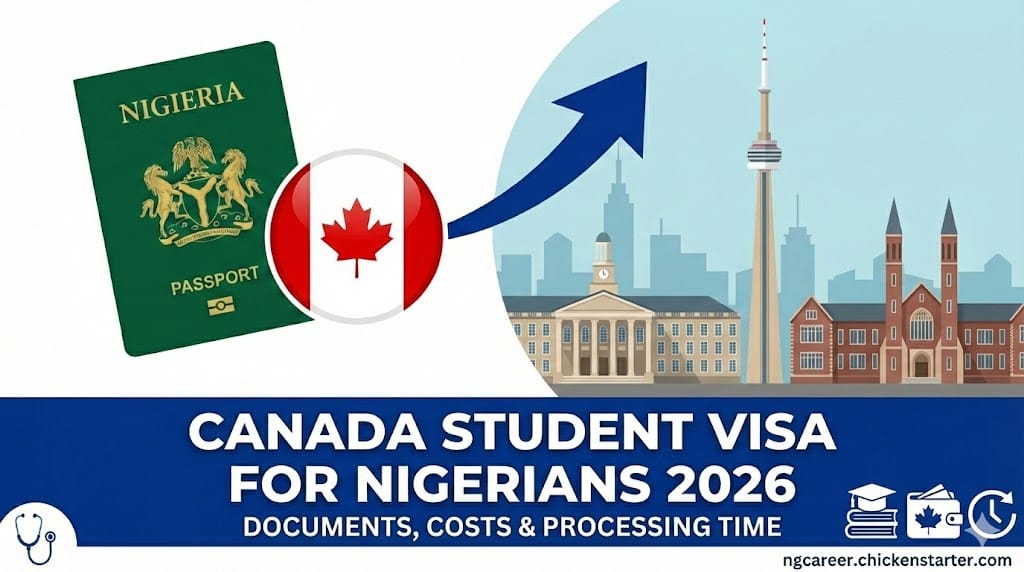
Canada continues to welcome Nigerian students despite significant policy changes that reshaped the international student landscape in late 2024 and early 2026. If you are planning to study in Canada this year, the rules have changed considerably from what you may have read in older guides online.
The Nigeria Student Express (NSE) program that once offered faster processing for Nigerian applicants no longer exists. According to MPOWER Financing, “As of November 8, 2024, the Government of Canada has permanently discontinued the SDS and Nigeria Student Express (NSE) programs.” All Nigerian students now apply through the regular study permit stream.
At NG Career, I have walked many Nigerian students through this updated process. The biggest confusion I encounter is outdated financial requirements circulating online. Some guides still cite $10,000 CAD as sufficient for living expenses. This is dangerously wrong. You now need proof of $20,635 CAD for living expenses alone (increasing to $22,895 CAD as of September 2025), plus your first year’s tuition. Students applying to Quebec institutions face even steeper requirements after Quebec tripled its proof of funds threshold effective January 1, 2026.
This guide reflects the current January 2026 requirements based on official IRCC data and recent policy changes.
Is Canada Giving Nigerians Visas Now? (2026 Update)
Yes, Canada continues to process study permits for Nigerian students. Despite study permit caps implemented nationally, legitimate applications from qualified Nigerian students are still being approved.
According to ICEF Monitor, “Immigration, Refugees and Citizenship Canada (IRCC) announced this week that it expects to issue up to 408,000 study permits in 2026.”
What Changed:
- Nigeria Student Express discontinued November 8, 2024
- All applicants now use the regular study permit stream
- Study permit caps in effect nationally (408,000 permits expected in 2026)
- Masters and PhD students exempt from caps
- Quebec significantly increased financial requirements from January 1, 2026
How Long Does It Take to Process a Canada Study Visa from Nigeria?
According to IRCC processing estimates, study permit applications from Nigeria are being processed in approximately 6-7 weeks through the regular stream.
| Application Stage | Timeline |
|---|---|
| Complete application submission | Day 0 |
| Biometrics instruction letter | Within days |
| Biometrics appointment | Within 30 days |
| Total processing time | 6-7 weeks (estimated) |
Note: With the discontinuation of the Nigeria Student Express program, all Nigerian applicants now go through the standard processing stream. Processing times may vary based on application volume and individual circumstances.
What Can Delay My Canada Student Visa?
According to MPOWER Financing, “Even small mistakes can pause your application or lead to extra requests.”
Common Delay Factors:
Documentation Issues:
- Incomplete application packages
- Missing or unclear documents
- Documents not meeting IRCC specifications
Financial Concerns:
- Insufficient proof of funds
- Large unexplained deposits appearing suddenly
- Bank statements showing unstable balances
- Vague sponsor letters without clear income details
Other Delays:
- Background or security checks
- Peak application seasons
- Requests for additional information
- Medical exam requirements
Minimum Bank Balance for Canada Student Visa from Nigeria
This is where many Nigerian applicants get rejected. The financial requirements have increased significantly, and outdated information online leads students to submit insufficient proof of funds.
Living Expenses Requirements (Outside Quebec)
According to official IRCC guidelines:
| Category | Amount (CAD) | Amount (Naira)* |
|---|---|---|
| Single student (living expenses) | $20,635 (increasing to $22,895 from Sept 2025) | ₦25.8M |
| First family member | +$7,000 | +₦8.75M |
| Each additional family member | +$3,500 | +₦4.4M |
| Plus first year tuition | Varies by program | Varies |
*Exchange rate: approximately CAD $1 = ₦1,250
Example Calculation: A student bringing a spouse and one child must show: $20,635 + $7,000 + $3,500 + tuition = $31,135 CAD minimum plus tuition fees.
Important September 2025 Update: Living expense requirements increased by approximately 10-11% effective September 1, 2025. Always verify current amounts on the official IRCC website as figures are updated annually.
According to IRCC, you must prove you have enough money “without working in Canada” to pay for tuition fees, living expenses for yourself and accompanying family members, and transportation to and from Canada.
Critical Point: You must show you have enough financial resources for the first year of your studies. For programs longer than one year, you must also tell IRCC how you plan to pay for the full duration of your studies.
Quebec Province: Tripled Requirements (January 2026)
If you are applying to study in Quebec, the financial requirements are now significantly higher. According to CIC News:
Effective January 1, 2026:
| Number of People | Until Dec 31, 2025 | As of Jan 1, 2026 |
|---|---|---|
| One person under 18 | $7,756 | $24,617 |
| One person aged 18+ | $15,508 | $24,617 |
| Two people aged 18+ | $22,745 | $34,814 |
| Two adults + one child under 18 | $25,479 | $42,638 |
| Two adults + two children under 18 | $27,499 | $49,234 |
Important: These amounts are separate from tuition costs and transportation fees. You must demonstrate capacity to cover all expenses.
How to Show Proof of Funds
Acceptable Documents:
| Document Type | Requirements |
|---|---|
| Bank statements | Last 4-6 months, showing consistent balance |
| GIC (Guaranteed Investment Certificate) | From participating Canadian financial institution |
| Education loan letters | From recognized banks |
| Scholarship/bursary confirmation | Must clearly state monthly and annual amounts |
| Fixed deposits/term deposits | Matured or easily liquidated |
| Proof of tuition payment | For first year (must be accompanied by other proof) |
| Bank letter | Must state current balance; Quebec provides sample format |
| Pay slips | Showing current employment income (for sponsors) |
| Income tax notice | Indicating annual income |
According to IRCC, proof of tuition payment “must be accompanied by other documents proving you have sufficient funds to cover living expenses and transportation costs.”
What Is NOT Acceptable:
- Undated or unsigned bank letters
- Fake or unverifiable financial documents
- Funds that are not easily accessible
- Funds only recently deposited without explanation
- Vague sponsor letters without relationship or income details
Documents Required for Canada Student Visa from Nigeria
According to AECC Global, IAS Services, and IRCC:
Complete Document Checklist
| Document | Details |
|---|---|
| Letter of Acceptance | From a Designated Learning Institution (DLI) in Canada |
| Valid Nigerian Passport | Valid for entire duration of stay, with blank pages |
| Passport Photos | 2 recent photos meeting specifications; name and date of birth on back |
| Proof of Funds | $20,635+ CAD for living expenses plus tuition |
| Statement of Purpose (SOP) | Explaining why you want to study in Canada |
| Academic Transcripts | From previous institutions |
| English Proficiency | IELTS, TOEFL, or equivalent |
| Medical Examination | From designated panel physician (if required) |
| Police Clearance | From Nigerian authorities (if required) |
| Quebec CAQ | Quebec Acceptance Certificate (if studying in Quebec) |
| Form IMM 1294 | Application for Study Permit Made Outside of Canada |
| Form IMM 5707 | Family Information Form |
| Biometric Data | May be required after application submission |
Nigerian-Specific Requirements
According to iCanStudent:
- WAEC/NECO certificates with required grades
- University transcripts
- NYSC certificate (if applicable)
- For Master’s applicants: Bachelor’s degree, academic CV, references, Statement of Purpose
English Proficiency Requirements
According to AECC Global:
| Level of Study | English Skill Level |
|---|---|
| Undergraduate | IELTS 6.0 or equivalent |
| Graduate | IELTS 6.5 or equivalent |
| Postgraduate | IELTS 7.0 or equivalent |
Quebec Acceptance Certificate (CAQ) — Required for Quebec Studies
According to Immigria, BorderPass, and Polytechnique Montréal:
If you are studying in Quebec, you must obtain a CAQ before applying for your federal study permit.
CAQ Application Process
Stage 1: Apply to Quebec’s Ministry (MIFI)
- Receive acceptance letter from Quebec educational institution
- Create account on Quebec immigration website
- Complete CAQ application form
- Pay CAQ fee: $135 CAD (as of January 1, 2026)
- Submit required documents via Arrima platform
- Processing time: 25 working days when application is complete
Stage 2: Apply for Federal Study Permit
- After receiving CAQ approval, apply to IRCC for study permit
- Upload CAQ approval letter with your study permit application
According to HEC Montréal, “You will receive confirmation that your Attestation of issuance of Certificat d’acceptation du Québec (CAQ) is issued through your online account approximately 25 working days after the Ministry receives the documents.”
Important: The same funds are assessed by both Quebec and IRCC. You do not need to show separate or additional funds for the federal assessment.
CAQ Required Documents
According to BorderPass:
- Acceptance letter from Quebec educational institution
- Valid passport copies
- Proof of financial capacity
- Application fee payment ($135 CAD)
- Background check from home country (if applicable)
- Language proficiency proof (if program is in French)
CAQ Exemptions
According to MyConsultant:
- Those who applied for CAQ before February 26, 2025 and awaiting decision are not subject to application cap
- Individuals with a valid CAQ are exempt
- Students currently enrolled needing new CAQ to continue at same institution are exempt
- Students in primary/secondary schools and adult education centers are exempt
How Much Is the Student Visa Fee from Nigeria to Canada?
Official Fees
| Fee Type | Amount (CAD) | Amount (Naira)* |
|---|---|---|
| Study permit application | $150 | ₦187,500 |
| Biometrics | $85 | ₦106,250 |
| Medical exam | $200-$400 | ₦250,000-₦500,000 |
| Quebec CAQ (if applicable) | $135 | ₦168,750 |
| Total Official Fees | $370-$770 | ₦462,500-₦962,500 |
*Exchange rate: approximately CAD $1 = ₦1,250
Additional Costs to Budget
| Cost Item | Amount |
|---|---|
| GIC (Guaranteed Investment Certificate) | $20,635+ CAD (refundable, released monthly after arrival) |
| Credential evaluation (WES) | $200-$300 CAD |
| Document translation | Varies |
| IELTS test | ₦100,000-₦120,000 |
| Courier/VAC service fees | Varies |
Canada Student Visa for Nigerians (2026)
If you are a Nigerian planning to study in Canada, understanding the current visa landscape is essential. The study permit process has undergone significant changes, most notably the permanent discontinuation of the Nigeria Student Express (NSE) program as of November 2024. All Nigerian applicants now follow the regular study permit process.
According to the 2026-2028 Immigration Levels Plan, Canada has implemented study permit caps limiting new international student arrivals to 155,000 in 2026 and 150,000 in 2027 and 2028. However, master’s and PhD students are now exempt from these caps, creating opportunities for graduate-level applicants.
Key requirements for Nigerian applicants include:
- Acceptance letter from a Designated Learning Institution (DLI)
- Proof of funds: $10,000 CAD for living expenses per year (outside Quebec), plus tuition fees
- Valid Nigerian passport
- English proficiency test results (IELTS, TOEFL, or Duolingo)
- Police clearance certificate
- Medical examination (if requested)
- Statement of Purpose explaining your study plans
- Biometrics
For a complete checklist of what you need to prepare, our guide on documents needed for studying abroad covers everything in detail. If you are still deciding which English test to take, our comparison of IELTS vs TOEFL can help you choose.
What Is the Canadian Student Visa Waiting Time for Nigerians?
According to current IRCC processing time data, Nigerian applicants can expect the following timelines:
| Application Type | Current Processing Time |
|---|---|
| Study Permit (from Nigeria) | 5 weeks |
| Study Permit (inside Canada, initial) | 8 weeks |
| Study Permit Extensions | 140 days |
| Work Permit (from Nigeria) | 8 weeks |
| Visitor Visa (from Nigeria) | 27 days |
These processing times assume your application is complete and accurate. According to IRCC, processing time starts the day they receive your complete application and ends when a decision is made. Applications with missing documents or requiring additional verification will take longer.
Important note: With the discontinuation of the Nigeria Student Express program, all Nigerian students now go through the regular processing stream. The expedited 20-day processing that was previously available through NSE no longer exists.
What Affects Processing Time?
Several factors can significantly impact how quickly your Canadian study permit is processed:
Factors that speed up processing:
- Complete application: Submitting all required documents correctly the first time
- Clear proof of funds: Well-documented bank statements and sponsor letters
- Strong ties to Nigeria: Evidence you will return after your studies
- Straightforward academic history: Clear, verifiable transcripts and certificates
- Early application: Applying well before your program start date
Factors that slow down processing:
- Missing or incomplete documents: Any gaps require IRCC to request additional information
- Unclear Statement of Purpose: A poorly written SOP raises questions about your intentions
- Complex financial documentation: Inconsistent bank statements or unclear fund sources
- Background checks: Security or admissibility concerns trigger additional screening
- High application volumes: Peak seasons (May-August) typically see longer wait times
- Medical examination requests: If IRCC requires a medical exam, this adds weeks to processing
How to minimize delays:
According to IRCC guidance, you should apply as soon as you receive your acceptance letter from your Designated Learning Institution. Ensure your passport is valid for the entire duration of your intended stay, and provide clear documentation of your financial support.
Your Statement of Purpose should clearly explain:
- Why you chose Canada for your studies
- Why you selected your specific program and institution
- Your career plans after graduation
- Your ties to Nigeria and intention to return (unless pursuing PGWP)
For strategies on funding your education and potentially reducing your financial documentation burden, explore our guide on how to apply for scholarships. Scholarship award letters can strengthen your proof of funds significantly.
How to Apply for Canada Student Visa from Nigeria (Step-by-Step)
According to AECC Global and IAS Services:
Step 1: Get Accepted to a Designated Learning Institution (DLI)
According to IAS Services, “you can only get a Study Permit for a Designated Learning Institution (DLI) — in other words, an education provider approved by the provincial or territorial government of Canada.”
- Apply to Canadian educational institutions on the DLI list
- Receive official letter of acceptance
- Verify your institution is designated to accept international students
Step 2: Gather Required Documents
According to AECC Global:
- Round up all required documents: passport, proof of funds, passport photos, transcripts, English test results
- Ensure bank statements cover the last 4-6 months with consistent balance
- Prepare Statement of Purpose explaining your study plans
- Collect WAEC/NECO certificates and university transcripts
Step 3: Apply for Quebec CAQ (If Studying in Quebec)
- Apply online through Quebec immigration portal
- Pay $135 CAD fee
- Wait approximately 25 working days for processing
- Receive CAQ approval before proceeding to federal application
Step 4: Open a GIC (Recommended)
- Open Guaranteed Investment Certificate with participating Canadian financial institution
- Deposit minimum $20,635 CAD (or more based on your situation)
- Receive GIC confirmation letter for your application
- Funds will be released monthly after you arrive in Canada
Step 5: Apply Online Through IRCC
According to AECC Global:
- Create IRCC Account: Register on the Immigration, Refugees, and Citizenship Canada (IRCC) website via GCKey
- Complete Form IMM 1294: Fill out the application form carefully
- Upload Documents: Scan and upload all required documents
- Pay Fees: $150 (study permit) + $85 (biometrics) = $235 CAD minimum
- Submit Application: Once confident everything is correct, submit
Step 6: Provide Biometrics
- Receive biometrics instruction letter after application submission
- Book appointment at Visa Application Centre (VAC) in Lagos or Abuja
- Submit fingerprints and photo
- Complete within 30 days of instruction letter
- Biometrics valid for 10 years
Step 7: Wait for Processing
- Current timeline: 6-7 weeks for Nigerian applicants (estimated)
- Monitor application status through your IRCC account
- Respond promptly to any requests for additional documents
Step 8: Receive Decision and Travel
According to AECC Global:
If Approved:
- Receive Port of Entry (POE) Letter of Introduction
- Perhaps receive temporary resident visa
- The actual study permit is issued at the Canadian border by a CBSA officer
- Carry Letter of Introduction, passport, admission letter, and proof of funds when travelling
Types of Canadian Student Visas
According to AECC Global:
| Type of Visa | Description | Duration |
|---|---|---|
| Study Permit | For full-time academic programs | Duration of program + 90 days |
| Short-term Study Visa | For short courses, language programs | 6 months or less |
| Post-Graduation Work Permit (PGWP) | For graduates wanting to work | Up to 3 years |
Post-Graduation Work Permit (PGWP) Information
According to IAS Services:
| Program Length | PGWP Eligibility |
|---|---|
| Less than 8 months | Not eligible |
| 8 months to less than 2 years | PGWP matching program length |
| 2+ years (undergraduate) | Up to 3 years PGWP |
| 16+ months (postgraduate) | Up to 3 years PGWP |
According to IAS Services, “Nigerians who have completed their courses of study can potentially extend their stay for up to three years with a Canadian Post-Graduation Work Permit (PGWP).”
How to Write Statement of Purpose (SOP) for Canada Student Visa
According to AECC Global, your SOP should include:
Introduction:
- Who you are
- Why you chose Canada
- Your background story
Why This Course:
- Specific reasons for choosing this program
- How it fits into your career goals
Post-Study Plans:
- Clear plans after graduation
- Career aspirations
Ties to Nigeria:
- Demonstrate roots in Nigeria
- Show reasons you will return
Conclusion:
- Reiterate your intentions and aspirations
According to iCanStudent, “Graduate applicants must pay special attention to their SOP, as it carries immense weight during admission and visa stages.”
Common Reasons for Canada Student Visa Refusal
According to AECC Global:
- Incomplete Application: Missed a document or filled something incorrectly
- Financial Hiccups: If they are not convinced you have the money to fund your Canadian adventure
- Intent Concerns: If officers think you are not coming back to Nigeria
- Health and Character: Failing health check or having criminal record
- SOP Issues: If your Statement of Purpose does not convince them of your intent
How Do I Find a Canadian Address for My Application?
This question comes up frequently, and the answer depends on which application you are completing and your current situation.
If you are applying from outside Canada:
For most immigration applications submitted from outside Canada (study permits, work permits, visitor visas, Express Entry), you are not required to provide a Canadian address. You will provide your current address in your home country, and IRCC will communicate with you via email and through your online account.
According to IRCC application guidelines, you should provide:
- Your current residential address (where you actually live)
- A mailing address if different from your residential address
- Your email address for correspondence
If you need to receive documents in Canada:
If your application requires you to receive physical documents at a Canadian address and you do not yet have one, options include:
- Using the address of a family member or friend in Canada who has agreed to receive mail on your behalf
- Using the address of your educational institution (for study permit applicants, with the school’s permission)
- Using the address of your employer (for work permit applicants, with employer’s permission)
- Using a registered immigration representative’s business address (if you have formally appointed one)
Important warnings:
- Do not use a fake or random Canadian address. Providing false information on an immigration application is misrepresentation and can result in a five-year ban from Canada.
- Do not use an address without permission from the person or organization at that address.
- Do not pay for “address services” from unverified third parties, as this is a common scam vector.
For official guidance:
Always refer to the specific application instructions on Canada.ca for your visa or permit type. The instruction guide for each application specifies exactly what address information is required and in what format.
If you are unsure about address requirements for your specific application, contact IRCC directly through their web form or consult with a licensed immigration consultant (RCIC) or immigration lawyer who can provide guidance based on your circumstances.
Common Mistakes Nigerian Applicants Make
Based on my experience helping Nigerian students at NG Career:
1. Using Outdated Financial Figures
Some guides online still cite $10,000 CAD as sufficient for living expenses. The current requirement is $20,635 CAD (increasing to $22,895 from September 2025) for single students outside Quebec. Quebec requires even more.
2. Wrong Family Member Amounts
The correct amounts are $7,000 CAD for the first family member and $3,500 CAD for each additional family member. Some outdated sources show lower figures.
3. Large Unexplained Deposits
Your bank statements should show consistent balances over 4-6 months. Sudden large deposits without explanation raise red flags.
4. Incomplete Document Packages
Always use the official IRCC checklist and verify you have every required document before submitting.
5. Applying to Non-DLI Institutions
Your school must be on the Designated Learning Institution list. Always verify before accepting admission.
6. Missing Quebec CAQ
If studying in Quebec, you must obtain the Quebec Acceptance Certificate (CAQ) before applying for your federal study permit.
7. Weak Statement of Purpose
Generic SOPs that do not clearly explain your study plans and ties to Nigeria often lead to refusals.
Renewal of Canada Student Visa
According to AECC Global:
If you need to extend your study permit:
- Check Expiry: Apply before current permit expires
- Gather Documents: Updated information, new admission letters if applicable
- Complete Form IMM 5709: To extend your stay
- Pay Fees: Renewal has associated fees
- Submit: Apply online through IRCC portal
Frequently Asked Questions
How long does it take to process a Canada study visa from Nigeria?
According to IRCC processing estimates, study permit applications from Nigeria currently take approximately 6-7 weeks to process through the regular stream. The Nigeria Student Express program was discontinued in November 2024.
How much bank balance do I need for Canada student visa from Nigeria?
You need $20,635 CAD (approximately ₦25.8 million) for living expenses plus your first year’s tuition fees. Add $7,000 CAD for the first family member and $3,500 CAD for each additional family member. If studying in Quebec, you need $24,617 CAD for living expenses as of January 1, 2026.
Is Canada giving Nigerians visas now?
Yes. Canada continues to process study permits for Nigerian students. According to ICEF Monitor, Canada expects to issue up to 408,000 study permits in 2026.
Is an interview required for Canada student visa?
Generally no. According to AECC Global, most applications are processed without interviews. However, IRCC may request one in specific cases, and biometrics (fingerprints and photo) are required.
What is the visa fee from Nigeria to Canada?
Study permit application fee is $150 CAD plus $85 CAD for biometrics. If studying in Quebec, add $135 CAD for the CAQ. Total official fees range from $235-$770 CAD depending on requirements.
What documents are required for Canada student visa from Nigeria?
Key documents include: acceptance letter from DLI, valid passport, proof of funds ($20,635+ CAD), Statement of Purpose, academic transcripts (including WAEC/NECO), English proficiency test results, passport photos, and completed application forms. Quebec students also need CAQ.
Your Application Checklist
Before Applying:
- Receive acceptance letter from DLI
- Verify institution is on DLI list
- Gather 4-6 months bank statements with consistent balance
- Open GIC ($20,635 CAD minimum; more for Quebec or family)
- Complete IELTS/TOEFL with required scores
- Get medical exam if required
- Apply for Quebec CAQ if studying in Quebec ($135 CAD, 25 working days)
Application:
- Create IRCC account (GCKey)
- Complete Form IMM 1294
- Prepare Form IMM 5707 (Family Information)
- Write compelling Statement of Purpose
- Upload all documents
- Pay $150 + $85 fees through official channels
- Submit application
After Submission:
- Complete biometrics within 30 days
- Monitor application status through IRCC account
- Respond promptly to any document requests
- Wait 6-7 weeks for decision
- Do not book travel until approved
For those also exploring scholarship opportunities to reduce costs, see our guide on fully funded Masters scholarships in Canada for Nigerians. If you are considering work opportunities, our guide on Canada visa-sponsored jobs for Nigerians covers legitimate pathways.
Canada remains an excellent destination for Nigerian students, but success requires understanding the current requirements, not outdated information. Start gathering your documents early, ensure your finances meet the updated thresholds, and submit a complete, well-organized application.
Verify all requirements on the official IRCC website before applying, as immigration rules may change. Financial requirements are subject to annual updates.