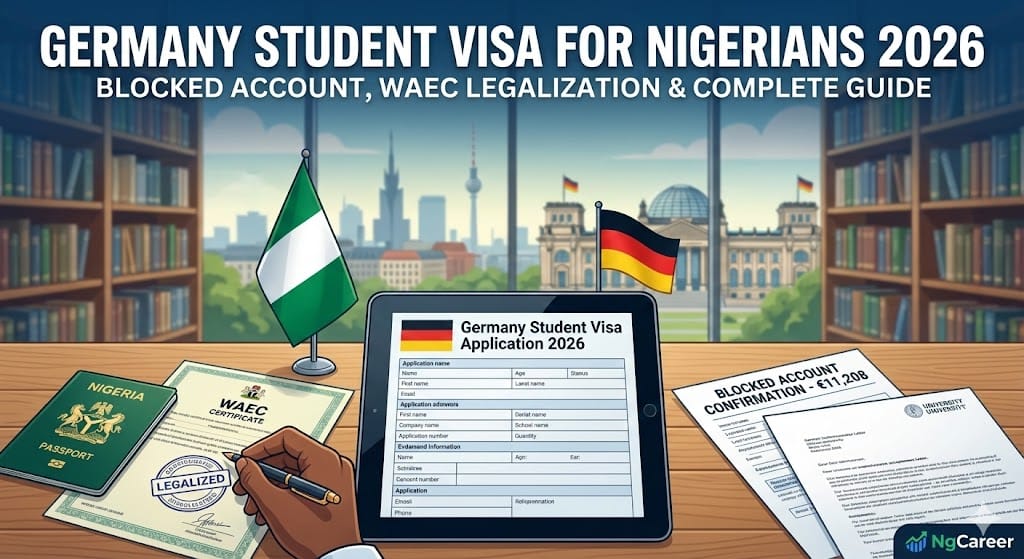
Studying in Germany offers Nigerian students access to world-class education with surprisingly affordable tuition fees, especially at public universities. However, the German student visa application process has specific requirements that trip up many applicants, particularly around document legalization and financial proof.
My name is Babatunde Oladepo, and I have been helping Nigerian students navigate international education opportunities since 2019. The Germany student visa process is one of the most frequently misunderstood among our readers. I regularly receive emails from students who had their applications delayed or rejected because they submitted apostilled documents instead of properly legalized ones, or because they only had proof of opening a blocked account rather than the required blocking confirmation.
The good news is that once you understand the specific requirements, the process becomes manageable. Germany has clear, documented procedures, and if you follow them precisely, your chances of approval are strong.
This guide covers everything Nigerian students need to know: the €11,904 blocked account requirement, the mandatory WAEC/NECO legalization process that differs from other countries, step-by-step application instructions, and the common mistakes that lead to visa denials.
Key Requirements at a Glance
Before diving into details, here is a summary of what you need for a German student visa from Nigeria:
| Requirement | Details |
|---|---|
| Blocked Account Amount | €11,904 minimum (€992 per month) |
| Visa Processing Fee | €75 for adults |
| Processing Time | 6 to 12 weeks (Lagos Consulate: approximately 2 months) |
| Document Legalization | Mandatory for WAEC/NECO (apostille not accepted) |
| Language Requirement | German or English at B2 level minimum |
| Application Method | Online portal booking + in-person biometrics |
| Appointment Booking | Free of charge |
| Work Permission | 140 full days or 280 half days per year |
How Much Is the Blocked Account for Germany Student Visa?
The blocked account (Sperrkonto) is a special German bank account that restricts how much you can withdraw monthly, ensuring steady financial support during your studies. According to official German government requirements and multiple verified sources including Fintiba, the blocked account requirement for 2026 is:
€11,904 per year, which equals €992 per month
This amount is based on the Federal Training Assistance Act (BAföG), Germany’s financial aid benchmark. The figure represents what German authorities consider the minimum needed to cover living expenses including accommodation, food, health insurance, transportation, and study materials.
Critical Points About the Blocked Account
The full amount must be deposited before your visa appointment. According to Fintiba’s guide for Nigerian students, “proof of account opening alone is not sufficient, you will need a blocking confirmation.” This is a common mistake. Many applicants assume that showing they opened an account is enough, but German authorities require proof that the full €11,904 has been deposited and blocked.
You cannot access the full amount immediately. After you arrive in Germany and activate your account, you can withdraw only €992 per month. This monthly release continues for 12 months until the balance is depleted.
The amount has increased over recent years. According to Studying-in-Germany.org, the blocked account requirement was €10,332 in 2021-2022, rose to €11,208 in 2023-2024, and reached €11,904 as of September 2024. Budget for potential future increases if you plan to study for multiple years.
Is a Blocked Account a Legal Issue?
No. This is a common misconception I see among Nigerian students. The term “blocked” refers to withdrawal restrictions, not illegality or any legal problem. A blocked account is simply a standard German financial requirement for student visas, similar to how other countries require proof of funds. The “block” ensures you have steady access to money throughout the year rather than spending it all at once. It is a protective measure, not a legal complication.
Naira Equivalent
At current exchange rates, €11,904 equals approximately ₦20 million to ₦21 million. Exchange rates fluctuate significantly, so verify the current rate when planning your deposit. I recommend checking rates from multiple sources and adding a buffer of 5-10% to account for transfer fees and rate fluctuations.
Higher Amounts for Certain Visas
If you are applying for a training or apprenticeship visa, language acquisition visa, or the Germany Opportunity Card (Chancenkarte), you may need to deposit 10% more, bringing the total to €13,094.40 (€1,091.20 per month). Verify the specific requirement for your visa type before depositing.
Which Blocked Account Provider Is Best for Germany?
Nigerian students typically choose between digital providers and traditional German banks. Based on the search results and feedback from students, here is how the main options compare:
| Provider | Setup Process | Key Features | Approximate Fees |
|---|---|---|---|
| Fintiba | Fully online | Fast confirmation, recognized by all German embassies, digital documents | Setup fee + monthly fees |
| Expatrio | Fully online | Combined blocked account + health insurance packages, free eBooks and resources | €69 setup (cashback available) + €5/month |
| Traditional German Banks | May require mailing certified documents | Traditional banking relationship | Varies |
Coracle is no longer an option. As of August 2025, Coracle stopped accepting new blocked account applications while upgrading their banking system. Do not apply through Coracle.
Important: Some users report Fintiba fees may have increased. Verify current pricing directly on their website before applying.
Fintiba
Fintiba offers a completely digital setup process. You can open the account online, upload documents, and receive your blocking confirmation electronically. The confirmation documents are accepted by the German Embassy in Nigeria.
Expatrio
According to Studying-in-Germany.org, Expatrio offers a Value Package that includes a blocked account, health insurance, and a free current account. This can simplify your preparation by bundling multiple requirements. They also provide resources about life and studies in Germany.
Important Considerations
Choose a provider recognized by German authorities. According to Fintiba’s guide, “The funds must be fully deposited before the visa appointment, because proof of account opening alone is not sufficient.”
Avoid providers not registered in Germany. The Germany-visa.org guide notes that some banks outside Germany may not be accepted by the embassy. Even if you get your visa, you might need to transfer funds to a German bank before obtaining your residence permit. To avoid extra steps, open an account directly with an approved provider.
Both Fintiba and Expatrio are widely used by Nigerian students and recognized by German embassies. Your choice may depend on whether you want bundled services (Expatrio) or prefer to arrange health insurance separately.
Alternative Ways to Prove Financial Resources
A blocked account is the most common method, but it is not the only option. According to official German sources, you can prove financial resources through:
1. Declaration of Commitment (Verpflichtungserklärung)
A permanent resident of Germany or a German national can sponsor your studies by signing a formal Declaration of Commitment. According to the German Federal Foreign Office, this document must:
- Be issued by the local Ausländerbehörde (foreigners’ authority) in Germany
- Not be older than six months
- Contain verification of the sponsor’s creditworthiness
- Cover the entire duration of your stay
Critical limitation: The sponsor must live in Germany. A relative in Nigeria, the UK, or the United States cannot use this method. If your potential sponsor lives outside Germany, you need a blocked account or scholarship instead.
2. Scholarship Award Letter
If you have won a scholarship from a recognized institution, the award letter can serve as financial proof. Requirements include:
- The scholarship must cover at least €992 per month
- The letter must specify the duration and exact amount
- Recognized providers include DAAD, German universities, and established foundations
- If your scholarship covers only part of your expenses (for example, €500 per month), you must deposit the remaining amount (€492 per month, or €5,904 per year) in a blocked account
Our guide on DAAD Scholarship explains how to apply for one of Germany’s most prestigious funding programs. For other options, see our comprehensive list of scholarships in Germany without IELTS for Nigerians.
3. Parent’s Financial Documents
You can use your parents’ financial records to prove support. This typically requires:
- Recent salary statements (usually last three months)
- Bank account statements (last six months)
- Letter confirming willingness to support you financially
- Proof of regular income source
This method may require additional documentation and can be more complex than a blocked account.
4. Bank Guarantee (Bankbürgschaft)
A statement from a bank guaranteeing coverage of your expenses can serve as financial proof. This may be an option if you have a strong banking relationship but limited liquid funds.
According to CBS.de, “Acceptance of alternatives depends heavily on the embassy or local immigration office, so blocked accounts remain the safest route.” If you are unsure whether your alternative proof will be accepted, a blocked account is the most reliable option.
WAEC and NECO Legalization for Germany: Step-by-Step Process
This section addresses one of the most common reasons for visa delays and rejections among Nigerian students. Germany does not accept apostilles for Nigerian documents. This is different from many other countries and catches many applicants off guard.
According to Fintiba’s guide for Nigerian students: “Unlike some countries that accept apostilles, Germany requires formal legalization for Nigerian documents. This process verifies documents through Nigerian authorities and the German diplomatic mission before they are accepted for visa and university purposes.”
Why Legalization Matters
German authorities do not automatically recognize Nigerian academic documents. The legalization process confirms that your certificates are genuine and issued by the appropriate examination body. Applications submitted without properly legalized WAEC or NECO results are likely to be delayed or refused, even if all other requirements are met perfectly.
Documents Requiring Legalization
For Nigerian students, the following academic documents typically require legalization:
- Original WAEC certificate
- Original NECO certificate (if applicable)
- Statement of result (only if the certificate has not yet been issued)
- Result verification printout (if applicable)
WAEC/NECO Academic Requirements
Beyond legalization, your results must meet specific academic standards:
Minimum grades: At least five credit passes, including English Language and subjects relevant to your chosen course
Sitting limit: German institutions generally require results from two separate sittings at most. Combined results beyond two sittings are usually not accepted. If you wrote WAEC three times to accumulate five credits, this may disqualify you from direct university admission.
Equivalency: Results must meet German university equivalency standards. Some programs may have additional subject requirements.
The Legalization Process
The exact process can vary, but generally involves:
- Obtain original certificates from WAEC or NECO
- Verification through Nigerian educational authorities
- Authentication at the relevant Nigerian ministry
- Submission to the German diplomatic mission in Nigeria
- Receipt of legalized documents for your visa application
Start this process early. Document legalization takes time, and delays here can push back your entire application timeline. I recommend beginning the legalization process as soon as you receive your university admission.
Common Legalization Mistakes
Based on feedback from students:
- Submitting apostilled documents: Germany requires formal legalization, not apostille. They are different processes.
- Submitting only statement of results: If your certificate has been issued, you need the certificate itself, not just the statement.
- Name discrepancies: Ensure your name appears exactly the same on all documents. Variations (e.g., “Oluwaseun” vs “Seun”) can cause problems.
- Submitting expired verification: Some documents have validity periods. Ensure yours are current.
Sample Application Timeline
To help you plan, here is a realistic timeline for the Germany student visa process from Nigeria:
| Timeline | Action |
|---|---|
| 6 months before departure | Begin university applications; request transcripts from Nigerian university |
| 5 months before | Start WAEC/NECO legalization process; research blocked account providers |
| 4 months before | Receive admission letter; open blocked account and begin funding |
| 3 months before | Complete blocked account deposit; gather all required documents; obtain health insurance |
| 2-3 months before | Book visa appointment through online portal |
| 6-12 weeks before | Attend biometric appointment; pay visa fee |
| Upon approval | Book flights; arrange accommodation; prepare for departure |
This timeline assumes everything goes smoothly. Nigerian universities can take several weeks or months to process transcript requests, and legalization can face delays. Start earlier if possible.
How to Apply for Germany Student Visa from Nigeria: Complete Process
The German student visa application follows a structured, appointment-based system. Here is the step-by-step process:
Step 1: Secure University Admission
Before applying for a visa, you need an admission letter (or conditional admission) from a recognized German institution.
Your admission letter must clearly state:
- Your full name
- The course of study and level (Bachelor’s or Master’s)
- The start date and duration of the program
For Master’s applicants, you also need official university transcripts from your Nigerian institution. According to Fintiba’s guide, these transcripts must be issued directly by the university, show all completed courses and grades, match the degree certificate details exactly, and may need to be sealed or verified.
Request transcripts early. Nigerian universities often take several weeks or months to process transcript requests. Start this process immediately after receiving your admission offer.
Step 2: Open Blocked Account and Deposit Funds
Choose your provider (Fintiba, Expatrio, or a traditional German bank), complete the setup process, and deposit the full €11,904. You need the blocking confirmation, not just proof of account opening.
Allow time for:
- Account approval (varies by provider)
- International transfer processing
- Confirmation document generation
Step 3: Legalize Academic Documents
Complete the WAEC/NECO legalization process as described above. Do not skip this step or assume apostille is acceptable.
Step 4: Gather All Required Documents
According to Studying-in-Germany.org, you need:
Identity and Application Documents:
- Properly filled out and signed national visa application form
- Valid passport with at least two blank pages
- Two copies of your passport
- Recent biometric passport photographs (up to 3)
- Birth certificate
- Marriage certificate (if applicable)
- Child’s birth certificate (if applicable)
- Photocopies of previous German residence titles (if applicable)
Academic Documents:
- Legalized WAEC/NECO certificates
- University transcripts (for Master’s applicants)
- University degree certificate (for Master’s applicants)
- Admission letter from German university
Financial Documents:
- Blocked account blocking confirmation (€11,904 minimum)
- OR Scholarship award letter (minimum €992/month coverage)
- OR Declaration of Commitment (Verpflichtungserklärung)
- OR Parent’s income documents and bank statements
Other Documents:
- Health insurance proof
- Language proficiency certificate (German or English at B2 level)
- Motivation letter outlining your study plans and goals
For Minors (under 18): According to the German Federal Foreign Office, minors must also submit a signed consent form from both parents in German or English, with a declaration allowing the minor to travel to Germany to study and withdraw money from the blocked account.
For detailed guidance on preparing these materials, see our guide on documents needed for studying abroad.
Step 5: Book Visa Appointment Online
According to Fintiba’s guide: “Nigerian students do not make their appointments for German student visa applications directly at the embassy or consulate. Instead, applications are handled through an online portal, which acts as the official visa application center for Germany in Nigeria.”
Key points:
- The online portal is for national D-visas (student visas)
- Schengen visas (short stays) use a different process
- Appointment booking is free of charge
You must attach required documents when booking via email.
Step 6: Attend Biometric Appointment
On your appointment day, appear in person at the German consulate. The interview can take anywhere from one hour to several hours, so plan accordingly and do not schedule other commitments immediately after.
Biometric enrollment includes:
- Fingerprint scanning
- Digital photograph
- Signature capture
You must bring:
- All original documents
- One or more sets of photocopies (as specified)
- Visa application forms and declarations
- Proof of appointment confirmation
Step 7: Pay Visa Fee
The visa processing fee is €75 for adults. Minors pay a reduced fee. Depending on your situation, German authorities may allow payment online, at the visa application center, or through bank transfer.
Step 8: Wait for Processing
Do not book non-refundable flights until your visa is approved.
German Student Visa Processing Time in Nigeria
According to MastersPortal and Fintiba, processing times vary:
- Average processing: 6 to 12 weeks
- German Consulate General in Lagos: Approximately 2 months waiting time for student visas
- Peak periods (May through September): May take longer due to incoming summer semester applications
- Incomplete documentation: Can cause significant delays
Recommendation: Start the application process several months in advance. Apply at least 3-4 months before your intended departure to account for processing time, potential requests for additional documents, and travel booking.
German Student Visa Types: Which One Do You Need?
According to Studying-in-Germany.org, there are three types of German national visa (D-visa) for students:
| Visa Type | Who Needs It | Key Requirement |
|---|---|---|
| German Student Visa | Accepted to a German university for a degree program | Admission letter from recognized institution |
| German Student Applicant Visa | Applied to a university and have a good chance of acceptance, but no admission letter yet | Proof of application and good acceptance prospects |
| German Language Course Visa | Attending intensive German language courses without plans to continue studying | Language course enrollment confirmation |
Duration Rules
Programs 90 days or less: You only need a Schengen visa. Citizens of countries with Schengen agreements may not need any visa for short stays.
Programs longer than 90 days: You need a national visa (D-visa). This applies to most degree programs.
After arrival: You must register with local authorities and apply for a residence permit at the Ausländerbehörde within three months of entering Germany. Your blocked account can only be activated after you have your residence permit.
Visa and Residence Permit Validity
According to MastersPortal, the German student visa (Type B) is valid for up to 3 years. However, the residence permit issued after arrival is typically valid for a maximum of 2 years at a time and must be renewed. When renewing, you must demonstrate continued enrollment and sufficient financial resources.
If you want to stay in Germany after your degree, you must apply for a different visa or renewal through the immigration office.
Working While Studying in Germany
One of the significant advantages of studying in Germany is the opportunity to work part-time. According to the German Federal Office for Migration and Refugees (BAMF) and the official Make it in Germany portal, international students have specific work rights.
Current Work Limits (Updated March 2024)
International students from non-EU countries can work up to 140 full days or 280 half days per calendar year without requiring approval from the Federal Employment Agency. This limit was increased from the previous 120/240 days effective March 1, 2024.
A half working day is defined as up to 4 hours of work.
Alternative calculation method: Since March 2024, students can also choose to work up to 20 hours per week during the lecture period. During semester breaks, you can work without restrictions. At the end of the year, only the equivalent of 2.5 days per week is counted.
Both calculation methods can be combined flexibly, but the total permitted hours must not be exceeded.
What Does NOT Count Toward the Work Limit
According to the German National Association for Student Affairs (Deutsches Studierendenwerk):
- Student jobs at universities: Academic assistant positions, tutoring, research assistant roles at universities, research institutes, or the Studierendenwerk do not count toward the 140/280 day limit and can be performed for unlimited time
- Mandatory internships: Internships required as part of your degree program do not count toward the limit
- Bachelor’s or Master’s thesis work: Work completed as part of your thesis does not count
- Vacation and sick days: Only days actually worked are counted
Important Restrictions
- Self-employment is generally not permitted without additional approval from the Ausländerbehörde
- If you want to work more than the permitted limit, you need prior written approval from the Ausländerbehörde
- Working beyond the limit without permission could jeopardize your residence status
- German language skills are necessary for many student jobs
Acting as Your Own Financial Guarantor
According to the official Make it in Germany portal, if you work as a student assistant and earn at least €992 per month, you can generally act as your own financial guarantor for residence permit renewals. Contact your local Ausländerbehörde to confirm whether this option is available in your case.
Can I Apply If I Do Not Speak German?
Yes, you can study in Germany without speaking German, but with conditions:
English-taught programs: Many German universities offer programs taught entirely in English, particularly at the Master’s level. For these programs, you need English proficiency at B2 level minimum. IELTS, TOEFL, or equivalent tests are accepted.
German-taught programs: For programs taught in German, you need German language proficiency. Common accepted tests include TestDaF and DSH.
Foundation courses (Studienkolleg): If your qualifications do not directly qualify you for German university admission, or if you need to improve your language skills, you may attend a foundation course first.
For test comparison, see our guide on IELTS vs TOEFL.
Is a Blocked Account Required for the Second Year?
According to Germany-visa.org, the blocked account is officially required only for the first year of studies. For subsequent years, if you need to extend your residence permit, you must show proof of financial means, but this does not necessarily have to be a blocked account.
Alternatives for second-year financial proof include:
- A personal bank account with sufficient funds
- Your parent’s or sponsor’s bank account
- Income from a part-time student job (earning at least €992 per month)
- Scholarship continuation
However, there have been cases where the Ausländerbehörde has asked students to extend their blocked account. It is ultimately up to immigration officers to evaluate your situation. If they decide your other financial evidence is insufficient, you might need to deposit funds for another year.
Common Reasons for Germany Student Visa Denial
Based on the search results and common patterns, here are the primary reasons applications fail:
1. Insufficient or Improper Financial Proof
- Blocked account not fully funded (below €11,904)
- Only account opening proof submitted, not blocking confirmation
- Scholarship letter does not specify adequate monthly amount
- Declaration of Commitment from someone outside Germany
2. Document Legalization Failures
- WAEC/NECO not properly legalized
- Apostille submitted instead of formal legalization
- Documents older than required validity period
- Missing verification from educational authorities
3. Academic Document Issues
- Name discrepancies across documents
- Grade inconsistencies between certificates and transcripts
- Combined WAEC/NECO results from more than two sittings
- Transcripts not sealed or officially verified
4. Incomplete Application
- Missing required documents
- Unsigned forms
- Insufficient passport validity or blank pages
- Missing photocopies
5. Inadequate Language Proficiency
- No proof of German or English at B2 level
- Certificate from unrecognized testing body
- Test results expired (most have 2-year validity)
6. Unconvincing Study Plan
- Motivation letter lacks clarity about goals
- Unexplained gaps between previous education and chosen program
- Program choice does not align with academic background
What Happens After You Arrive in Germany?
Your visa grants entry, but you have important steps to complete after arrival:
Register your address (Anmeldung): You must register your residence at the Einwohnermeldeamt (Residents’ Registration Office) within two weeks of arrival. You will receive a registration certificate (Anmeldebescheinigung).
Apply for residence permit: Within three months of entering Germany, apply for a residence permit at the Ausländerbehörde. You will need your passport with entry stamp, registration certificate, and other documents. The residence permit is typically valid for a maximum of 2 years and must be renewed before expiration.
Activate blocked account: Once you have your residence permit (and sometimes just the registration certificate, depending on provider), you can activate your blocked account. The process varies by provider but typically involves uploading documents online or visiting a bank branch.
Open a regular bank account: You will need a current account for receiving your monthly €992 disbursement and managing daily expenses.
Enroll at university: Complete your university enrollment with your original documents.
How to Access Your Blocked Account Funds
Understanding how to access your money after arrival is crucial. Many students arrive in Germany expecting immediate access to their blocked account funds, only to discover the process takes several weeks.
Why You Cannot Access Funds Immediately
According to the German Federal Foreign Office, “Only a certain amount can be withdrawn every month from the blocked account. This is to make sure that the minimum amount for each month is available and that the money that is meant to last for a whole year cannot be withdrawn right at the start of the stay.”
Steps to Activate Your Blocked Account
- Register your address (Anmeldung) at the Einwohnermeldeamt within two weeks of arrival
- Open a current account (Girokonto) with a German bank
- Apply for your residence permit at the Ausländerbehörde
- Submit activation documents to your blocked account provider
The documents typically required for activation include:
- Proof of residence registration (Anmeldung certificate)
- Your current account details
- Passport with entry stamp
- Residence permit (some providers require this)
Timeline Expectation
The activation process typically takes 2 to 4 weeks after arrival. During this period, you cannot access your blocked account funds.
Critical advice: Bring extra money (€1,000 to €1,500 recommended) to cover your first few weeks in Germany, including accommodation deposits, initial groceries, and transportation costs before your blocked account is activated.
Monthly Withdrawal Process
Once activated, €992 is automatically transferred to your current account each month. You cannot withdraw more than this monthly amount, even if you have an emergency. The remaining balance stays blocked until the following months.
Post-Study Options: Staying in Germany After Graduation
Germany offers attractive pathways for international students who want to remain after completing their studies:
18-Month Job Seeker Visa
According to official German sources, international students who complete their studies can apply for an 18-month residence permit to search for employment. During this time:
- You must have sufficient funds to cover living expenses
- You can work unlimited hours while searching
- The job you eventually accept must match your qualifications
Work Permit and EU Blue Card
Once you secure employment:
Standard Work Permit: Tied to your specific employer and position. Enables you to work and reside in Germany as long as you hold that employment.
EU Blue Card: Available for highly skilled professionals. According to HHL Leipzig, if you secure a job with a minimum salary of approximately €45,000 per year, you can apply for the EU Blue Card, which offers:
- Fast track to permanent residency
- Ability to bring family members to Germany
- Greater flexibility to change employers
Important Note on Permanent Residence
You cannot obtain permanent residence directly with a student residence permit. You must first complete your studies, find employment, and apply for a work visa or EU Blue Card. After several years of legal residence and employment, you can then apply for permanent residence.
For those interested in working in Germany without studying first, see our guide on Germany Job Seeker Visa for Nigerians 2026.
Family Reunification: Bringing Family to Germany
International students with a valid residence permit may be able to bring their spouse and children to Germany under certain conditions:
- You must have been married before obtaining your residence permit (marriage must predate your permit)
- Your residence permit must be valid for at least one year at the time of application
- You must have adequate living space and financial resources to support family members
- Your spouse may need to demonstrate basic German language skills (A1 level)
This is a complex process with specific requirements. Contact the Ausländerbehörde for detailed guidance on your situation.
Documents Checklist for Nigerian Applicants
Print this checklist and check off each item as you prepare:
Identity Documents:
- Valid passport (at least two blank pages, valid beyond your planned stay)
- Recent biometric passport photographs (up to 3)
- Birth certificate (original and copy)
- Marriage certificate if applicable (original and copy)
Academic Documents:
- Legalized WAEC certificate (original and copy)
- Legalized NECO certificate if applicable (original and copy)
- University transcripts, sealed/verified (for Master’s applicants)
- University degree certificate (for Master’s applicants)
- Admission letter from German university
Financial Documents:
- Blocked account blocking confirmation showing €11,904 minimum
- OR Scholarship award letter specifying minimum €992/month
- OR Declaration of Commitment (Verpflichtungserklärung) not older than 6 months
- OR Parent’s income documents and bank statements
Other Required Documents:
- Completed and signed visa application form
- Health insurance proof valid in Germany
- Language proficiency certificate (German or English B2)
- Motivation letter explaining study plans
- Photocopies of ALL documents
For Minors (under 18):
- Signed consent form from both parents (German or English)
- Declaration allowing minor to travel and withdraw from blocked account
Frequently Asked Questions on Germany Student Visa for Nigerians
How much is the blocked account for Germany student visa in 2026?
The blocked account requirement is €11,904 per year, equivalent to €992 per month. This amount is set by the German Federal Training Assistance Act (BAföG) and represents the minimum living costs for students in Germany. At current exchange rates, this equals approximately ₦20-21 million.
Is a blocked account a legal issue or problem?
No, this is a common misconception. The “blocked” in blocked account refers to withdrawal restrictions, not any legal issue. It is a standard German requirement that ensures you have steady access to funds throughout the year. The account releases €992 monthly after you arrive and activate it. There is nothing illegal or problematic about it; it is simply a financial proof mechanism.
Which blocked account is best for Germany?
Fintiba and Expatrio are the most popular providers for Nigerian students due to their digital setup process and recognition by all German embassies. Both offer confirmation documents required for visa applications. Expatrio offers bundled packages including health insurance. Traditional German banks are also an option but may require mailing certified documents.
Do I need to legalize my WAEC certificate for Germany?
Yes, this is mandatory. Germany does not accept apostilles for Nigerian academic documents. You must complete formal legalization through Nigerian authorities and the German diplomatic mission. Applications with improperly legalized documents are commonly delayed or refused.
How long does the German student visa take to process in Nigeria?
Processing typically takes 6 to 12 weeks, though this varies based on case complexity and time of year. The German Consulate General in Lagos has approximately a 2-month waiting time. Peak periods (May through September) may take longer. Incomplete documentation causes significant delays. Apply at least 3-4 months before your intended departure.
How many hours can I work as a student in Germany?
International students can work up to 140 full days or 280 half days per year (increased from 120/240 effective March 2024). Alternatively, you can work up to 20 hours per week during the lecture period, with unlimited work during semester breaks. Student jobs at universities, mandatory internships, and thesis work do not count toward these limits.
Can I combine a partial scholarship with a blocked account?
Yes. If your scholarship does not cover the full €992 monthly requirement, deposit the difference in a blocked account. For example, if your scholarship provides €500 per month, you need €492 per month (€5,904 per year) in a blocked account.
Can a relative outside Germany sponsor me?
No. A sponsor for the Declaration of Commitment (Verpflichtungserklärung) must live in Germany and have their creditworthiness verified by local authorities. If your relative lives in Nigeria, the UK, the US, or elsewhere outside Germany, you need a blocked account or scholarship instead.
What happens if my blocked account runs out after one year?
For subsequent years, you can prove financial support through various means including a regular bank account with sufficient funds, a part-time student job earning at least €992 monthly, continued scholarship, or parental support. However, the Ausländerbehörde may request additional blocked account deposits if they find your other evidence insufficient.
Can I stay in Germany after completing my studies?
Yes. Germany offers an 18-month job seeker visa for graduates to find employment. Once employed in a position matching your qualifications, you can obtain a work permit. If your salary exceeds approximately €45,000, you may qualify for an EU Blue Card, which provides a faster path to permanent residence.
Is the €75 visa fee refundable if my application is denied?
No. The visa processing fee is non-refundable regardless of the application outcome.
Can I bring my family to Germany as a student?
Possibly. You must have been married before obtaining your residence permit, and your permit must be valid for at least one year. Adequate living space and financial resources are required. Contact the Ausländerbehörde for specific guidance on family reunification.
What happens to my blocked account if my visa is rejected?
If your student visa application is rejected and you no longer need your blocked account, you can request a refund of your deposited funds. According to Germany-visa.org, you will need to submit documentation from the German immigration office containing the original notice of your visa rejection stamped by the German Embassy.
Depending on your blocked account provider, you submit these documents by post or email. The refund typically processes within two to four weeks.
Important: You may not receive back the processing/setup fees if you choose to close the account voluntarily. Setup fees are generally non-refundable.
Is my money safe in a blocked account?
Yes. All German banks are part of a Deposit Protection Scheme (Einlagensicherung) that guarantees your deposits up to €100,000. This includes blocked accounts held with registered German financial institutions. Providers like Fintiba and Expatrio work with German partner banks that are covered by this protection.
Considering Other Options?
Germany offers excellent opportunities, but it is not the only path for Nigerian students. If you want to explore alternatives:
- Canada Scholarships for Nigerians 2026 covers funding opportunities in a country with strong post-study work options
- Canada Student Visa for Nigerians explains the Canadian study permit process
- UK Student Visa Nigeria Application Guide covers studying in Britain
- Germany Job Seeker Visa for Nigerians 2026 is relevant if you are considering working in Germany instead of studying
For scholarship applications specifically, our guide on how to apply for scholarships provides strategies that work across multiple countries.
Final Thoughts
The German student visa process has specific requirements, but they are documented and achievable. The key is precision: deposit the full €11,904 (not just open an account), legalize your documents properly (not apostille), and submit complete applications with all required documents.
Start early. Document legalization, transcript requests, and blocked account setup all take time. The students who succeed are those who begin preparation months before their intended departure, not weeks.
If you have followed the steps in this guide and ensured every document meets the requirements, you have positioned yourself well for approval. Germany welcomes international students, and Nigerians study there successfully every year.
For the most current and authoritative information, always verify requirements on the official German diplomatic mission website for Nigeria and the German Federal Foreign Office before your application.
This article reflects information verified as of January 2026. Visa requirements and financial thresholds can change. Always confirm current requirements through official German government sources before applying.