Finding scholarships that match your profile and submitting winning applications requires strategy, persistence, and careful planning. When I started my scholarship search in 2022, I spent three months applying to opportunities I was not even eligible for because I did not understand how to filter and target the right programs. After several rejections and one successful application, I learned that scholarship hunting is a skill you can develop with the right approach.
This guide covers everything Nigerian students need to know about finding legitimate scholarships, meeting requirements, and submitting applications that stand out. Whether you want to study in Nigeria, the USA, Canada, UK, Germany, or anywhere else, these strategies will help you maximize your chances of securing funding.
Types of Scholarships Available for Nigerian Students
Before searching for scholarships, understand the different types available. This helps you target opportunities that match your situation.
By Funding Level
| Type | What It Covers | Competition Level |
|---|---|---|
| Full Scholarship | Tuition, accommodation, living expenses, flights | Very High |
| Partial Scholarship | Tuition only or percentage of costs | Moderate to High |
| Tuition Waiver | Tuition fees only | Moderate |
| Stipend/Grant | Monthly living allowance | Varies |
By Source
Government Scholarships: These are funded by governments (Nigerian or foreign) and typically have clear eligibility criteria. Examples include the Commonwealth Scholarship, Fulbright Program, and DAAD scholarships.
According to the Federal Ministry of Education Nigeria website, Nigerian applicants for Commonwealth Scholarships should visit the official CSC UK website for Masters and PhD application details.
University Scholarships: Individual universities offer scholarships to attract talented international students. According to the University of Sussex website, the Sussex Nigeria Scholarship for Masters students is applied automatically if you meet the eligibility criteria—no separate application required.
Foundation/Private Scholarships: Private organizations and foundations fund scholarships based on various criteria. According to Ulearngo, the Jim Ovia Foundation Scholarship provides full funding covering tuition, accommodation, textbooks, and monthly stipend for students at selected Nigerian universities. The Bridge Foundation commits approximately ₦700 million annually to supporting Nigerian students from disadvantaged backgrounds.
Merit-Based Scholarships: Awarded based on academic achievement, test scores, or special talents.
Need-Based Scholarships: Awarded based on demonstrated financial need.
By Study Level
- Undergraduate scholarships
- Masters scholarships
- PhD scholarships
- Postdoctoral fellowships
- Research grants
Where to Find Legitimate Scholarships
The biggest challenge Nigerian students face is separating legitimate opportunities from scams. Here are verified sources to search:
Official Government Portals
Nigerian Government:
- Federal Ministry of Education website (education.gov.ng) announces government-sponsored scholarships
- State scholarship boards (Lagos State Scholarship Board, Enugu State Scholarship, Sokoto State Scholarship, etc.)
Foreign Government Scholarships:
- USA: U.S. Embassy Nigeria (ng.usembassy.gov) for Fulbright and other programs
- UK: Commonwealth Scholarship Commission (cscuk.fcdo.gov.uk)
- Germany: DAAD (daad.de)
- Canada: EduCanada portal and provincial scholarship programs
According to the U.S. Embassy Nigeria website, applications for the Fulbright Foreign Student Program for 2026/2027 must be completed online at apply.iie.org/ffsp2026. All applicants must attach supporting documents including three academic and professional references, CV, academic transcripts, and a writing sample.
University Scholarship Pages
Always check the financial aid or scholarship section of your target university’s website. Many universities have dedicated pages for international students.
According to the University of Michigan LSA scholarships page, the annual deadline to apply is April 15, and applications are reviewed on a rolling basis—applying early increases your chances of being matched with a scholarship.
According to the University of Alabama international scholarships page, Summer/Fall 2026 applicants should submit applications and all supporting documents by the December 5 priority deadline. Notifications can be expected in late February.
Trusted Scholarship Databases
Several websites aggregate scholarship opportunities:
- Scholars4dev.com – Lists international scholarships with deadlines
- ScholarshipAir – Focuses on scholarships for Nigerian students
According to Scholars4dev, current opportunities include:
- Joint Japan World Bank Graduate Scholarship Program (Deadline: 27 Feb/29 May 2026)
- VLIR-UOS ICP Connect Scholarships in Belgium (Deadline: 1/28 Feb 2026)
- Aga Khan Foundation International Scholarship Programme (Deadline: 31 Mar 2026)
- Wells Mountain Foundation Empowerment Through Education Scholarships (Deadline: 1 March 2026)
- York University International Student Scholarships (Deadline: 26 Jan 2026)
Nigerian-Specific Scholarships
According to the Ruth Titilayo Educational Foundation website, Nigerian students in Federal or State Universities can apply for the Ruth Titilayo Undergraduate Scholarship 2026. Eligibility requires:
- Being domiciled in Nigeria
- Being under age 25
- Having a minimum GPA of 4.0 in a 5-point system
- Being a current student or registered within the last three years
According to icanstudent.com, the STEM to Space Fully Funded Scholarship 2026 is available for Nigerian undergraduate students in STEM disciplines. Applicants must:
- Be a Nigerian citizen
- Be an undergraduate student in Science, Technology, Engineering, or Mathematics
- Not be in their final year of study
- Be enrolled in a recognized Nigerian university
- Submit original responses and a personal video
What to Avoid
Be extremely cautious of:
- Scholarships requiring upfront payment
- Opportunities not traceable to official websites
- “Guaranteed” scholarship promises
- Agents claiming exclusive access to scholarships
For guidance on identifying scams, read our guide on how to spot fake recruitment agencies.
What Qualifications Do You Need for a Scholarship?
Requirements vary by scholarship, but most evaluate these factors:
Academic Requirements
GPA Requirements: Most competitive scholarships require strong academic performance.
According to the Ruth Titilayo Foundation requirements, applicants need a minimum GPA of 4.0 in a 5-point system (or equivalent).
| Scholarship Type | Typical GPA Requirement |
|---|---|
| Highly competitive (Fulbright, Rhodes) | First Class or 3.5+ (on 4.0 scale) |
| University merit scholarships | 3.0-3.5+ |
| Need-based scholarships | 2.5-3.0 minimum |
| Some partial scholarships | 2.0+ |
Academic Transcripts: You will need official transcripts from all institutions attended. Start requesting these early as Nigerian universities can take weeks to process requests.
English Proficiency
Most international scholarships require IELTS or TOEFL scores. However, according to scholarship application guides, English tests are not always compulsory—check specific scholarship requirements.
For detailed comparison, see our guide on IELTS vs TOEFL for Nigerian students.
Other Common Requirements
| Requirement | Purpose |
|---|---|
| Letters of Recommendation | Verify your academic ability and character |
| Personal Statement/Essay | Assess your motivation and goals |
| CV/Resume | Document your achievements |
| Proof of Financial Need | For need-based scholarships |
| Research Proposal | For postgraduate research scholarships |
| Portfolio | For arts, design, or creative programs |
According to the STEM to Space Scholarship requirements, applicants must submit:
- Completed online application form
- Short written responses about STEM journey and challenges
- Essay (300-500 words) explaining motivation and personal story
- 30-second video introducing yourself and explaining what you want to do for Nigeria through STEM
- Proof of university enrollment (student ID, registration slip, or admission letter)
- Estimated tuition and academic fees document
How to Apply for Scholarships: Step-by-Step Process
Step 1: Start Early and Create a Timeline
According to Ulearngo’s scholarship planning guide, organize your search by timeline:
| Period | Actions |
|---|---|
| January-March | Research scholarships, gather documents, start essays |
| April-June | Submit applications with mid-year deadlines |
| July-September | Apply for scholarships with autumn deadlines |
| October-December | Submit applications for following academic year |
Starting early is critical. According to the University of Wisconsin admissions page, the King-Morgridge Scholarship application deadline is November 15, 2025 for Fall 2026 entry—over a year before you would start studying.
Step 2: Research Thoroughly Before Applying
Before applying to any scholarship:
- Verify eligibility: Read requirements carefully. According to the STEM to Space Scholarship, final-year students are not eligible. Missing such criteria wastes time.
- Understand what is covered: Some “full scholarships” do not include flights or living costs.
- Note all deadlines: According to the Gilman Scholarship website, deadlines are in Pacific Time (PT)—take time zone differences into account. The March 2026 deadline is March 5, 2026 at 11:59pm Pacific Time.
- Check application method: Some scholarships require online applications, others need nominations, and some (like the Sussex Nigeria Scholarship) are applied automatically.
Step 3: Gather Required Documents
Most scholarship applications require similar documents. Prepare these in advance:
Academic Documents:
- Official transcripts from all institutions
- Degree certificates
- WAEC/NECO results
- English proficiency scores (IELTS/TOEFL)
Identity Documents:
- International passport
- Birth certificate
- Passport photographs
Supporting Documents:
- Letters of recommendation (2-3 typically required)
- CV/Resume
- Personal statement/Essay
- Proof of financial need (if applicable)
According to the Fulbright application requirements, applicants must submit academic transcripts from each post-secondary institution attended, three academic and professional references, a CV, and a writing sample.
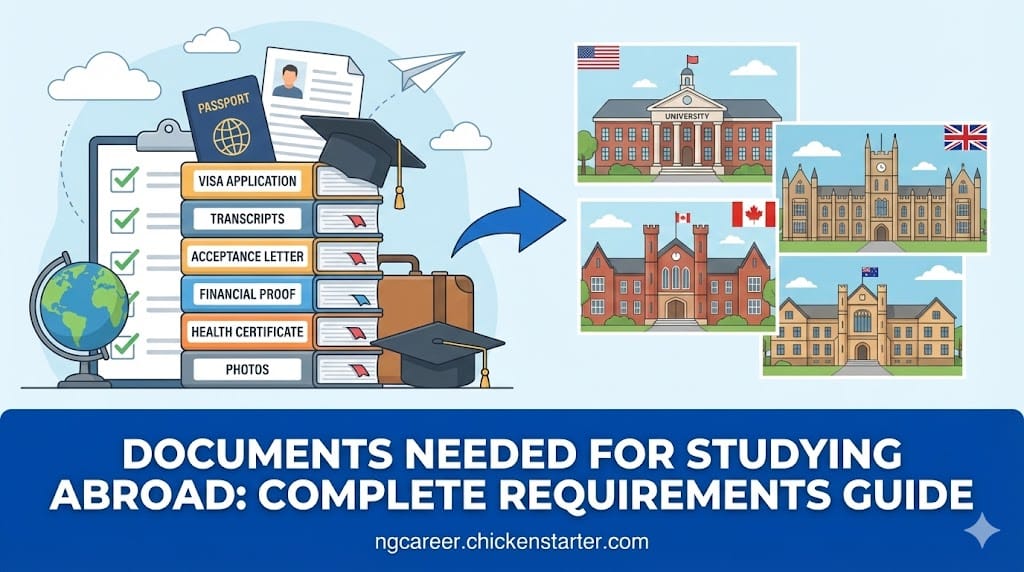
For complete documentation guidance, see our guide on documents needed for studying abroad.
Step 4: Write a Compelling Personal Statement
This is where most Nigerian students struggle. According to scholarship application guidance, a personal statement is not where you tell your life story from primary school.
What to include:
- Why this specific course?
- Why this specific school/country?
- What problem do you want to solve?
- How will this scholarship help your future?
According to the STEM to Space Scholarship criteria, the program places strong emphasis on honesty, personal motivation, and real-life experiences. Generic statements are easy to spot and get rejected fast.
Personal Statement Structure:
| Section | Content | Word Count |
|---|---|---|
| Opening Hook | Compelling story or statement that captures attention | 50-100 words |
| Background | Relevant academic and personal context | 100-150 words |
| Motivation | Why this program and why now | 150-200 words |
| Goals | What you will achieve and contribute | 100-150 words |
| Closing | Strong conclusion linking back to opening | 50-100 words |
Step 5: Secure Strong Recommendation Letters
Request recommendations from people who know your work well:
- Academic supervisors or lecturers
- Employers or internship supervisors
- Research mentors
- Community leaders (if relevant)
Tips for getting good recommendations:
- Ask at least 4-6 weeks before the deadline
- Provide your CV and personal statement draft
- Remind them of specific projects or achievements to mention
- Follow up politely one week before the deadline
Step 6: Submit Before the Deadline
Never submit at the last minute. According to the University of Michigan LSA scholarships page, applications are reviewed on a rolling basis—applying early increases your chances of being matched with a scholarship.
Before submitting, verify:
- All required fields are completed
- Documents are in correct format (PDF, size limits)
- Essays are proofread for grammar and spelling
- Recommenders have submitted their letters
- You have received confirmation of submission
Scholarship Application Timeline for 2026
Based on current deadlines from official sources:
January 2026 Deadlines
| Scholarship | Deadline | Study Destination |
|---|---|---|
| York University International Student Scholarships | 26 January 2026 | Canada |
| Zeribe Nwosu Foundation Scholarship | 30 January 2026 | Nigeria |
| Various scholarships (see Scholarships.com) | Throughout January | Various |
February 2026 Deadlines
| Scholarship | Deadline | Study Destination |
|---|---|---|
| Texas A&M Summer 2026 | 1 February 2026 | USA |
| Seoul Tech Scholarship | 14 February 2026 | South Korea |
| Science@Leuven Scholarships | 15 February 2026 | Belgium |
| Joint Japan World Bank Graduate Scholarship | 27 February 2026 | Various |
| VLIR-UOS ICP Connect Scholarships | 28 February 2026 | Belgium |
| Warwick Undergraduate Global Excellence Scholarship | 27 February 2026 | UK |
March 2026 Deadlines
| Scholarship | Deadline | Study Destination |
|---|---|---|
| Wells Mountain Foundation Scholarships | 1 March 2026 | Developing Countries |
| Gilman Scholarship (March Deadline) | 5 March 2026 | Various |
| STEM to Space Scholarship | 6 March 2026 | Nigeria |
| Aga Khan Foundation Scholarships | 31 March 2026 | Various |
April 2026 Deadlines
| Scholarship | Deadline | Study Destination |
|---|---|---|
| University of Michigan LSA Scholarships | 15 April 2026 | USA |
| Texas A&M Fall 2026 | 15 April 2026 | USA |
Can Nigerians Still Get Scholarships in America?
Yes, absolutely. Nigerian students continue to receive scholarships from American universities and government programs.
According to the U.S. Embassy Nigeria, the Fulbright Foreign Student Program is actively accepting applications from Nigerian candidates for the 2026/2027 academic year.
According to the Gilman International Scholarship website, the March 2026 deadline covers programs starting between May 1, 2026 to April 30, 2027. The application opens mid-January 2026 with a student deadline of March 5, 2026.
US Scholarships Open to Nigerians
| Scholarship | Type | Deadline |
|---|---|---|
| Fulbright Foreign Student Program | Government-funded | Varies |
| Gilman International Scholarship | Government-funded | March 5, 2026 / October 1, 2026 |
| University of Alabama International Scholarships | University-funded | December 5 (priority) |
| University of Michigan Scholarships | University-funded | April 15 |
| Texas A&M Scholarships | University-funded | February 1 / April 15 |
| University of Wisconsin King-Morgridge | University-funded | November 15 |
Which Country Is Easiest to Get a Scholarship?
No country offers “easy” fully-funded scholarships—all competitive programs require strong applications. However, some destinations have more opportunities for Nigerian students:
Germany
Germany offers free tuition at public universities, reducing the funding needed. Several scholarships cover living expenses only.
For German scholarship opportunities, see our guides on:
Canada
Canada has numerous scholarship programs for international students at both federal and provincial levels.
For Canadian opportunities, see our guide on Canada scholarships for Nigerians 2026.
UK
Many UK universities offer automatic scholarships for students from specific countries. According to the University of Sussex, the Sussex Nigeria Scholarship is applied automatically if you meet eligibility criteria—no separate application needed.
Factors That Increase Your Chances
| Factor | Impact |
|---|---|
| Less competitive programs (not business, medicine, law) | Higher acceptance rate |
| Smaller universities | Less competition |
| Programs specifically for Africans/Nigerians | Targeted funding |
| Countries actively recruiting international students | More opportunities |
| Postgraduate over undergraduate | Often more funding available |
How to Get a Full Scholarship
Full scholarships covering tuition, accommodation, living expenses, and sometimes flights are highly competitive. Here is how to increase your chances:
Target the Right Opportunities
According to current scholarship listings, fully-funded options include:
Government Programs:
- Fulbright (USA)
- Commonwealth Scholarships (UK)
- DAAD (Germany)
- Chevening (UK)
- Australia Awards
Foundation Programs:
- Jim Ovia Foundation (Nigeria)
- Aga Khan Foundation
- Wells Mountain Foundation
- MasterCard Foundation Scholars Program
Build a Strong Profile Early
| Area | What to Develop |
|---|---|
| Academics | Maintain first class or strong 2.1 |
| Leadership | Hold positions in clubs, organizations |
| Community Service | Volunteer work with measurable impact |
| Research | Publications, conference presentations |
| Work Experience | Internships, relevant employment |
Apply to Multiple Scholarships
Do not put all your hopes on one scholarship. Apply to 5-10 opportunities that match your profile. Even with strong applications, acceptance rates for competitive scholarships can be below 5%.
Nigerian Scholarships: Options Within Nigeria
You do not have to study abroad to get scholarship funding. Several Nigerian scholarships support students at local institutions.
Federal and State Government Scholarships
According to Ulearngo, notable state scholarship programs include:
Lagos State Scholarship: Available to Lagos indigenes studying in approved institutions. Applications typically open mid-year through the Lagos State Scholarship Board.
Enugu State Scholarship: The Enugu State Government provides scholarships to indigenes in Nigerian and some international universities.
Sokoto State Scholarship: Available to Sokoto indigenes pursuing undergraduate and postgraduate studies.
Check with your state’s ministry of education or scholarship board for current opportunities.
Private Foundation Scholarships
According to verified sources, active Nigerian foundation scholarships include:
Jim Ovia Foundation Scholarship:
- Full tuition, accommodation, textbooks, and monthly stipend
- Requires strong academic record (typically first class or strong 2.1 potential)
- Demonstrated financial need and leadership potential
Bridge Foundation Scholarship:
- Approximately ₦700 million committed annually
- Targets students from disadvantaged backgrounds
- Operates across multiple Nigerian universities
Ruth Titilayo Undergraduate Scholarship:
- Available for students in Federal or State Universities
- Tuition allowance up to ₦100,000 plus maintenance
- Requires minimum GPA of 4.0 (5-point system)
- Must be under age 25
STEM to Space Scholarship:
- For undergraduate STEM students in Nigerian universities
- Not open to final-year students
- Requires video submission and essay
How to Write a Winning Scholarship Essay
Your essay is often the deciding factor between equally qualified candidates. Here is how to make yours stand out:
What Scholarship Committees Look For
According to the STEM to Space Scholarship criteria, programs emphasize:
- Honesty
- Personal motivation
- Real-life experiences
- Clear vision for contributing to development
Essay Structure That Works
Opening (50-100 words): Start with a specific story, moment, or insight—not generic statements. Avoid openings like “Education is important” or “I have always wanted to study abroad.”
Body (300-400 words):
- Connect your background to your goals
- Explain specific challenges you have overcome
- Show how this scholarship addresses a real need
- Demonstrate knowledge of the program and institution
Closing (50-100 words):
- Reinforce your commitment
- Connect back to your opening
- End with forward-looking statement about impact
Common Mistakes to Avoid
| Mistake | Why It Hurts Your Application |
|---|---|
| Generic statements | Shows you did not research the program |
| Listing achievements without context | Does not show impact or growth |
| Focusing only on hardship | Committees want to see resilience, not just problems |
| Poor grammar and spelling | Suggests lack of attention to detail |
| Exceeding word limits | Shows inability to follow instructions |
| Copying sample essays | Plagiarism detection is common |
Sample Essay Framework
Prompt: Why do you want to study [field] and how will this scholarship help you achieve your goals?
| Section | Content Example |
|---|---|
| Hook | Specific experience that sparked your interest |
| Background | Your current situation and relevant experiences |
| Why This Field | Specific aspects that attract you, not generic reasons |
| Why This Program | Research showing you know the specific university/scholarship |
| Goals | Concrete plans for after graduation |
| Impact | How you will use your education to contribute |
What Is the Best Age to Apply for Scholarships?
There is no single “best age”—different scholarships target different stages:
Undergraduate Scholarships
Most undergraduate scholarships accept applicants ages 17-25. According to the Ruth Titilayo Foundation, applicants must be under age 25.
Postgraduate Scholarships
Masters and PhD scholarships often have higher age limits (30-35 for many programs) or no age limit at all.
Scholarships with Age Restrictions
| Scholarship Type | Typical Age Limit |
|---|---|
| Youth leadership programs | Under 30-35 |
| Young professional programs | Under 35-40 |
| Academic scholarships | Often no limit |
| Some foundation scholarships | Under 25-30 |
Key point: Apply as soon as you are eligible. Do not wait for the “perfect” time.
Free Resources for Scholarship Applications
You do not need to pay anyone to find or apply for scholarships. All legitimate scholarships are free to apply.
Official Websites to Bookmark
| Resource | URL | What It Offers |
|---|---|---|
| Fulbright Nigeria | apply.iie.org/ffsp2026 | US government scholarship |
| Commonwealth Scholarships | cscuk.fcdo.gov.uk | UK government scholarships |
| DAAD | daad.de | German scholarships |
| EduCanada | educanada.ca | Canadian scholarships |
| Scholars4dev | scholars4dev.com | Scholarship database |
What About Scholarship Agents?
Avoid paying anyone to find or apply for scholarships. Legitimate scholarships do not require agents. If someone asks for money to “process” your application, it is likely a scam.
For guidance on identifying fraudulent agencies, see our guide on how to spot fake recruitment agencies.
Frequently Asked Questions
What is the best way to find and apply for scholarships?
The best approach is to start with official sources: government websites (Federal Ministry of Education, foreign embassy websites), university scholarship pages, and established databases like Scholars4dev. Create a spreadsheet tracking deadlines, requirements, and application status. Apply to multiple scholarships that match your profile, and start at least 6-12 months before you want to begin studying.
What GPA qualifies for a scholarship?
GPA requirements vary by scholarship. Highly competitive programs like Fulbright or Rhodes typically require first class or equivalent (3.5+ on 4.0 scale). Many university merit scholarships require 3.0-3.5. Need-based scholarships may accept 2.5+. According to the Ruth Titilayo Foundation, their scholarship requires a minimum GPA of 4.0 in a 5-point system.
What is the easiest scholarship to get?
No scholarship is “easy” in the sense of guaranteed acceptance. However, scholarships with larger award pools, less competition, or specific targeting (for your nationality, field, or background) may have higher acceptance rates. Automatic scholarships like the Sussex Nigeria Scholarship, which are applied without separate application if you meet criteria, remove some application barriers.
How do I get a 100% free scholarship?
All legitimate scholarships are free to apply for—you should never pay application fees to scholarship bodies (though universities may charge application fees separately). Fully-funded scholarships covering 100% of costs exist through programs like Fulbright, Commonwealth, DAAD, and many university-specific awards. Success requires strong academics, compelling essays, good recommendations, and strategic targeting of appropriate opportunities.
Can Nigerians still get scholarships in America?
Yes. According to the U.S. Embassy Nigeria, the Fulbright Foreign Student Program actively accepts Nigerian applicants. American universities also offer merit and need-based scholarships to Nigerian students. According to the Gilman Scholarship website, applications for programs starting May 2026 through April 2027 have a deadline of March 5, 2026.
What types of scholarships are available?
Scholarships include merit-based (academic achievement), need-based (financial situation), field-specific (STEM, arts, etc.), country-specific (for Nigerian applicants), identity-based (women, minorities), and talent-based (sports, arts). They may be funded by governments, universities, foundations, corporations, or individuals. Coverage ranges from partial tuition to full funding including living expenses and travel.
What requirements are needed to get a scholarship?
Common requirements include academic transcripts, English proficiency scores (IELTS/TOEFL), letters of recommendation, personal statement/essay, CV, and proof of identity (passport). Some scholarships require interviews, research proposals, portfolios, or video submissions. According to the STEM to Space Scholarship, applicants must submit a 30-second video introducing themselves and their STEM vision for Nigeria.
What is the hardest scholarship to get?
The most competitive scholarships include Rhodes (acceptance rate under 1%), Marshall, Gates Cambridge, and Schwarzman Scholars. These programs attract thousands of exceptional applicants globally for very limited spots. However, difficulty also depends on your profile—a scholarship may be “hard” if you do not match its criteria but accessible if you are exactly what they seek.
How many scholarships should I apply for?
Apply to 5-15 scholarships that genuinely match your profile. More applications increase your chances, but only if each application is high quality. One excellent, targeted application beats ten generic ones. Focus on scholarships where you meet all eligibility criteria and can write compelling responses to their specific prompts.
Action Steps: Your Scholarship Application Plan
Use this checklist to start your scholarship search:
Immediate Actions (This Week)
- List your academic qualifications (GPA, test scores, certificates)
- Identify your target countries and programs
- Create accounts on official scholarship portals
- Start a spreadsheet tracking opportunities and deadlines
- Request academic transcripts (they take time)
Short-Term Actions (Next 1-3 Months)
- Register for IELTS or TOEFL if needed
- Identify potential recommenders and make initial requests
- Draft your personal statement
- Research specific universities and programs
- Apply to scholarships with upcoming deadlines
Ongoing Actions
- Check scholarship websites weekly for new opportunities
- Update your CV with new achievements
- Refine your personal statement for each application
- Follow up with recommenders before deadlines
- Track application statuses and respond to requests promptly
For related study abroad information, explore our guides on: