If you are a Nigerian nurse considering a career in Canada, you are looking at one of the most rewarding international opportunities available in healthcare today. Canada is actively recruiting nurses from around the world, and Nigerian nurses are increasingly finding pathways to licensure and permanent residence through systematic processes designed for internationally educated nurses.
I have helped several Nigerian nurses navigate this process over the years, and the most common mistake I see is starting with immigration before understanding the licensing pathway. Here is the truth: you cannot work as a nurse in Canada without Canadian licensure, and getting that license requires navigating a credential assessment system that most guides oversimplify.
According to the National Nursing Assessment Service (NNAS), the organization was established by nursing regulatory bodies in Canada in 2012 and is the first step in the process for Internationally Educated Nurses (IENs). This guide walks you through every step: from NNAS application to provincial licensing, from salary expectations to immigration pathways.
Key facts to understand from the start:
- NNAS is mandatory for most provinces (except Quebec and the Territories)
- The complete process takes 6 months to over 1 year
- According to the Canadian Council of Registered Nurse Regulators (CCRNR), there are 12 provincial and territorial nursing regulators across Canada
- Nigerian nurses often require additional competency assessments in several provinces
For nurses from other countries: This guide focuses on Nigerian nurses, but the NNAS process is identical for Internationally Educated Nurses from the Philippines, India, UK, and other countries. Provincial requirements may vary based on your country of education.
Overview of the Canadian Nursing Licensure Process for Nigerian Nurses
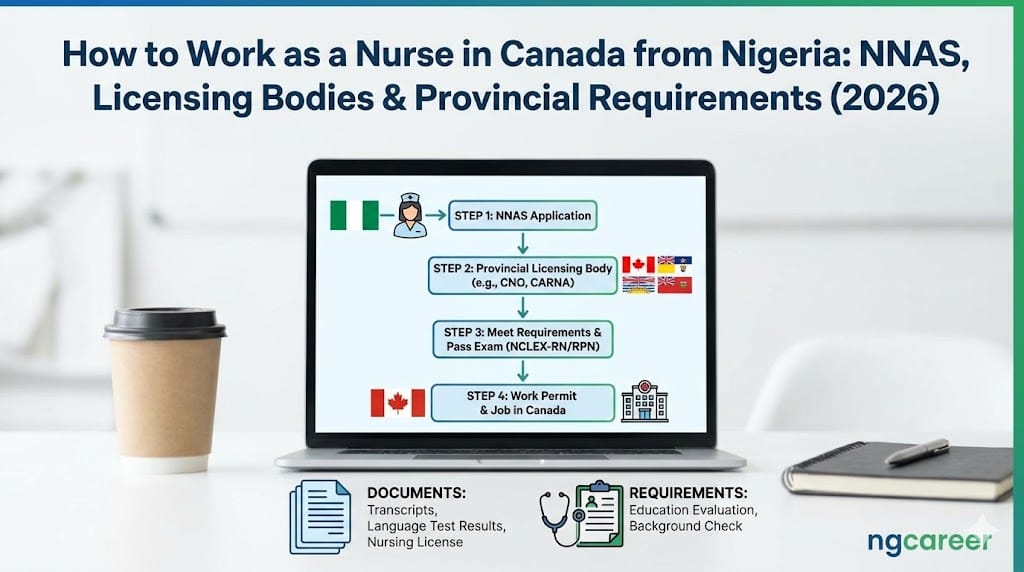
Before diving into details, let me give you the complete pathway overview. According to guidance from nursing regulatory bodies, the journey involves five key stages:
| Step | Action Required | Key Outcome |
|---|---|---|
| 1 | Apply to NNAS and submit documentation | NNAS Advisory Report |
| 2 | Apply to Provincial Regulatory Body | Provincial license requirements identified |
| 3 | Complete assessments, bridging programs (if required), and examinations | Eligibility for licensure |
| 4 | Apply for Canada work visa or permanent residence | Legal status to work in Canada |
| 5 | Receive RN or LPN License | Start working in Canada |
The entire process from NNAS application to receiving your Canadian license and work authorization can take 6 months to over 1 year, depending on your province, documentation, and whether additional training is required.
What Is NNAS and Why Is It Required?
The National Nursing Assessment Service is a Canadian non-profit organization responsible for credential assessments for Internationally Educated Nurses (IENs) interested in practicing nursing in Canada.
Key facts about NNAS:
- Established by nursing regulatory bodies in 2012
- Began issuing reports in 2015
- Collects and verifies documentation related to IENs’ education and professional experience
- Issues Advisory Reports accepted by all nursing regulatory bodies in Canada except Quebec and the Territories
Critical clarification: Per NNAS official documentation, “NNAS does not grant licences to practice nursing in Canada. NNAS does not have a role in making decisions about licences, nor can NNAS advocate on behalf of any applicant. Only nursing regulatory bodies in Canada have the authority to decide whether an application is successful.”
Think of NNAS as your credential passport. It does not get you licensed, but you cannot proceed to licensing without it in most provinces.
Types of Nursing Licenses in Canada
Before applying, you need to understand what you are applying for. There are four regulated nursing professions in Canada:
| Nursing Designation | Education Required | Scope of Practice |
|---|---|---|
| Nurse Practitioner (NP) | Master’s degree in nursing | Advanced practice, can prescribe medications, diagnose conditions |
| Registered Nurse (RN) | Four-year bachelor’s degree in nursing | Full nursing scope, assessment, care planning, medication administration |
| Licensed Practical Nurse (LPN) | Two to three years college nursing program | More limited scope than RN, works under RN supervision in many settings |
| Registered Psychiatric Nurse (RPN) | Specialized psychiatric nursing program | Mental health specialty (primarily in western provinces) |
Important terminology note: In Ontario, Licensed Practical Nurses are called Registered Practical Nurses (RPNs). This is different from Registered Psychiatric Nurses, who also use the RPN abbreviation in western provinces. Do not confuse the two.
For most Nigerian nurses with a BSc Nursing or its equivalent, the Registered Nurse (RN) pathway is the most common target.
NNAS Eligibility Requirements for Nigerian Nurses
According to the NNAS eligibility criteria, you are eligible to apply if you have:
- Completed post-secondary (college or university) nursing education outside of Canada
- Never been licensed as a nurse in Canada in the profession to which you are applying
- Have been licensed as a nurse outside of Canada (required for Expedited Service)
Important note for Nigerians: NNAS guidance confirms that “Canadian citizens and residents who completed their nursing education outside of Canada are also required to apply to NNAS.” This means even if you have PR or citizenship but trained in Nigeria, you still go through NNAS.
Who should NOT apply to NNAS:
- Nurses who completed nursing education in Canada
- Midwives (nursing and midwifery are separate professions in Canada)
- Those seeking to work in Quebec (apply directly to Quebec regulatory body)
- Those seeking to work in Territories (Yukon, Northwest Territories, Nunavut)
For nurses trained in the United States: US-educated nurses follow a different pathway. Contact your target province’s regulatory body directly, as many provinces have reciprocal recognition agreements with US nursing boards.
NNAS Services: Expedited vs. Regular Service
NNAS offers two service pathways with different features and costs.
NNAS Expedited Service
| Feature | Details |
|---|---|
| Cost | $750 CAD |
| What’s included | Single RN and LPN application combined |
| Additional regulators | Can select any participating regulator at no additional cost (while application is open) |
| Processing | Advisory Reports released within five business days of all documents being received |
| Requirement | Must have been licensed as a nurse outside Canada |
Per NNAS official fees page, “A single Advisory Report is now issued for both the Registered Nurse (RN) and Licensed/Registered Practical Nurse (LPN/RPN) professions for a single fee.”
NNAS Regular Service
| Feature | Details |
|---|---|
| Cost | $650 USD (approximately $845 CAD) |
| Processing time | Advisory Report issued in 12 weeks once all documents received |
| Additional regulator (same profession) | $55 USD ($70 CAD) |
| Additional regulator (different profession) | $220 USD ($285 CAD) |
| Flexibility | Can apply to multiple provinces or nursing professions |
Additional costs to consider:
- NNAS document translation: $115 CAD per page (Expedited) or $85 USD per page (Regular)
- Appeals: $500 CAD (Expedited) or $500 USD (Regular)
- Reactivation of expired application: $240 CAD (Expedited) or $180 USD (Regular)
Participating regulators in Regular Service include:
- College of Nurses of Ontario (CNO)
- College of Registered Psychiatric Nurses of Alberta (CRPNA)
- College of Registered Psychiatric Nurses of Manitoba (CRPNM)
- College of Registered Psychiatric Nurses of Saskatchewan (CRPNS)
- British Columbia College of Nurses and Midwives (BCCNM) for RPN only
For most Nigerian nurses applying for RN licensure, the Expedited Service at $750 CAD is typically the recommended option due to faster processing and combined profession coverage.
How to Apply Through NNAS Canada: Step-by-Step Process
Per NNAS application guidance, there are five steps to complete your application.
Step 1: Create Your NNAS Online Account
- Go to the NNAS application portal at nnas.ca
- Create an online account using your email address and a secure password
- Agree to the Terms and Conditions
- Complete the application form with personal information
How do I access NNAS login? Log in to your NNAS account at the official NNAS portal (nnas.ca). Your login credentials are the email address and password you created during account registration. If you forget your password, use the password recovery option with your security questions.
Step 2: Submit Information and Pay Fees
- Provide your educational background details
- Provide your professional licensing history
- Pay the application fee:
- Expedited Service: $750 CAD
- Regular Service: $650 USD (approximately $845 CAD)
Step 3: Submit Required Documents
NNAS requirements specify the following documents:
| Document Category | Examples |
|---|---|
| Identity documents | Valid passport, government-issued ID |
| Educational documents | Nursing diploma or degree, official transcripts, course outlines or syllabi |
| Licensing documents | Current nursing license from Nigeria (Nursing and Midwifery Council of Nigeria), registration certificates |
| Professional experience | Employment verification letters from employers, reference letters |
| Language proficiency | IELTS, CELBAN, PTE, or CELPIP results (if required by your target province) |
Important: Many documents must be submitted directly by the issuing institutions to NNAS, not by you personally. Your nursing school in Nigeria will need to send transcripts directly. The Nursing and Midwifery Council of Nigeria will need to verify your license directly.
One nurse I assisted spent three months waiting for her Nigerian nursing school to send transcripts to NNAS. Starting document collection before submitting your application would have saved her significant time. Begin this process early because institutional responses can take weeks or months.
Step 4: Document Verification
NNAS verifies all submitted documents directly with issuing institutions, including your nursing school, licensing body, and employers.
Critical tip from NNAS: “Make sure documents you believe were submitted on your behalf have been received by NNAS.” Follow up with your institutions and check your NNAS portal regularly.
Step 5: Receive Your Advisory Report
- Expedited Service: Released within five business days after all documents received
- Regular Service: Issued in 12 weeks after all documents received (if no clarification needed)
- Report is sent to your chosen provincial regulatory body
- You can then apply directly to the regulatory body from the NNAS portal
Critical Application Expiry Warning
Per NNAS official guidance, if you do not complete the Expedited Service within 12 months of purchasing the Main Application Order, it will expire, and you will need to re-apply and pay the application fee again.
Reactivation option: You can re-activate a main application order within 12 months of the expiry date. This may only be done once and costs $240 CAD (Expedited) or $180 USD (Regular).
Which Provinces Use NNAS in Canada?
NNAS Advisory Reports are accepted by all nursing regulatory bodies in Canada except Quebec and the Territories.
Provinces Requiring NNAS
| Province | Regulatory Body | Processing Time | Fees (Approximate) |
|---|---|---|---|
| Ontario | College of Nurses of Ontario (CNO) | 3-5 months | RN: $678 |
| British Columbia | British Columbia College of Nurses and Midwives (BCCNM) | 3-6 months | $690 |
| Alberta | College of Registered Nurses of Alberta (CRNA) | 3-6 months | $525 |
| Saskatchewan | Saskatchewan Registered Nurses Association (SRNA) | 4-6 months | $525 |
| Manitoba | College of Registered Nurses of Manitoba (CRNM) | 4-6 months | $525 |
| Nova Scotia | Nova Scotia College of Nursing (NSCN) | 6-8 months | $469 |
| New Brunswick | Nurses Association of New Brunswick (NANB) | 4-6 months | $452 |
| Newfoundland & Labrador | College of Registered Nurses of NL (CRNNL) | 3-6 months | $170 |
| Prince Edward Island | College of Registered Nurses of PEI (CRNPEI) | 4-6 months | $500 |
Which Province Does Not Require NNAS in Canada?
The following jurisdictions have their own separate processes:
| Jurisdiction | Process |
|---|---|
| Quebec | Apply directly to Ordre des infirmières et infirmiers du Québec (OIIQ). French proficiency required. |
| Yukon | Apply directly to Yukon Registered Nurses Association |
| Northwest Territories | Apply directly to Registered Nurses Association of the Northwest Territories and Nunavut |
| Nunavut | Apply directly to territorial regulatory body |
Important for Quebec: Quebec has its own unique immigration system, and proficiency in French is a requirement for nursing practice there. If you are not fluent in French, focus on English-speaking provinces.
Provincial Licensing Requirements After NNAS
After receiving your NNAS Advisory Report, you apply to your chosen province’s regulatory body. They will assess your credentials and determine what additional requirements you must meet.
NCLEX-RN Examination
Canada adopted the National Council Licensure Examination (NCLEX-RN) as its official licensing exam for Registered Nurses. This is the same exam used in the United States.
Key information:
- Required for RN licensure in all provinces
- Computer-adaptive test with variable length
- Can be taken at Pearson VUE testing centers (including some locations outside Canada)
- Registration through NCSBN (National Council of State Boards of Nursing)
NCLEX-RN Registration Process: According to NCSBN, NCLEX-RN registration requires creating a Pearson VUE account, paying the examination fee (approximately $360 USD), and receiving Authorization to Test (ATT) from your provincial regulatory body. The ATT is typically valid for 90 days.
For Licensed Practical Nurses, Ontario and British Columbia require the Regulatory Exam-Practical Nurse (REx-PN) rather than NCLEX. This is a separate examination specifically for LPN/RPN licensure.
Jurisprudence Examination
Each province requires you to pass a jurisprudence exam testing your knowledge of the laws, ethics, and standards of practice specific to that province. You cannot practice without understanding local regulations.
Competency Assessments and Bridging Programs
Provincial bodies may identify gaps between your education and experience versus Canadian standards. If gaps are identified, you might be required to:
- Complete a clinical competency assessment
- Enroll in a bridging education program (typically 12 to 18 months)
- Complete additional clinical hours
According to provincial data, nurses from Nigeria, the Philippines, and India are often required to complete Substantially Equivalent Competency (SEC) assessments in provinces like Alberta, New Brunswick, Newfoundland, and Saskatchewan.
Recent Practice Hours Requirement
You must demonstrate recent active nursing practice. The required hours vary by province but generally range from 450 to 1,125 hours practiced as an RN in the last five years. If you do not meet currency requirements, you may receive a provisional registration while completing additional practice hours.
Nova Scotia: Expedited Pathway for Nigerian Nurses
Nova Scotia has implemented expedited pathways specifically for nurses licensed in certain countries, including Nigeria. This has significantly reduced licensure processing time to weeks rather than years in some cases.
Nova Scotia benefits:
- Issues conditional licenses enabling practice before passing NCLEX or while enrolled in bridging programs
- Relaxed requirements regarding language test expiry dates
- Active recruitment of internationally educated nurses
If you want the fastest pathway to practice, Nova Scotia deserves serious consideration.
Which Province in Canada Has High Demand for Nurses?
Canada has a significant nursing shortage across multiple provinces. Labor market data indicates approximately 21,000 job vacancies for registered nurses and 10,000 vacancies for licensed practical nurses nationally.
Top High-Demand Provinces for Nurses in 2026
| Province | Demand Level | Key Information |
|---|---|---|
| Ontario | Highest number of vacancies | Invested CAD 4.2 million to expand nursing education; OINP targets healthcare workers |
| British Columbia | Strong demand, especially Vancouver | PNP includes healthcare worker streams; bridging programs available |
| Alberta | Strong demand in Calgary and Edmonton | Best-funded healthcare system; AINP targets healthcare professionals |
| Nova Scotia | Significant nursing shortage | Atlantic region actively recruiting; expedited pathways for Nigerian nurses |
| Quebec | High demand | Requires French proficiency; unique immigration system |
| Manitoba & Saskatchewan | Growing rural healthcare demand | Lower cost of living; provincial incentives for retention |
Ontario has the highest number of nursing job vacancies, with cities like Toronto and Ottawa having particularly high demand.
Which Province Has the Highest Pay for Nurses in Canada?
Salary varies significantly by province and nursing designation. Here is the breakdown based on current compensation data.
Registered Nurse (RN) Salaries by Province
| Province/Territory | Average Annual Salary | Approximate Hourly Rate |
|---|---|---|
| Nunavut | $134,555 | $64/hr |
| Northwest Territories | $104,238 – $116,480 | $49-55/hr |
| Yukon | $100,464 – $101,399 | $48/hr |
| Alberta | $89,972 – $97,760 | $43-47/hr |
| Saskatchewan | $88,518 – $97,386 | $42-47/hr |
| British Columbia | $86,329 – $93,600 | $41-45/hr |
| Ontario | $83,200 – $84,042 | $39-40/hr |
| Nova Scotia | $80,843 – $83,200 | $38-40/hr |
| Prince Edward Island | $81,429 – $87,360 | $39-42/hr |
| Newfoundland & Labrador | $80,582 – $87,360 | $38-42/hr |
| Quebec | $79,115 – $83,200 | $37-40/hr |
| Manitoba | $78,398 – $91,520 | $37-44/hr |
| New Brunswick | $75,047 – $89,440 | $35-43/hr |
The Territories (Nunavut, Northwest Territories, Yukon) offer the highest salaries but come with challenging living conditions including extreme cold, isolation, and limited amenities.
Among provinces, Alberta consistently offers the highest nursing salaries with a moderate cost of living compared to British Columbia or Ontario.
Salary vs. Cost of Living Consideration
| Province | Salary Level | Cost of Living | Net Advantage |
|---|---|---|---|
| Alberta | Highest among provinces | Moderate | Excellent value |
| Ontario | Moderate | High (Toronto very expensive) | Reduced by housing costs |
| British Columbia | High | Very high (Vancouver expensive) | Reduced by housing costs |
| Nova Scotia | Moderate | Moderate (Halifax growing) | Good value |
| Manitoba/Saskatchewan | Moderate | Low to moderate | Good value |
If maximizing your take-home income is the priority, Alberta, Saskatchewan, or Manitoba often provide better value than higher-cost cities like Toronto or Vancouver.
Licensed Practical Nurse (LPN) Salaries by Province
| Province | LPN Hourly Rate | Notes |
|---|---|---|
| Saskatchewan | $37/hr (highest) | Best LPN wages in Canada |
| Ontario (RPN title) | $37-45/hr | Uses Registered Practical Nurse title |
| British Columbia | $38-46/hr | Strong demand |
| Canada Average | $29/hr median | Varies significantly |
| New Brunswick | $26/hr (lowest) | Lowest LPN wages |
Highest-Paying Nursing Specialties in Canada
If you are planning for career advancement, certain nursing specialties command significantly higher salaries:
| Specialty | Average Annual Salary | Notes |
|---|---|---|
| Pediatric Nurse Practitioners | $114,400 | Highest specialty pay |
| Nurse Practitioners (General) | $103,381 | Requires master’s degree |
| Public Health Nurses | ~$117,000 | 28% above average |
| OR Nurses | $87,360 | Surgical settings |
| Nurse Educators | $87,610 | Research and academic roles |
Entry-level positions for nurse practitioners start at around $70,239 annually, while seasoned professionals can earn up to $104,706.
Immigration Pathways for Nigerian Nurses to Canada
Having a nursing license does not automatically give you the right to work in Canada. You need legal work authorization, either through a work permit or permanent residence.
Express Entry
Express Entry manages applications for skilled workers through programs like the Federal Skilled Worker Program (FSWP). Nurses score well because:
- High education points
- Strong language scores (required for licensing anyway)
- In-demand occupation provides additional points
- Processing time approximately 6 months
Nurses fall under NOC 3012 (Registered Nurses and Registered Psychiatric Nurses) or related codes depending on specialty.
Provincial Nominee Programs (PNPs)
Many provinces have specific streams for healthcare workers to meet regional labor needs:
| Province | Program | CRS Points Added |
|---|---|---|
| British Columbia | BC Provincial Nominee Program Healthcare Professional category | 600 points |
| Nova Scotia | Labour Market Priorities Stream | 600 points |
| Saskatchewan | International Health Worker Expression of Interest pool | 500 points |
| New Brunswick | Internationally Educated Nurses (IEN) program | 400 points |
| Ontario | Ontario Immigrant Nominee Program (OINP) | 600 points |
| Alberta | Alberta Immigrant Nominee Program (AINP) | Varies |
A provincial nomination adds 600 points (or 500-400 depending on program) to your Comprehensive Ranking System (CRS) score, virtually guaranteeing an Invitation to Apply for permanent residence.
Work Permit Options
If you receive a job offer before obtaining PR:
- Employer-sponsored work permits (LMIA required)
- International Mobility Program (certain exemptions)
- Bridging Open Work Permit (if transitioning from temporary to permanent status)
For detailed information on Canadian immigration pathways, see our guide on Canada visa sponsorship jobs for Nigerians.
Step-by-Step Timeline: Nigerian Nurse to Canadian RN
Based on official guidance and typical processing experiences, here is a realistic timeline:
| Phase | Estimated Duration | Activities |
|---|---|---|
| Phase 1: NNAS Application | 3-6 months | Document collection from Nigerian institutions, submission, verification, Advisory Report |
| Phase 2: Provincial Application | 2-4 months | Submit to regulatory body, competency assessment, gap identification |
| Phase 3: Examinations | 2-6 months | NCLEX-RN preparation and writing, Jurisprudence exam |
| Phase 4: Bridging (if required) | 3-18 months | Complete any required courses or clinical hours |
| Phase 5: Immigration | 3-12 months | Work permit or PR application processing |
| Phase 6: Licensure | 1-2 months | Final license issuance |
Total estimated timeline: 12-24 months (varies significantly based on individual circumstances, province chosen, and whether bridging is required)
Factors to Consider When Choosing a Province
Salary and Cost of Living
Compare average nursing salaries against local living costs including housing, transportation, and food. Higher salaries in cities like Toronto or Vancouver may be offset by significantly higher living expenses.
Licensing and Credential Requirements
Each province has specific requirements. Some provinces (like Nova Scotia) have expedited pathways for Nigerian nurses. Others may require extensive bridging programs. Research before committing.
Job Market Demand and Growth Potential
Provinces with acute shortages offer better job security, faster career growth, and potentially signing bonuses or relocation assistance.
Language Requirements
- Quebec: French proficiency absolutely required
- New Brunswick: Bilingual (French/English) advantageous
- Other provinces: English proficiency sufficient
Summary Recommendation by Priority
| If Your Priority Is… | Best Provinces |
|---|---|
| Highest salary | Alberta, Saskatchewan, Territories |
| Highest demand | Ontario, British Columbia, Alberta, Nova Scotia |
| Lowest cost of living | Manitoba, Saskatchewan, Nova Scotia |
| Fastest immigration pathway | Nova Scotia, Manitoba, Saskatchewan (through PNPs) |
| Largest job market | Ontario, British Columbia |
Language Proficiency Requirements
All provinces require proof of English (or French in Quebec) proficiency. Acceptable tests and minimum scores typically include:
| Test | Minimum Scores |
|---|---|
| IELTS Academic | 6.5 in each module (some provinces require 7.0) |
| CELBAN | CLB 7 for Writing, CLB 8 for Speaking, Listening, Reading |
| CELPIP | Minimum score of 7 in each module |
| PTE Academic | Overall 65+ (varies by province) |
Important: Language test results are generally valid for two years, though some provinces like Nova Scotia and Ontario have relaxed expiry requirements for applicants with ongoing applications.
If you are also preparing for language tests, our guide on IELTS vs TOEFL compares the major English proficiency tests.
Financial Requirements and Bursaries
The complete process involves significant costs. Here is a breakdown:
| Cost Item | Estimated Amount |
|---|---|
| NNAS Expedited Service | $750 CAD |
| NNAS Regular Service | $650 USD (~$845 CAD) |
| Document Translation (per page) | $85-115 CAD |
| Provincial Registration | $170 – $690 CAD |
| NCLEX-RN Examination | ~$360 USD |
| Language Tests | $300 – $400 CAD |
| Bridging Program (if required) | $5,000 – $25,000 CAD |
| Immigration Application | $1,500 – $2,500 CAD |
| Document Authentication | $200 – $500 CAD |
| Total (without bridging) | $3,000 – $5,000 CAD |
| Total (with bridging) | $10,000 – $30,000 CAD |
Available Financial Support
Some provinces offer bursaries:
- Manitoba: The Internationally Educated Nurses (IENs) project provides financial assistance of up to $23,000 to eligible IENs pursuing registration. These grants do not have to be repaid.
- British Columbia: Bursaries available for IENs navigating licensing requirements
Research provincial support programs before starting your journey.
Common Mistakes to Avoid in the NNAS Process
Based on NNAS guidance and applicant experiences:
- Not tracking document submissions: NNAS guidance states, “Make sure documents you believe were submitted on your behalf have been received by NNAS.” Follow up with your Nigerian nursing school and the Nursing and Midwifery Council of Nigeria.
- Letting your application expire: Remember the 12-month expiry rule for Expedited Service applications. Set calendar reminders and complete your application before expiration.
- Applying to multiple provinces unnecessarily: Focus on the province where you actually plan to live and work. This saves time and money.
- Not using support resources: If you face barriers, NNAS provides an applicant navigator. Contact applicantnavigator@nnas.ca.
- Waiting too long to start document collection: Begin gathering documents from Nigerian institutions before submitting your NNAS application. Institutional responses take time.
- Ignoring provincial requirements: Research your target province’s specific requirements, including SEC assessments that Nigerian nurses often need.
- Letting language tests expire: Plan your timeline so language test results remain valid throughout the process.
For more guidance on avoiding immigration mistakes and scams, see our guide on how to spot fake recruitment agencies.
Frequently Asked Questions
What provinces use NNAS?
NNAS Advisory Reports are accepted by all nursing regulatory bodies in Canada except Quebec and the Territories (Yukon, Northwest Territories, Nunavut). Major participating provinces include Ontario, British Columbia, Alberta, Saskatchewan, Manitoba, Nova Scotia, New Brunswick, Newfoundland & Labrador, and Prince Edward Island.
How much does NNAS cost in Canada?
The Expedited Service costs $750 CAD for a single combined RN and LPN application. The Regular Service costs $650 USD (approximately $845 CAD) for one profession and one regulator. Additional fees apply for extra regulators or professions in Regular Service.
What documents are required for NNAS?
Required documents include: identity documents (passport), educational documents (nursing diploma or degree, official transcripts), licensing documents (current nursing license from Nigeria), professional experience verification letters from employers, and language proficiency test results if required by your target province.
Which province does not require NNAS in Canada?
Quebec and the three Territories (Yukon, Northwest Territories, Nunavut) do not participate in NNAS. Applicants to these jurisdictions must apply directly to their respective regulatory bodies. Quebec requires French proficiency.
Which province in Canada has high demand for nurses?
Ontario has the highest number of nursing job vacancies, followed by British Columbia, Alberta, and Nova Scotia. Ontario invested CAD 4.2 million to expand nursing education, indicating continued strong demand.
Which province has the highest pay for nurses in Canada?
Among Territories, Nunavut offers the highest pay at approximately $134,555 per year. Among provinces, Alberta offers the highest at $89,972 to $97,760 per year, with Saskatchewan close behind.
How long does the NNAS process take?
For Expedited Service, Advisory Reports are released within five business days after all documents are received. For Regular Service, the Advisory Report is issued in 12 weeks once all documents are received and no clarification is needed. However, document collection from Nigerian institutions often adds 2-4 months before that timeline begins.
Do Nigerian nurses need bridging programs in Canada?
Nurses from Nigeria, the Philippines, and India are often required to complete Substantially Equivalent Competency (SEC) assessments in several provinces. Depending on the assessment results, bridging programs of 12 to 18 months may be required.
Can I work while completing licensing requirements?
Some provinces like Nova Scotia issue conditional licenses that allow you to practice nursing while completing remaining requirements like NCLEX or bridging programs. Check with your target province’s regulatory body.
How do I access NNAS login?
Log in to your NNAS account at the official NNAS portal (nnas.ca). Your login credentials are the email address and password you created during account registration. If you forget your password, use the password recovery option. Check the portal regularly to track your application status and document submissions.
How much does NCLEX-RN cost?
The NCLEX-RN examination fee is approximately $360 USD. Registration requires creating a Pearson VUE account and receiving Authorization to Test (ATT) from your provincial regulatory body, which is typically valid for 90 days.
What happens if my NNAS application expires?
If you do not complete the Expedited Service within 12 months of purchasing your Main Application Order, it expires. You can re-activate an expired application within 12 months of the expiry date for $240 CAD (Expedited) or $180 USD (Regular). This reactivation may only be done once.
Related Resources
If you are exploring multiple pathways to work abroad, these guides may help:
- How to work as a nurse in the UK from Nigeria
- Canada student visa for Nigerians
- Canada scholarships for Nigerians 2026
- Documents needed for studying abroad
- How to book a VFS Canada biometrics appointment
Key Takeaways
- NNAS is mandatory for most provinces (except Quebec and Territories)
- NNAS Expedited Service costs $750 CAD for combined RN and LPN application
- NNAS Regular Service costs $650 USD (approximately $845 CAD)
- Expedited Advisory Reports: Released within five business days after all documents received
- Regular Advisory Reports: Issued in 12 weeks after all documents received
- Application expiry: Expedited Service expires after 12 months if not completed
- Highest salaries: Territories ($100,000-$134,000), Alberta, Saskatchewan
- Highest demand: Ontario, British Columbia, Alberta, Nova Scotia
- Nova Scotia has expedited pathways specifically for Nigerian nurses
- Complete process timeline: 6 months to over 1 year (up to 24 months with bridging)
- Immigration options: Express Entry and Provincial Nominee Programs actively target nurses
- NCLEX-RN required for RN licensure in all provinces (~$360 USD)
- Quebec requires French proficiency and has separate application process
- Budget $3,000-$30,000 CAD depending on whether bridging programs are required
Disclaimer: NNAS requirements, provincial licensing processes, fees, and immigration policies change regularly. Always verify current information on the official NNAS website, provincial regulatory body websites, and Canada.ca before beginning your application. Processing times and requirements may vary based on individual circumstances.