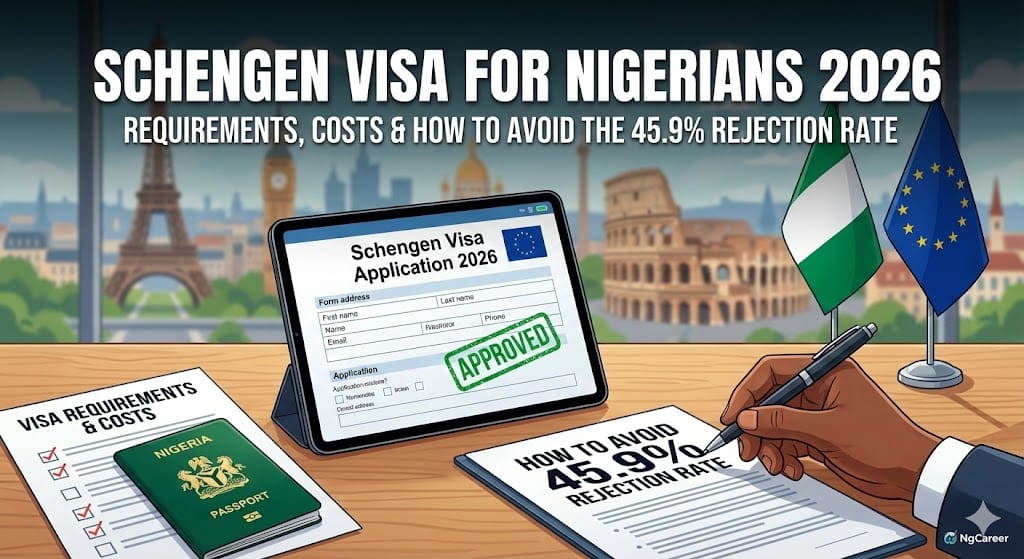
Nearly one in every two Nigerian Schengen visa applications is rejected. According to European Commission data published in May 2025 and reported by Punch Nigeria, Nigeria recorded a 45.9% rejection rate for Schengen visas in 2024. This is more than three times the global average of 14.8%.
The financial impact is staggering. According to the same report citing analysis by the LAGO Collective, African applicants collectively lost an estimated €60 million in non-refundable visa fees to European consulates in 2024 alone through rejected applications. Nigerian applicants specifically lost approximately €4 million (about ₦7.1 billion) from 50,376 rejected applications.
As Marta Foresti, founder of the LAGO Collective research group, noted: “The poorest countries in the world are paying the richest countries not to let them in. The poorer the country of origin, the higher the rejection rates.”
My name is Babatunde Oladepo, and since 2019, I have been helping Nigerian applicants understand why their applications failed and how to strengthen reapplications. The patterns are remarkably consistent, and largely avoidable. I have seen applications rejected because a hotel booking was for a different city than stated in the cover letter, a simple mismatch that cost the applicant €90 and weeks of preparation. This guide explains exactly what causes these rejections and how to position your application for approval.
Key Statistics at a Glance
| Metric | 2024 Data |
|---|---|
| Nigerian rejection rate | 45.9% |
| Change from previous year | Up from 40.8% (2023), a 12.5% increase |
| Global ranking | 6th highest globally |
| African ranking | 4th highest among African countries |
| Global average rejection rate | 14.8% |
| Nigerian applications submitted | 111,201 (highest in 15 years) |
| Nigerian applications rejected | 50,376 (highest in 15 years) |
| Money lost by Nigerians to rejections | €4 million (~₦7.1 billion) |
| Visa fee (non-refundable) | €90 for adults |
| Total global applications | 11.7 million |
| Total global visas issued | 9.8 million |
Nigeria ranks 6th globally according to the complete European Commission dataset, though some analyses listing fewer countries place Nigeria 3rd.
Countries with Highest Schengen Visa Rejection Rates (2024)
According to AXA Schengen citing European Commission data, these countries have the highest rejection rates globally:
| Rank | Country | Rejection Rate |
|---|---|---|
| 1 | Bangladesh | 54.9% |
| 2 | Pakistan | 47.5% |
| 3 | Guinea-Bissau | 47.0% |
| 4 | Senegal | 46.8% |
| 5 | Haiti | 46.3% |
| 6 | Nigeria | 45.9% |
| 7 | Ghana | 45.5% |
| 8 | Congo (Brazzaville) | 43.0% |
| 9 | Mali | 42.9% |
Among African countries specifically, Nigeria ranks fourth behind Comoros, Guinea-Bissau, and Senegal according to Punch Nigeria’s analysis.
According to the Henley Africa Wealth Report, “The rejection rates for African applicants for Schengen visas are generally 10% higher than the global average, three times higher than the highest rejection rate from developed nations, and ten times higher than for US-Americans.”
What Is a Schengen Visa?
The Schengen visa allows you to travel freely across 29 European countries that have abolished internal border controls. With a single Schengen visa, you can visit multiple member countries without additional visa applications.
According to the German Federal Foreign Office, “The Schengen visa allows you to stay a maximum of 90 days per 180 days in the Schengen area.”
Schengen Member Countries
Austria, Belgium, Bulgaria, Croatia, Czech Republic, Denmark, Estonia, Finland, France, Germany, Greece, Hungary, Iceland, Italy, Latvia, Liechtenstein, Lithuania, Luxembourg, Malta, Netherlands, Norway, Poland, Portugal, Romania, Slovakia, Slovenia, Spain, Sweden, and Switzerland.
Types of Schengen Visas
| Visa Type | Purpose | Duration |
|---|---|---|
| Type C (Short-stay) | Tourism, business, visiting family | Up to 90 days within 180 days |
| Type A (Airport transit) | Layovers only | Hours only |
| Type D (National visa) | Work, study, residence | More than 90 days |
This guide focuses on the Type C short-stay visa, which is what most Nigerian travelers need for tourism, business trips, or visiting friends and family.
Schengen Visa Requirements for Nigerian Applicants
Nigerian applicants must provide the following documents:
1. Valid Passport
Your passport is the foundation of your application:
- Must be valid for at least 6 months beyond your planned return date
- Must contain at least 2 blank visa pages (preferably facing pages)
- Must be in excellent physical condition with no tears, water damage, or missing pages
- Must be issued within the last 10 years
Also prepare:
- Clear photocopy of passport bio-data page
- Copies of all previous Schengen visas (if any)
- Copies of other international visas (UK, US, Canada, Dubai)
If your passport expires within 12 months, consider renewing it before applying.
2. Completed Visa Application Form
- Download and complete the form from the specific embassy website
- Print, sign, and date the form
- All information must match your supporting documents exactly
- Use only English or the language of the country you are applying to
3. Biometric Passport Photographs
According to Schengen standards:
- 2 recent photos (taken within last 6 months)
- Size: 35mm × 45mm
- White or light background
- 70-80% face coverage
- Neutral expression, both ears visible
- No glasses (unless medically necessary)
4. Travel Medical Insurance
Travel insurance is compulsory for all Schengen visa applications.
Mandatory requirements:
- Minimum medical coverage: €30,000 (approximately ₦50 million)
- Valid across all 29 Schengen countries
- Covers your entire trip duration (plus buffer days recommended)
- Must include emergency medical treatment, hospital admission, medical evacuation, and repatriation of remains
5. Proof of Accommodation
Option 1: Hotel Bookings
- Confirmed reservations covering your entire stay
- Must list every city and country you will visit
- Each booking should show hotel name, address, phone number, check-in and check-out dates, and confirmation number
Option 2: Invitation Letter from Host
- Must be from a legal resident of a Schengen country
- Include host’s full name, address, and contact details
- Copy of host’s passport or residence permit
- Proof of accommodation (utility bill, rental agreement)
- Statement accepting financial responsibility (if applicable)
Critical warning: Never submit fake bookings. Embassies verify reservations directly. Fraudulent documents result in automatic rejection and potential bans.
6. Flight Itinerary
- Round-trip booking showing clear departure and return dates
- Your full name exactly as it appears in your passport
- Flight numbers, airlines, and layover details
You do not need fully paid tickets. Embassies accept reservations. Purchase tickets only after visa approval.
7. Proof of Financial Means
This is one of the most scrutinized documents in your entire application.
Essential requirements:
- 6 months of consecutive bank statements (3 months minimum, 6 recommended)
- Dated within 15 days of submission
- Shows consistent monthly income matching your employment
- Sufficient balance to cover travel expenses
- Bank-stamped and signed (not just online printouts)
Recommended minimum balances:
- Solo traveler (2 weeks): ₦1,500,000 to ₦2,000,000
- Solo traveler (3-4 weeks): ₦2,500,000 to ₦3,500,000
8. Proof of Ties to Home Country
Embassies want evidence of strong ties to Nigeria, reasons you will return home after your trip.
For employed applicants:
- Employment letter on company letterhead including your full job title, salary details, employment start date, approved leave period, and company contact information
- Recent payslips (last 3-6 months)
- Company registration certificate (CAC)
For self-employed applicants:
- Business registration documents (CAC certificate)
- Tax clearance certificate or Tax Identification Number (TIN)
- Business bank statements (6 months)
- Client contracts, invoices, or receipts
- Brief company profile
For sponsored applicants:
- Detailed sponsorship letter explaining relationship, reason for sponsorship, and full financial commitment
- Sponsor’s bank statements (6 months minimum)
- Sponsor’s employment letter and recent payslips
- Proof of relationship (birth certificate, marriage certificate)
- Sponsor’s valid ID or passport copy
9. Cover Letter
A brief letter (1 page maximum) explaining:
- Purpose of your trip
- Countries you will visit and why
- Your ties to Nigeria (job, family, property)
- Confirmation you will return before visa expires
How Much Does a Schengen Visa Cost from Nigeria?
| Fee Type | Amount |
|---|---|
| Visa application fee (adults) | €90 |
| Visa application fee (children 6-12) | €45 |
| Visa application fee (children under 6) | Free |
| VFS Global/TLScontact service fee | Varies by location |
According to the German Embassy: “The visa fee is payable at the current exchange rate in Nigerian Naira in cash or via POS. The processing fee is not refundable in case of visa rejection.”
The real cost of applying:
The €90 fee is just the beginning. Factor in:
- VFS/TLScontact service charges
- Document preparation (translations, certifications, bank letters)
- Travel to embassy or visa center
- Passport photographs
- Travel insurance
- Provisional flight and hotel bookings
According to Punch Nigeria, Nigerians spent ₦130 billion on Schengen visa applications between 2014 and 2024, with ₦7.1 billion lost to rejected applications in 2024 alone.
Which Schengen Countries Are Easiest and Hardest for Approval?
This is one of the most common questions I receive. Based on European Commission 2024 data reported by Nairametrics:
Schengen Countries with Lowest Rejection Rates (Easier)
| Country | Rejection Rate 2024 | Applications Processed |
|---|---|---|
| Iceland | 6.6% | 35,413 |
| Bulgaria | ~9.4% | Lower volume |
| Romania | ~9.4% | Lower volume |
| Slovakia | 9.9% | Lower volume |
| Latvia | 10.9% | Lower volume |
According to AXA Schengen, “Iceland has been the Schengen country with the lowest refusal rate for a few years… It also processes far fewer visa applications (35,413 in 2024) than more coveted destinations. This leads to shorter processing time and thus quicker answers for applicants.”
Denmark had the highest non-issuance rate for Nigerian applicants specifically at 34.94%, according to SchengenVisaInfo.
Schengen Countries with Highest Rejection Rates (Harder)
| Country | Rejection Rate 2024 | Applications Processed |
|---|---|---|
| Malta | 38.5% | 45,578 |
| Estonia | 27.2% | 12,125 |
| Belgium | 24.6% | 255,564 |
| Slovenia | 24.5% | 18,171 |
| Sweden | 24.0% | 188,623 |
| Denmark | 23.7% | 132,158 |
For Nigerian Applicants Specifically
According to Punch Nigeria’s analysis:
- Switzerland proved the easiest country for Nigerians to obtain a Schengen visa, with an approval rate of 79.40%
- Belgium emerged as the most difficult, with a rejection rate of 62.32% for Nigerian applicants
- France, the top destination for Nigerian applicants (55,833 applications), had a 43.5% rejection rate
Important: You must apply to the country that is your main destination regardless of rejection rates. Applying to an “easier” embassy when it is not your primary destination can result in rejection for misrepresentation.
Where to Apply: Which Embassy or Consulate?
You must apply to the embassy of the country that is your main destination. If you are visiting multiple Schengen countries equally, apply to the country you will enter first.
Germany
According to the German Embassy Abuja, processing is limited at the Abuja embassy. Most applicants must apply through the Consulate General in Lagos.
Abuja embassy handles only:
- Medical emergencies
- Government officials on official travel
- Members of the Presidency, National Assembly, Senate
- Military personnel on official travel with German invitation
- Diplomats and staff of diplomatic missions
- Spouses and children of Germans
- Scholarship holders funded by German public funds
- Participants in German government-organized programs
All other applicants: Must apply at the Consulate General in Lagos.
Germany processed approximately 1.5 million visa applications in 2024 with a 13.7% rejection rate globally.
France
France receives the most applications from Nigerians but has significant rejections:
- 55,833 Nigerian applications in 2024
- 24,301 rejections (43.5% rejection rate)
France processed over 3 million applications globally in 2024, issuing 2.5 million visas with a 15.8% global rejection rate.
Netherlands
According to the Netherlands Worldwide portal, where you apply depends on your state of residence:
If you live in these states, apply at TLScontact in Abuja (Belgian application center): Adamawa, Bauchi, Benue, Borno, FCT Abuja, Gombe, Jigawa, Kaduna, Kano, Katsina, Kebbi, Kogi, Nasarawa, Niger, Plateau, Sokoto, Taraba, Yobe, Zamfara
If you live in any other state: Apply at TLScontact in Lagos (French application center)
Spain
All applications must be submitted at BLS International visa centers.
Submission time: 8:00 AM to 2:00 PM (last entry 2:30 PM) Collection time: 8:00 AM to 4:00 PM Processing requirement: Applications must be submitted at least 20 days prior to proposed travel date
Italy
Visa applications are handled by the Consulate General in Lagos. Applications must be submitted through TLScontact, which has offices in both Abuja and Lagos.
Italy received around 1.2 million applications globally in 2024 and denied 134,303, reflecting a 10.9% rejection rate.
The Application Process Step by Step
Step 1: Determine which Schengen country to apply to (main destination or first entry point)
Step 2: Gather all required documents
Step 3: Purchase travel insurance
Step 4: Book an appointment at VFS Global, TLScontact, BLS, or the embassy directly (depending on country)
Step 5: Pay visa fee (€90 for adults, €45 for children 6-12)
Step 6: Attend appointment and submit biometrics (fingerprints and photo)
Step 7: Attend interview if required
Step 8: Track application status
Step 9: Collect passport with visa decision
Important timing:
- Applications can be submitted up to 6 months before travel
- Applications must be submitted at least 15 calendar days before travel
- Processing typically takes 15 working days, but can extend to 30-45 days during peak seasons
What Are the Most Common Reasons for Schengen Visa Rejection?
Understanding why applications fail is crucial for Nigerian applicants facing a 45.9% rejection rate. According to Punch Nigeria citing European consulate sources:
1. Insufficient Proof of Financial Means
This is the leading cause of rejection. Consular officers assess whether:
- Your income matches your lifestyle
- The trip cost makes sense for your finances
- Savings look genuine, not recently borrowed
- There is a clear income trail through payslips, tax returns, or business records
When the numbers do not logically align, doubt is raised, and doubt often leads to rejection.
Common mistakes:
- Large, unexplained deposits shortly before application
- Bank balance that does not match stated income
- Missing payslips or employment documentation
- Inconsistent information between bank statements and employment letter
2. Unclear Purpose of Travel
This appears on refusal letters as: “The purpose and conditions of the intended stay could not be ascertained.”
It happens when the consulate cannot clearly understand:
- Why you are traveling
- Where you will stay
- What you will actually do during your visit
How to fix this:
- Provide a detailed day-by-day itinerary
- Ensure accommodation bookings match your stated plans
- Include specific reasons for visiting each location
- If visiting someone, provide a proper invitation letter
3. Weak Ties to Home Country
According to Punch Nigeria, European consulates cite “weak ties to the home country” as a major reason for denying Nigerian applications. Risk indicators often flagged include:
- Unemployment or informal work without documentation
- Remote work without a written contract
- Recent relocation or unstable residential status
- No dependents, spouse, or family obligations
- No property ownership or long-term commitments
- Limited international travel history
None of these equals automatic refusal. But combined, they may suggest overstay risk in the officer’s assessment.
4. Non-Compliant Travel Insurance
Insurance must meet specific Schengen requirements:
- Minimum coverage: €30,000
- Valid across all Schengen countries
- Coverage for the entire duration of stay
- Must cover medical emergencies and repatriation
Many applicants purchase cheap insurance that does not meet these requirements, resulting in rejection.
5. Fake or Inconsistent Documents
This is treated extremely seriously and can result in:
- Immediate refusal
- A flag on your file affecting future applications
- In severe cases, a ban from entering the Schengen area
Common issues include:
- Fake hotel bookings or unverifiable reservations
- Manipulated bank statements or altered balances
- Agent errors such as wrong dates or mismatching details
- Contradictions between application form, documents, and statements
According to the German Embassy: “Falsified documents may be forwarded to the appropriate authorities.”
6. Incomplete or Inconsistent Documentation
According to Nairametrics, “Incomplete travel plans often lead to rejections, emphasizing the need for detailed itineraries” and “many submissions still fell short of compliance standards, highlighting the need for complete and accurate documentation.”
7. Lack of Prior International Travel
European consulates cite “lack of prior international travel” as a factor in denying applications. First-time travelers may face additional scrutiny.
How to Show Strong Ties to Home Country
This is one of the most critical factors for Nigerian applicants given the high rejection rate.
What Counts as Strong Ties
| Category | Examples |
|---|---|
| Employment | Employment contract, employer letter confirming return date, salary slips, leave approval |
| Business ownership | CAC registration, business bank statements, client contracts, invoices |
| Property | Land ownership documents, property deeds, rental income records |
| Family | Marriage certificate, children’s birth certificates, school enrollment letters |
| Education | University enrollment, exam schedules, academic calendar |
| Financial commitments | Loan repayment schedules, mortgage documents |
What Counts as Weak Ties
- No formal employment contract
- No property ownership
- Single with no dependents
- Recently relocated to a new city
- Limited international travel history
- Freelance or remote work without proper documentation
How to Strengthen Your Application
If your ties appear weak, compensate with:
- A compelling cover letter explaining your situation and reasons for return
- Evidence of ongoing business relationships or contracts
- Proof of upcoming events you must attend (weddings, graduations, business launches)
- Documentation of elderly parents or dependents who rely on you
- Evidence of investments or business ventures in Nigeria
How to Avoid Schengen Visa Rejection: Practical Strategies
Show Stable Bank History
- Provide 6 months of statements showing consistent income
- Avoid large, unexplained deposits shortly before application
- Ensure the balance logically supports your trip costs
- Get bank statements stamped and signed, not just online printouts
Include Verifiable Income Documentation
- Salary slips from the last 3-6 months
- Tax returns or business records
- Employer letter confirming position, salary, and leave approval
- For business owners: CAC registration, invoices, contracts
Align All Dates Across Documents
- Flight itinerary dates must match accommodation dates
- Insurance validity must cover entire trip plus buffer days
- Application form dates must be consistent throughout
- Leave approval dates must match travel dates
Ensure Travel Insurance Is 100% Compliant
- Minimum €30,000 coverage
- Valid across all Schengen countries
- Covers entire duration of stay
- Includes medical emergencies, hospitalization, and repatriation
Create a Credible, Detailed Itinerary
- Day-by-day plan of activities
- Specific locations and purposes for each city
- Logical flow that makes sense for your stated purpose
- Matching accommodation bookings for each location
Never Submit Fake Documents
- Embassies verify hotel bookings directly
- Bank statement manipulation can be detected
- Fraudulent documents result in automatic rejection
- Severe cases lead to entry bans
Can I Reapply After a Schengen Visa Refusal?
Yes, but with important considerations.
Immediate Reapplication
- There is no mandatory waiting period
- However, reapplying with the same documents will likely result in the same outcome
- You must address the specific reasons stated in your refusal letter
Understanding Your Refusal Letter
| Refusal Wording | Meaning |
|---|---|
| “Proof of sufficient means of subsistence not provided” | Financial documentation was inadequate |
| “Purpose and conditions of stay could not be ascertained” | Trip plan was not clear or credible |
| “Reasonable doubts as to intention to leave Schengen Area” | Home-country ties were insufficient |
| “Travel medical insurance inadequate” | Insurance did not meet requirements |
| “Information submitted not proven reliable” | Documents appeared inconsistent or manipulated |
Before Reapplying
- Carefully read your refusal letter to understand the specific reasons
- Address each stated reason with new or additional documentation
- Consider what has changed since your last application
- If your circumstances have not changed significantly, consider waiting until they do
Consequences of Repeated Rejections
- Multiple rejections can create a pattern that makes future approvals harder
- Each rejection is recorded in the system
- Never submit false or manipulated documents, as this can result in a multi-year ban
Processing Time: What to Expect
According to the German Embassy: “The processing time of Schengen visa applications at the consulate/embassy is at least 15 days. In individual cases, the processing time may increase to several weeks.”
Standard Timeline
| Stage | Duration |
|---|---|
| Minimum processing | 15 calendar days |
| Standard processing | 15-30 days |
| Complex cases | Up to 45 days |
| Peak season (May-September) | Extended processing common |
Factors That Extend Processing
- Incomplete applications requiring additional documents
- High volume at specific embassy
- Security checks or verification needs
- Peak travel seasons
Application Timing Strategy
- Apply as early as possible (up to 6 months before travel)
- Never apply later than 15 days before travel
- Avoid peak seasons if possible (summer months see highest volumes)
- Ensure all documents are complete to avoid delays
Important Notes After Visa Approval
According to the German Embassy: “The issuance of a Schengen visa does not constitute a right of entry. The final decision is made by the border police upon entry into the Schengen area.”
This means even with an approved visa, you may be asked to present documents at the border proving:
- Your financial means
- The duration and purpose of your stay
- Your health insurance coverage
Recommendation: Take a complete set of your visa documents on your trip, including:
- Invitation from host (if applicable)
- Hotel reservations
- Travel health insurance documents
- Return flight itinerary
- Bank statements
Historical Context: Nigerian Schengen Visa Trends
According to Punch Nigeria’s analysis of European Commission data spanning 15 years:
| Period | Applications | Key Trends |
|---|---|---|
| 2009-2024 | ~1.1 million total | 491,844 rejected overall |
| 2014-2019 (Pre-pandemic) | Higher volume | €43.9m spent on applications |
| 2020-2022 (Pandemic) | Reduced volume | €11.3m spent; €5.2m lost to rejections |
| 2024 | 111,201 (highest ever) | €8.9m spent; €4m lost to rejections |
Historical rejection rates:
- 2017: 53% (highest recorded)
- 2019: 51%
- 2022-2023 combined: 46.35%
- 2024: 45.9%
The 2024 figure marked both the highest number of applications (111,201) and the highest number of rejections (50,376) in the 15 years covered by the data.
Frequently Asked Questions
What is the most common reason for Schengen visa refusal?
Insufficient proof of financial means is a leading cause of rejection. Consular officers assess whether your bank statements show stable, sufficient funds for your trip and whether your income logically supports your travel plans. Large, unexplained deposits shortly before application are a major red flag.
What is Nigeria’s Schengen visa rejection rate?
Nigeria recorded a 45.9% rejection rate in 2024, up from 40.8% in 2023. This ranks Nigeria 6th globally for highest rejection rates and 4th among African countries. The global average rejection rate is 14.8%, meaning Nigerian applicants are rejected at more than three times the global rate.
How much does a Schengen visa cost for Nigerians?
The visa application fee is €90 for adults, €45 for children aged 6-12, and free for children under 6. This fee is non-refundable regardless of the application outcome. Additional costs include VFS/TLScontact service fees, document preparation, and travel insurance.
How long does Schengen visa processing take?
Processing takes a minimum of 15 calendar days but can extend to 30-45 days for complex cases or during peak seasons. The German Embassy advises that processing may increase to “several weeks” in individual cases.
Which Schengen country is easiest to get a visa from Nigeria?
Based on 2024 data, Switzerland has the highest approval rate for Nigerian applicants at 79.40%. Globally, Iceland has the lowest rejection rate at 6.6%. However, you must apply to the country that is your main destination.
Which Schengen country is hardest to get a visa from Nigeria?
Belgium has the highest rejection rate for Nigerian applicants at 62.32%. Globally, Malta has the highest rejection rate at 38.5%. Belgium rejected over 61,000 applications out of 255,564 in 2024.
Can I visit other Schengen countries with my visa?
Yes. A Schengen visa issued by any member country allows you to travel freely across all 29 Schengen countries during your approved stay (up to 90 days within 180 days). However, you should primarily visit the country that issued your visa.
How much money should I have in my bank account?
There is no official minimum, but for Nigerian applicants, solo travelers should show at least ₦1.5 million to ₦2 million for a 2-week trip, and ₦2.5 million to ₦3.5 million for a 3-4 week trip. More importantly, your balance should logically match your stated income and trip costs.
What counts as weak ties to home country?
Weak ties include: no formal employment contract, no property ownership, being single with no dependents, recently relocating, limited international travel history, and freelance work without documentation. These do not guarantee rejection but may raise concerns.
Can I reapply immediately after rejection?
Yes, there is no mandatory waiting period. However, you must address the specific reasons for refusal in your new application. Reapplying with identical documents will likely result in the same outcome. Consider what has changed or what additional evidence you can provide.
Why are African applicants rejected at higher rates?
According to the Henley Africa Wealth Report, “The rejection rates for African applicants for Schengen visas are generally 10% higher than the global average, three times higher than the highest rejection rate from developed nations, and ten times higher than for US-Americans.” Africa accounted for seven of the top 10 countries with the highest Schengen visa rejection rates in 2022.
Related Resources
If you are considering studying or working abroad instead of short visits, these guides may help:
- Germany Student Visa for Nigerians covers long-stay student visa requirements including the blocked account
- Spain Student Visa for Nigerians explains Spanish student visa requirements
- Germany Job Seeker Visa for Nigerians 2026 covers the job seeker visa if you want to work in Germany
- How to Spot Fake Recruitment Agencies helps you avoid scams when seeking international opportunities
- Documents Needed for Studying Abroad provides general guidance on preparing application documents
Final Thoughts
With a 45.9% rejection rate, Nigerian Schengen visa applicants face significant challenges. But understanding why applications fail reveals that most rejections are avoidable.
The key factors are:
- Complete, consistent documentation with no contradictions or gaps
- Clear financial evidence showing stable income and sufficient funds
- Strong ties to Nigeria demonstrating reasons to return
- A credible, detailed travel plan with matching bookings
- Compliant travel insurance meeting all Schengen requirements
- Never submitting fake or manipulated documents
Every document should tell the same story. Your employment letter, bank statements, travel itinerary, and accommodation bookings should all align. When consular officers see consistency, credibility increases. When they see contradictions, doubt is raised.
The €90 fee is non-refundable. The stress of rejection is significant. But with proper preparation and attention to the specific requirements, Nigerian applicants can position themselves among the 54.1% who are approved.
This article reflects information from European Commission 2024 visa statistics published in May 2025 and verified through multiple sources. Visa requirements and processing procedures can change. Always verify current requirements directly with the embassy or consulate you are applying to before submitting your application.