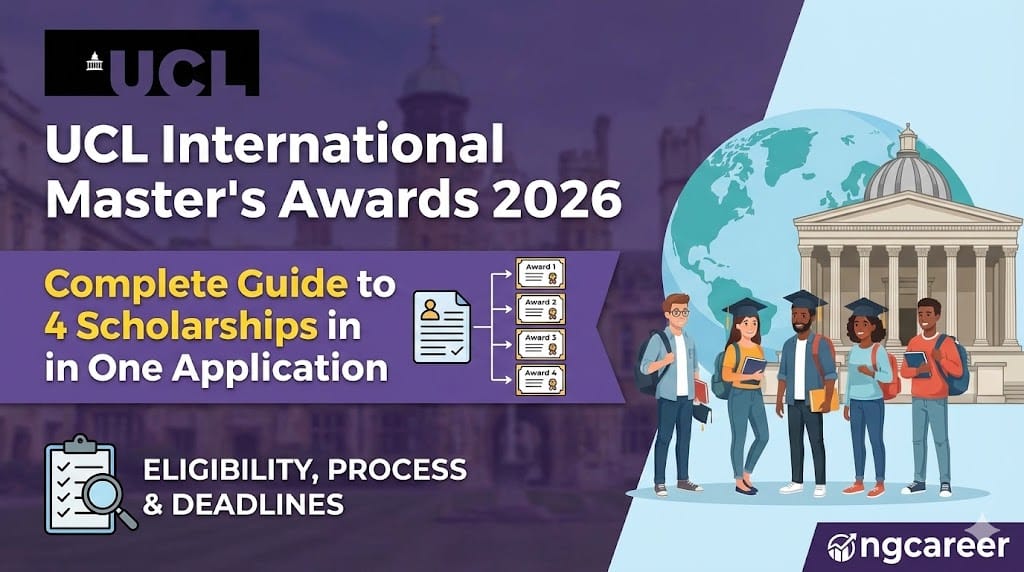
Here’s something most scholarship websites won’t tell you: UCL lets you apply once and get considered for four different funding schemes. The International Master’s Awards isn’t a single scholarship—it’s a unified application system designed to maximize your chances of receiving funding for postgraduate study at one of the world’s top universities.
Most international students apply to individual scholarships without realizing that UCL has created a centralized portal where one application form unlocks consideration for multiple awards simultaneously. According to the official UCL International Master’s Awards page, this umbrella application process “allows students to apply once and to be considered for all the schemes it encompasses, as long as they meet the eligibility criteria.”
The four scholarship schemes accessible through a single International Master’s Awards application are:
- UCL Global Masters Scholarship (up to £15,000)
- GREAT Scholarship (for students from specific partner countries)
- Humanitarian Scholarship (for refugees and displaced persons)
- Musubi Global Master’s Scholarship (for Japanese students)
The deadline is 5:00 PM BST on Thursday, 7 May 2026. I verified every detail in this guide directly from UCL’s official scholarship pages to ensure you receive accurate, current information.
Quick Overview: UCL International Master’s Awards 2026
| Detail | Information |
|---|---|
| Programme Name | UCL International Master’s Awards (IMA) |
| Application Type | One application for multiple schemes |
| Schemes Included | Global Masters, GREAT, Humanitarian, Musubi |
| Maximum Potential Value | Up to £15,000+ |
| Application Deadline | 7 May 2026, 5:00 PM BST |
| Results Timeline | Late June 2026 |
| Eligible Students | Overseas fee-paying postgraduate taught |
| Application Portal | Portico (UCL student system) |
What Are the UCL International Master’s Awards?
The UCL International Master’s Awards (IMA) is UCL’s centrally administered umbrella scholarship scheme for international postgraduate taught students. Rather than requiring separate applications for each funding opportunity, UCL has created a unified system where completing one application form automatically considers you for every scheme where you meet the eligibility criteria.
According to UCL’s official IMA application guidance, the IMA “is an umbrella application process that allows students to apply once and to be considered for all the schemes it encompasses.”
This approach benefits applicants in several ways. You save time by completing one comprehensive financial assessment rather than multiple forms. You’re automatically matched to schemes you qualify for, even ones you might not have discovered independently. And if new awards are added after you submit your application, you’ll still be considered for them.
According to UCL’s official page, “This list may be updated as more awards are confirmed for 2026/27. Do not worry if awards are added after you submit your application as applicants will be considered for all awards listed by the 7 May deadline.”
The IMA is not the same as individual scholarships. It’s a portal or system that houses multiple funding schemes under one application process.
All Scholarship Schemes Under UCL International Master’s Awards
The International Master’s Awards encompasses four distinct scholarship schemes for the 2026/27 academic year. Each has different eligibility criteria, target groups, and application requirements.
| Scheme | Value | Target Group | Selection Basis | Additional Requirements |
|---|---|---|---|---|
| UCL Global Masters Scholarship | £15,000 | International students from lower-income backgrounds | Financial need | Standard application only |
| GREAT Scholarship | Varies | Students from specific GREAT partner countries | Need + merit | Statement upload required |
| Humanitarian Scholarship | Varies | Refugees, displaced persons | Need + circumstances | Statement upload + additional questions (Q37-43) |
| Musubi Global Master’s Scholarship | £15,000 | Japanese students | Financial need | Must be from Japan |
UCL Global Masters Scholarship
This is UCL’s flagship needs-based award for international Master’s students. According to the official UCL Global Masters Scholarship page, up to 85 scholarships are available for 2026/27, with five ring-fenced for students from India and one for a student from Japan.
The £15,000 award is applied first to tuition fees, with any remainder paid in three equal installments throughout the academic year toward maintenance support. For two-year programmes, the scholarship is split 50% per year.
For comprehensive details on this specific scheme, see our dedicated guide on UCL Global Masters Scholarship.
GREAT Scholarship
The GREAT Scholarship is offered in partnership with the GREAT Britain Campaign and targets students from specific partner countries. According to UCL’s guidance, applicants must upload additional statements responding to three questions (200 words maximum each):
- Demonstrate how you are passionate about your field of study (work experience/accomplishments)
- Give an example of when you have contributed to your community
- How you will use what you learn at UCL for change in your country
Check UCL’s official GREAT Scholarship page for the current list of eligible nationalities, as this varies by academic year.
Humanitarian Scholarship
The Humanitarian Scholarship supports refugees, displaced persons, and those from humanitarian backgrounds. This scheme requires additional application components:
According to UCL’s application guidance, Humanitarian Scholarship applicants must answer questions Q37-43, which cover displacement history, current location, and living situation. You’ll also need to upload the same statement document as GREAT Scholarship applicants.
If shortlisted, UCL will request evidence of displacement. According to the official guidance, “Evidence we will require is: Evidence of refugee status, or Humanitarian Protection as recognised by the 1951 UN Convention on the Status of Refugees provided by UNHCR, the country in which you are taking refuge, or a recognised aid agency. We would also accept a signed reference from your place of residence stating when you arrived, and where you arrived from.”
Musubi Global Master’s Scholarship
This scheme specifically supports Japanese students and provides £15,000 in funding. The Musubi Global Master’s Scholarship follows the same financial need assessment as the Global Masters Scholarship but is exclusively available to students from Japan.
What About the “UCL Global Talent Scholarship”?
Some searches reference a “UCL Global Talent Scholarship,” but UCL’s official scholarship pages do not list a scheme by this exact name. Students searching for this term are likely looking for the UCL Global Masters Scholarship (£15,000 needs-based award) or department-specific funding. All UCL master’s funding for international students is accessed through the International Master’s Awards or Master’s Funding Awards application systems.
UCL International Master’s Awards Eligibility Requirements
General Eligibility (All IMA Schemes)
According to UCL’s official guidance, to apply for any scheme under the International Master’s Awards, you must:
- Be eligible to pay the overseas fee rate (not UK home fee status)
- Have submitted a complete admission application to UCL, including references that have been submitted and verified
- Be applying for a full-time taught Master’s programme
- Plan to attend UCL in person (distance-learning programmes are not eligible)
Important: You do not need to have received an offer of admission to apply for these awards. However, according to UCL, “you will need to have had your fee status confirmed by UCL Admissions.”
For some students, fee status confirmation happens shortly after applying. For many others, it doesn’t happen until just before an admission offer is made. If you cannot access the scholarship application form, you may need to wait until UCL makes an admission decision.
Scheme-Specific Eligibility
| Requirement | Global Masters | GREAT | Humanitarian | Musubi |
|---|---|---|---|---|
| Nationality | Any overseas | GREAT partner countries | Any overseas | Japan only |
| Income criteria | Lower income | May vary by country | Lower income + humanitarian circumstances | Lower income |
| Additional statement | No | Yes (200 words × 3) | Yes (200 words × 3) | No |
| Prior postgraduate degree | Deprioritized | Check scheme | Check scheme | Deprioritized |
According to UCL’s application guidance, “for some schemes based on financial need, students who have not yet had the opportunity to study for a postgraduate degree will be given preference to those that already hold a Master’s or Doctoral degree.”
How to Apply for UCL International Master’s Awards (Step-by-Step)
The application process involves two stages: your admission application and your scholarship application. Here’s exactly how to navigate it.
Step 1: Submit Your UCL Admission Application
Before you can access the scholarship application, you must submit a complete application for admission to a full-time taught Master’s programme at UCL. This includes:
- Personal statement
- Academic transcripts
- References (must be submitted, not just requested)
- English language test scores
- Programme-specific requirements
According to UCL’s guidance, “If you have not yet submitted a complete application for 2026/27 (including your referee submitting references and them having been verified by Admissions via the normal process, which can take a day or two), then you will not be able to apply for central UCL funding.”
UCL strongly advises: “Please apply for admission well before the scholarship deadline.”
For guidance on preparing your application documents, see our comprehensive guide on documents needed for studying abroad.
Step 2: Wait for References and Fee Status Confirmation
Two things must happen before you can access the scholarship form:
References: According to UCL, “it can take up to 24 hours for a reference to show on your application after it has been submitted.” Make sure your referees submit their references promptly.
Fee status: Your overseas fee status must be confirmed by UCL Admissions. For some students this happens quickly; for many it happens just before an admission offer is made.
Step 3: Access the Scholarship Application via Portico
Once your admission application is complete and fee status confirmed, follow these exact steps from UCL’s official guidance:
- Login to Portico with your normal details
- Click “View” for the “Active Application” you wish to apply for funding for
- Click “Funding” in the menu at the top of the page
- Click “Check and apply” under “Funds Available”
- Click on the scholarship name of the scheme you wish to apply for
Step 4: Complete the Financial Assessment Questions
The application form collects comprehensive information about your financial situation. I’ll cover the specific questions in detail in the next section.
Step 5: Upload Required Statements (GREAT and Humanitarian Only)
If you’re applying for the GREAT Scholarship or Humanitarian Scholarship, you must upload additional statements. According to UCL’s guidance, these should answer three questions with 200 words maximum per question:
- Demonstrate how you are passionate about your field of study (work experience/accomplishments)
- Give an example of when you have contributed to your community
- How you will use what you learn at UCL for change in your country
Upload your document as a Word document or PDF only.
Step 6: Submit Before the Deadline
The deadline is 5:00 PM BST on Thursday, 7 May 2026.
Once you click “Next” on the final page after selecting “Yes,” your application is submitted. According to UCL, “you should receive an automated email confirming receipt of your completed application. You will no longer be able to access the application form.”
Critical note from UCL: “For each Master’s programme that you wish to apply for funding for, you will need to submit a separate scholarship application form.” If you’ve applied to multiple UCL programmes, submit separate scholarship applications for each.
What Questions Does the UCL International Master’s Awards Application Ask?
Understanding the application questions in advance helps you prepare accurate information. Based on UCL’s official application guidance, here’s what to expect:
Academic Details
Q2 (Mandatory): If you have previously completed, or are expected to complete, a Master’s or PhD degree by the start of the next academic year, please select the degree.
This question matters because students without previous postgraduate degrees may be given preference for needs-based schemes.
Financial Information
All financial values should be the overall total for all academic years of your course combined (not per year). Amounts should be in UK Sterling. Use numerical values only (e.g., 1500, no commas or symbols).
According to UCL’s guidance, you can use xe.com for currency conversion when calculating your household income in GBP.
Available Funding Sources
The application asks about multiple funding types:
| Funding Type | What to Include |
|---|---|
| Government loans (Q20) | Any postgraduate loan schemes from your country |
| Private loans (Q21) | Bank loans or other private lending |
| Scholarships/Awards (Q24) | Other scholarships applied for or already secured |
| Family contribution (Q26) | Monetary support or loans from family for duration of studies |
| Personal savings (Q27) | Your own savings available for studies |
| State benefits (Q28) | Government benefits you receive |
| Any other funding (Q29) | Funding not captured in other categories |
Important note from UCL: For family contributions, include “any monetary support or loan provided by your family or household for the duration of your studies.” Other “in kind” support like rent-free accommodation should be highlighted in the “any other funding” section rather than estimated as a monetary contribution.
Personal Circumstances
Q32 (Mandatory): Are you the first member of your family to attend university at any level? This includes immediate family (parents, spouse, siblings) who have studied at undergraduate or postgraduate level.
Q34 (Mandatory): Are you registered as having a disability? Mark “Yes” if you are recognised as disabled. UCL will verify this through their Disability Services department.
Q35 (Mandatory): Are you a single parent?
Q36 (Mandatory): Are you currently in receipt of state benefits? Include any benefits from your local government that would stop as a result of your studies. You’ll need to provide evidence if successful.
Humanitarian Scholarship Specific Questions (Q37-43)
If applying for the Humanitarian Scholarship, additional questions cover displacement history, current location, and living circumstances. Check the scheme eligibility before completing these.
Q41: Do you currently hold valid travel documents? (passport or UN Refugee Travel Document)
Q42: If not, do you anticipate having required documents by May 2026? According to UCL, “To be considered for the Humanitarian Scholarship, you must have a valid passport or UN Refugee Travel Document by the time of the scholarship selection so you can apply for your student visa if selected.”
Which Scholarship Is Fully Funded for MSc in UK?
Let me be direct: the UCL International Master’s Awards provide partial funding, not full scholarships. The maximum award through this system is £15,000, which typically covers 40-60% of tuition fees depending on your programme.
UCL does not offer fully funded scholarships at Master’s level for general international applicants through this scheme.
Fully Funded UK Alternatives
If you need complete funding coverage, consider these external options:
Commonwealth Scholarships: For citizens of Commonwealth countries (including Nigeria and India), these cover full tuition, living allowance, and airfare. See our guide on Commonwealth Scholarship 2026.
Chevening Scholarships: The UK government’s flagship award covers full tuition and living costs for one-year Master’s programmes.
Gates Cambridge Scholarships: Fully funded awards for study at Cambridge (not UCL).
The honest reality is this: most UK Master’s funding for international students is partial. The UCL International Master’s Awards represent substantial support but require additional funding sources.
UCL International Master’s Awards vs Master’s Funding Awards
UCL operates two separate centralized scholarship systems with different deadlines and target students. Understanding the difference helps you apply to the right one.
| Feature | International Master’s Awards | Master’s Funding Awards |
|---|---|---|
| Primary audience | International (overseas fee) students | Home and international students |
| Key schemes | Global Masters, GREAT, Humanitarian, Musubi | UCL Master’s Bursary, Professor Malcolm Grant Scholarship, others |
| Deadline 2026 | 7 May 2026 | Check UCL website for current deadline |
| Selection basis | Primarily financial need | Varies by scheme |
If you’re an international student paying overseas fees, the International Master’s Awards is your primary application. Home fee students should focus on the Master’s Funding Awards instead.
Application Timeline for UCL International Master’s Awards 2026
| Date | Event |
|---|---|
| Now – April 2026 | Submit UCL admission application (including references) |
| After admission submission | Wait for fee status confirmation |
| After fee status confirmed | Access and complete IMA application via Portico |
| 7 May 2026, 5:00 PM BST | Application deadline |
| Mid-May 2026 | Shortlisted candidates contacted for financial evidence |
| Late June 2026 | Results announced; successful candidates notified |
| September 2026 | Programme begins |
Time zone note for Nigerian applicants: BST (British Summer Time) is UTC+1. During May, 5:00 PM BST equals 5:00 PM in Nigeria (WAT), so there’s no time difference to calculate.
What GPA Do You Need for UCL Masters?
This is a common point of confusion. The UCL International Master’s Awards have no GPA requirement because they’re awarded based on financial need, not academic merit.
However, you must meet UCL’s admission requirements to be eligible for funding. For most Master’s programmes, UCL typically requires:
- UK Upper Second Class Honours degree (2:1) or international equivalent
- English language proficiency (typically IELTS 6.5-7.5 depending on programme)
For Nigerian applicants, a Second Class Upper (2:1) from a recognized institution typically translates to UK 2:1 requirements. Specific requirements vary by programme—check your intended course page.
The scholarship application asks for your highest qualification and grade achieved, but this information provides context rather than determining selection. Selection is based on financial need.
For English test preparation, see our comparison guide on IELTS vs. TOEFL.
Can You Combine UCL Scholarships with Other Funding?
Yes, but with conditions and disclosure requirements.
According to UCL’s official guidance, the Global Masters Scholarship “may be held alongside other scholarships, studentships, awards, or bursaries depending on the total value of other funds received by the student.”
However, there are responsibilities:
- Mandatory disclosure: “Scholarship recipients are obliged to inform the UCL Student Funding Office immediately of any other funding they are awarded towards their UCL Master’s degree studies, before or subsequent to the UCL Global Masters Scholarship being awarded.”
- Potential adjustment: UCL may adjust your award based on your total funding from all sources.
- Total limits: Combined funding must not exceed permitted limits.
Be honest about all funding sources in your application. Hiding other awards could result in scholarship withdrawal.
Evidence Required if Shortlisted
If your application is competitive, you’ll be contacted in mid-May 2026 to provide evidence of your financial situation. According to UCL’s guidance, acceptable evidence includes:
- Tax returns or official tax documentation from a Government Office
- Payslips
- Bank statements
- Letters from employers
- Evidence of state benefits
According to UCL’s official guidance, evidence can be “for the year September 2022 to September 2023, OR for the most recently completed tax year, depending on the type of evidence you will be able to provide.”
UCL also notes: “If there has been a significant change in your circumstance since April 2025, you can additionally include a more contemporary estimate in Q15, and will need to provide additional documents if shortlisted to show the income in both years.”
Prepare documents in advance. When UCL contacts shortlisted candidates, the response window is typically short. Having documents ready ensures you don’t miss the evidence submission deadline.
For Humanitarian Scholarship applicants, UCL will also require evidence of displacement, such as refugee status recognition from UNHCR or a signed reference from your place of residence confirming when and where you arrived from.
What Happens After You Apply?
Once you submit your International Master’s Awards application, here’s the process:
- Confirmation email: You’ll receive an automated email confirming receipt of your completed application
- Assessment: The UCL Student Funding Office reviews all applications
- Shortlisting (mid-May): Competitive applicants are contacted to provide financial evidence
- Evidence review: Submitted documents are assessed
- Results (late June): Successful candidates are notified
- Award application: Scholarship applied to your fee invoice; any remainder paid in installments
Important note from UCL: “If your admission offer is still pending or conditional then any funding award offer from UCL is subject to you receiving an offer of admissions and/or meeting all conditions stipulated in that offer.”
This means even if you receive a scholarship offer, you must still secure your admission offer and meet all conditions to actually receive the funding.
Preparing Your UK Student Visa
If you receive funding and accept your UCL offer, you’ll need a UK Student Visa. Your scholarship award can count toward your financial evidence, but you must still demonstrate sufficient funds for:
- Remaining tuition fees (after scholarship is applied)
- Living costs: £1,334 per month for up to 9 months (London rate)
Start your visa preparation early. For detailed guidance, see our comprehensive guide on UK student visa application for Nigerians.
Frequently Asked Questions
What are the International Master’s Awards UCL?
The UCL International Master’s Awards (IMA) is a centralized application portal that allows international postgraduate students to apply once and be considered for multiple scholarship schemes simultaneously. The schemes include the UCL Global Masters Scholarship (£15,000), GREAT Scholarship, Humanitarian Scholarship, and Musubi Global Master’s Scholarship.
How do I apply for the UCL Global Masters Scholarship?
Submit your UCL admission application first (including references), then access the scholarship application through Portico. Navigate to Funding > Funds Available > select the scholarship scheme. Complete the financial assessment and submit before 7 May 2026 at 5:00 PM BST.
What is the UCL Global Masters Scholarship eligibility?
You must be classified as an overseas fee-paying student, come from a lower-income background, have submitted a complete admission application for a full-time taught Master’s degree, and plan to attend UCL in person. Distance learning is not eligible.
Do I need an admission offer to apply for the scholarship?
No. According to UCL’s official guidance, “you do not need to hold an offer of admission to apply for these awards, just have the completed application for admission.” However, your fee status must be confirmed as overseas.
Where can I get a 100% scholarship for UK Masters?
Fully funded UK Master’s scholarships include Commonwealth Scholarships, Chevening Scholarships, and Gates Cambridge Scholarships. The UCL International Master’s Awards provide substantial partial funding (up to £15,000) but do not cover 100% of costs.
How much is the UCL Global Masters Scholarship worth?
The UCL Global Masters Scholarship provides £15,000. This is applied first to tuition fees, with any remainder paid in three equal installments toward living costs. For two-year programmes, the award is split 50% per year (£7,500 annually).
How many scholarships are available?
Up to 85 UCL Global Masters Scholarships are available for 2026/27, with five ring-fenced for students from India and one for a student from Japan. Additional awards through GREAT and Humanitarian schemes vary.
When is the UCL International Master’s Awards deadline?
The deadline is 5:00 PM BST on Thursday, 7 May 2026. Late applications are not accepted.
Can I apply for multiple UCL programmes and scholarships?
Yes, but you must submit separate scholarship applications for each programme. According to UCL’s guidance, “for each Master’s programme that you wish to apply for funding for, you will need to submit a separate scholarship application form.”
When will I find out the results?
Shortlisted candidates are contacted in mid-May to provide financial evidence. According to UCL, successful candidates are “notified as soon as decisions are made, typically by late June.”
Do I need additional statements for all schemes?
No. The GREAT Scholarship and Humanitarian Scholarship require additional statement uploads (three questions, 200 words each). The Global Masters Scholarship and Musubi only require the standard financial assessment.
What is the UCL Global Talent Scholarship?
UCL’s official scholarship pages do not list a scheme called “UCL Global Talent Scholarship.” Students searching for this term may be looking for the UCL Global Masters Scholarship (£15,000 needs-based award) or department-specific funding.
Alternative Scholarships for International Students
If you don’t qualify for the UCL International Master’s Awards or need additional funding, consider these alternatives:
UK-Wide Opportunities
Commonwealth Scholarships: Fully funded for Commonwealth country citizens. See our Commonwealth Scholarship 2026 guide.
Chevening Scholarships: UK government flagship awards covering full costs for one-year Master’s programmes.
Alternative Study Destinations
Germany: Many programmes have no tuition fees. See our guide on scholarships in Germany without IELTS for Nigerians.
Canada: Strong universities with various funding options. See our guide on Canada scholarships for Nigerians 2026.
For general scholarship application strategies, see our guide on how to apply for scholarships.
What You Should Do Next
If you’re considering applying for UCL’s International Master’s Awards, here’s your action plan:
- Submit your UCL admission application early with all references included
- Wait for fee status confirmation (can take time for some applicants)
- Access the scholarship application through Portico once eligible
- Complete the financial assessment honestly and thoroughly
- Upload additional statements if applying for GREAT or Humanitarian schemes
- Submit before 7 May 2026 at 5:00 PM BST
- Prepare financial evidence documents in case you’re shortlisted in mid-May
- Apply for multiple programmes if interested—each gets a separate scholarship application
The International Master’s Awards system is designed to maximize your funding opportunities through a single application process. Don’t miss the chance to be considered for multiple schemes simultaneously.
Disclaimer: Scholarship terms, eligibility criteria, and deadlines may change. Always verify current information on the official UCL scholarships page before applying.
This article was researched and written by Babatunde Oladepo, founder of NG Career. After experiencing the frustration of inaccurate scholarship information firsthand, every article on this site is verified directly against official university sources.