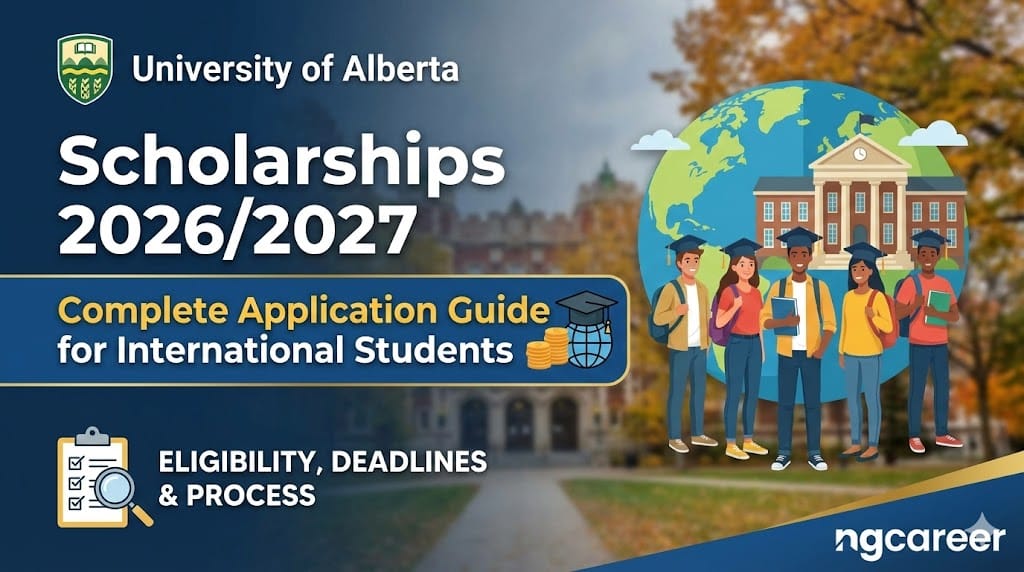
When I first started helping Nigerian students navigate Canadian scholarship applications back in 2021, the University of Alberta was rarely on anyone’s radar. Everyone wanted to talk about the University of Toronto or McGill. But after watching several students I advised receive funding from UAlberta, including one who secured the President’s International Distinction Scholarship worth $120,000 over four years, I realized this Edmonton-based institution was quietly offering some of the most accessible scholarship opportunities for Nigerian students willing to do the research.
The University of Alberta distributes over $52 million in financial support annually, according to the university’s official scholarship portal. That figure is not marketing fluff. It translates into real funding across undergraduate, masters, and doctoral programs, with awards ranging from $5,000 to $120,000 depending on your academic profile and leadership credentials.
While this guide focuses on Nigerian applicants, the scholarship information applies to all international students. Students from other African countries, South Asia, the Caribbean, and Latin America are equally eligible for all awards listed here.
Urgent deadline alert: If you are a current undergraduate student at UAlberta or considering research opportunities, there are active scholarships with a February 2, 2026 deadline that I will cover in detail below. Do not miss these opportunities.
For those targeting the Fall 2026 intake, the January 10, 2026 deadline for application-based entrance scholarships has passed. However, admission-based scholarships remain available if you apply for admission before the March 1, 2026 deadline. I will break down exactly what this means for your options.
Is the University of Alberta Fully Funded for International Students?
Let me address this directly since it is the most common question I receive.
No single scholarship covers 100% of tuition plus living expenses for most programs. However, the President’s International Distinction Scholarship ($120,000 over four years) covers 75-100% of tuition depending on your program. Graduate students can achieve near-full funding by combining scholarships with teaching and research assistantships.
The term “fully funded” in scholarship marketing often means substantial coverage, not necessarily complete coverage of all expenses. Understanding this distinction helps you plan realistically.
Why Nigerian Students Should Consider the University of Alberta
The University of Alberta sits in Edmonton, the capital city of Alberta province. While it lacks the name recognition of Toronto or Vancouver among Nigerian families, it consistently ranks among Canada’s top five universities. According to the QS World University Rankings 2025, UAlberta holds the 5th position nationally and places firmly in the world’s top 150 institutions globally.
What does this ranking mean practically? It means your degree carries international weight. Employers and graduate programs worldwide recognize an Alberta credential. More importantly for Nigerian students, it means the university has the resources and reputation to offer substantial scholarships rather than token awards.
The university enrolls over 39,000 students from approximately 150 countries. This international diversity is not accidental. Alberta actively recruits globally because international students bring perspectives that enrich the academic environment. That recruitment commitment translates into funding mechanisms specifically designed for international applicants.
A Success Story Worth Sharing
For context, let me share what happened with Chinedu, a student I advised in 2023. He had strong A-Level results from a Lagos secondary school, including A grades in Mathematics and Physics. His initial plan was to apply exclusively to universities in Ontario because that is what everyone in his network recommended. I suggested he add Alberta to his list, specifically because the scholarship structure rewards academic excellence regardless of nationality.
Chinedu received the International Leader Scholarship worth $15,000, combined with the Gold Standard Scholarship worth $6,000. That $21,000 in his first year significantly reduced his financial burden. His story is not unique, but it required understanding how UAlberta’s scholarship system actually works.
If you are exploring multiple scholarship opportunities in Canada, our comprehensive guide on Canada scholarships for Nigerians in 2026 covers other universities worth considering alongside Alberta.
Types of University of Alberta Scholarships for International Students
The scholarship landscape at UAlberta divides into two distinct categories: admission-based awards and application-based awards. Understanding this distinction is critical because it determines both your strategy and your deadlines.
Admission-Based Scholarships (No Separate Application Required)
These scholarships evaluate you automatically when you apply for admission. You do not fill out additional forms or write supplementary essays. The university’s system assesses your academic credentials against established criteria and matches you with appropriate awards.
Gold Standard Scholarship
This award targets the top 5% of students in each faculty based on academic achievement. The value reaches up to $6,000, and the beautiful thing about it is that you do not need to do anything beyond submitting a strong application. If your admission average places you in the top tier of your faculty’s applicant pool, you receive this scholarship automatically.
For Nigerian students with excellent WAEC or A-Level results, this scholarship is realistic. The key is ensuring your credentials are properly evaluated and converted to the Canadian grading scale. I have seen students lose out on this award not because their grades were insufficient, but because their transcript conversion was handled poorly.
International Admission Scholarship
This $5,000 award is based purely on your admission average. There is no leadership component, no essay, no interview. If your grades meet the threshold for your chosen program, you qualify automatically.
International Student Scholarships
This award provides up to $9,000 distributed over four years for undergraduate international students. Unlike the one-time International Admission Scholarship, this funding spreads across your degree program, providing ongoing support throughout your studies.
Regional Excellence Scholarship
Worth up to $5,000, this scholarship considers both your admission average and your geographic region. African students are eligible, and the award recognizes that academic excellence looks different across educational systems. This is another automatic consideration, meaning you do not apply separately.
How Admission-Based Scholarships Stack
Multiple admission-based scholarships can combine. A student receiving the Gold Standard Scholarship ($6,000), International Admission Scholarship ($5,000), and qualifying for ongoing International Student Scholarships could accumulate significant funding without submitting any additional applications. This stacking potential makes strong academic credentials particularly valuable at UAlberta.
Application-Based Scholarships (Supplementary Application Required)
These scholarships require you to complete additional applications beyond your standard admission documents. They typically consider leadership, community involvement, and personal qualities alongside academic achievement.
President’s International Distinction Scholarship
This is the flagship award for international undergraduates. At up to $120,000 payable over four years ($30,000 annually), it represents one of the most valuable scholarship opportunities available to Nigerian students at any Canadian university.
The requirements are substantial. You need a superior admission average, but that alone is insufficient. The selection committee evaluates demonstrated leadership qualities, which means you need documented evidence of leading initiatives, organizations, or community projects.
According to the University of Alberta’s scholarship documentation, recipients of this award are expected to be future global leaders. That expectation shapes the selection process. They are not looking for students who simply participated in activities. They want students who initiated, organized, and led.
For Nigerian applicants, this often means highlighting roles like head prefect, president of student organizations, founder of community initiatives, or leadership in religious or civic organizations. The key is specificity. Do not write “I was involved in community service.” Write “I organized a team of 15 volunteers to provide free tutoring to 50 WAEC candidates in my local government area over six months.”
International Leader Scholarship
Valued at up to $15,000, this one-time award targets well-rounded applicants with superior academics and demonstrated leadership. It sits below the President’s Scholarship in value but remains highly competitive.
The selection criteria overlap significantly with the President’s Scholarship, making it a natural second-tier outcome. Some students who apply for the President’s Scholarship but do not receive it are instead awarded the International Leader Scholarship.
CPK Memorial International Distinction Scholarship
This scholarship carries similar prestige to the President’s Scholarship and targets students who demonstrate exceptional promise. The specific criteria align with the President’s Scholarship, and the award value is comparable.
Kora Martensson International Scholarship
This award supports international students demonstrating academic excellence and financial need. It provides additional funding opportunities for students who may not qualify for the top-tier leadership scholarships but still demonstrate strong academic credentials.
Scholastic Distinction Scholarship
According to the University of Alberta’s scholarship portal, this application-based award recognizes students with exceptional academic achievement. You must apply to your program first and then complete the scholarship application through the Awards Hub.
Entrance Leadership Scholarship
This award recognizes students who demonstrate strong leadership qualities alongside academic excellence. It requires a separate application and considers your extracurricular involvement and community contributions.
University of Alberta Scholarship Deadlines: Complete 2026/2027 Calendar
Understanding deadlines prevents missed opportunities. Missing a deadline by even one day means waiting an entire year for the next cycle.
Urgent: Research Studentship Deadlines (February 2, 2026)
According to the University of Alberta Awards Hub, several research-focused awards are currently open with a deadline of February 2, 2026. If you are already a UAlberta student or will be enrolled by summer, these represent immediate funding opportunities:
| Award | Description | Deadline |
|---|---|---|
| Alberta Diabetes Institute Summer Studentship | Supports undergraduate research in diabetes | February 2, 2026 |
| Alberta Innovates Summer Research Studentship | Funding for summer research projects | February 2, 2026 |
| Cancer Research Institute of Northern Alberta (CRINA) Summer Studentship | Cancer-related research funding | February 2, 2026 |
| Future Energy Systems Stipend | Energy research support | February 2, 2026 |
| Li Ka Shing Institute of Virology Summer Studentship | Virology research funding | February 2, 2026 |
| Alberta Respiratory Centre Summer Studentship | Respiratory research support | February 2, 2026 |
| Alberta Transplant Institute Summer Studentship | Transplant-related research funding | February 2, 2026 |
| Campus as a Living Lab Stipend | Sustainability research support | February 2, 2026 |
| URI Undergraduate Researcher Stipend | General undergraduate research | February 2, 2026 |
| URI Connie Varnhagen Stipend | First-year student research | February 2, 2026 |
| URI Social Sciences & Humanities Stipend | Social sciences research | February 2, 2026 |
You must sign in with your University of Alberta CCID and password to access the application portal.
Current Students and Transfer Students (February 1 to March 31, 2026)
If you are a current UAlberta student, transferring from another institution, entering a professional program, or completing your degree, your application window differs from incoming high school students.
According to the Awards Hub, you must complete:
- General Application
- Additional Information Application
- Faculty-specific application
This window runs from February 1 until March 31 annually. Applications cannot be updated or reopened after the deadline.
Incoming High School Students (October 1 to Mid-January)
High school applicants entering directly must complete:
- General Application
- Entrance Scholarship Application
This application window typically runs from October 1 until mid-January annually. For Fall 2026 intake, this deadline has passed. For Fall 2027, expect the window to open October 1, 2026.
General Admission Deadlines
The University of Alberta offers four intake periods annually with the following deadlines:
| Intake | Application Deadline |
|---|---|
| September admission | March 1, 2026 |
| January admission | November 1, 2026 |
| May admission | March 1, 2026 |
| July admission | May 1, 2026 |
Not all programs are available for all intakes, and scholarship availability varies. The September intake typically offers the most scholarship opportunities for international students.
Alberta Student Aid Provincial Scholarships
Beyond university-specific awards, Alberta Student Aid offers additional scholarships through the provincial government. According to the Alberta Student Aid website, scholarship applications become available August 1 annually for students whose study period begins on or after that date.
If your study period begins on or after August 1, 2026, you must wait for the 2026-2027 scholarship applications available August 1, 2026. This represents an additional funding source many Nigerian applicants overlook.
University of Alberta Scholarship for Masters Students: Complete Funding Guide
Graduate funding at UAlberta operates differently from undergraduate scholarships. The university provides substantial support, but the mechanisms vary by program, department, and faculty.
Faculty-Specific Funding Differences
Graduate funding is not uniform across the university. Engineering and Science faculties typically have larger research budgets and more funded positions than Arts or Humanities. Before applying, research your specific department’s funding track record.
For example, the Faculty of Engineering often provides full funding packages to competitive PhD applicants that combine scholarships, teaching assistantships, and research assistantships. The Faculty of Arts may have fewer funded positions but offers teaching assistantships that provide tuition remission plus stipends.
Masters Entrance Scholarship
International masters students can receive a stipend of $17,500 plus an additional $10,000 to cover fees. This combination makes UAlberta one of the more financially accessible options for Nigerian students pursuing graduate education in Canada.
The critical point here is that funding decisions often happen at the department level. Your potential supervisor’s support matters enormously. Before applying, I strongly recommend contacting professors in your field of interest, sharing your research interests and credentials, and gauging their willingness to support your application.
Alberta Graduate Excellence Scholarship (AGES)
This scholarship provides up to $12,000-$15,000 as a one-time payment for masters and doctoral students. However, there are important restrictions you need to understand.
You cannot apply directly for AGES. This scholarship requires faculty nomination, meaning your department must put your name forward. Students who have previously received AGES are not eligible to receive it again.
Additional eligibility requirements include:
- GPA of 3.3 or higher over the most recent 15 units
- Must be enrolled in years 1-4 of a masters program or years 1-6 of a doctoral program
- Must reside in Alberta during enrollment with an Alberta home address
- Must have a Canadian bank account to receive funds
The evaluation considers research output, publications, presentations, and community engagement. Strong academic performance alone is insufficient.
Doctoral Recruitment Scholarship
PhD students receive $5,000 annually through this scholarship. While it sounds modest compared to undergraduate awards, doctoral students typically receive funding packages that combine this scholarship with teaching assistantships, research assistantships, and supervisor-provided funding.
Teaching and Research Assistantships
The reality of doctoral funding at UAlberta is that fully funded positions exist, but they require proactive work on your part. You need to:
- Identify supervisors with research funding
- Demonstrate fit with their research programs
- Often secure provisional acceptance before the formal application deadline
Teaching assistantships typically pay $7,000 to $12,000 per term depending on hours and department. Research assistantships vary based on supervisor grants and can range from partial to full funding.
For Nigerian students considering graduate studies, our guide on how to apply for scholarships covers strategies that apply across undergraduate and graduate levels.
University of Alberta Scholarship Requirements: What Nigerian Students Need
Understanding requirements prevents wasted applications. Let me break down exactly what you need across different award categories.
Academic Requirements
For undergraduate scholarships, your admission average is the primary academic criterion. The university converts international grades to its own scale, and the conversion matters more than you might expect.
Nigerian students typically apply with WAEC results, A-Level results, or a combination. The university accepts these credentials but requires official evaluation. I recommend using World Education Services (WES) Canada or the International Qualifications Assessment Service (IQAS) for credential evaluation.
Here is a practical example: A student with A1 grades in five WAEC subjects might assume they are competitive for top scholarships. But the converted GPA depends on which subjects you took, how the evaluation service interprets your results, and how Alberta’s admissions office processes that evaluation. I have seen students with seemingly identical WAEC results receive different converted GPAs based solely on how their documents were processed.
My advice: Get your credentials evaluated early, review the evaluation carefully, and if something seems wrong, challenge it with supporting documentation.
For graduate scholarships, you need a completed undergraduate degree. Masters applicants need a bachelor’s degree, and doctoral applicants typically need a master’s degree. Some doctoral programs accept exceptional students directly from bachelor’s degrees, but this is rare and requires extraordinary credentials.
For AGES eligibility specifically, you need a GPA of 3.3 or higher over your most recent 15 units of coursework.
English Language Proficiency
The university accepts IELTS, TOEFL, Duolingo English Test, and other standardized assessments. The minimum requirements vary by program, but typical thresholds are:
| Test | Minimum Score |
|---|---|
| IELTS Academic | 6.5 overall, no band below 6.0 |
| TOEFL iBT | 90 overall, no section below 21 |
| Duolingo English Test | 120 overall |
These are minimum admission requirements, not scholarship thresholds. For competitive scholarship consideration, you want scores well above these minimums. A student with an IELTS 8.0 demonstrates stronger English proficiency than one with 6.5, and that difference can influence scholarship decisions.
If you are deciding between English tests, our detailed comparison of IELTS vs TOEFL can help you choose based on your strengths.
Documentation Requirements
You will need:
- Official academic transcripts
- Proof of English language proficiency
- Statement of purpose or personal statement
- Letters of recommendation (optional for some scholarships but strongly recommended)
- Valid passport
- CV or resume
- Proof of leadership activities and volunteer work
The statement of purpose deserves special attention. This is where Nigerian applicants often underperform, not because they lack achievements, but because they do not know how to present those achievements for a Canadian audience.
Canadian selection committees value specificity, measurable impact, and reflection on lessons learned. A statement that says “I led my school’s debate team” is weak. A statement that says “As debate captain, I redesigned our training program, recruited 12 new members, and led our team to the state finals for the first time in five years, where I learned that consistent practice matters more than natural talent” demonstrates leadership, impact, and self-awareness.
Our guide on how to write a scholarship essay provides a framework for crafting statements that resonate with international selection committees.
How to Access the University of Alberta Scholarship Application Form
The application process happens through multiple portals depending on your status.
For Admission Applications
All students begin by applying for admission through the University of Alberta’s main application portal. You will:
- Create an account
- Select your program
- Enter personal and academic information
- Upload required documents
- Pay the application fee
For Scholarship Applications (Undergraduates)
Scholarship applications are managed through Bear Tracks, the university’s student portal, or the Awards Hub. High school applicants complete their entrance scholarship application through this system after applying for admission.
To access the scholarship application:
- Visit the University of Alberta Awards Hub
- Sign in with your University of Alberta CCID and password
- Complete the General Application
- Complete the Entrance Scholarship Application (for high school applicants)
- Complete any faculty-specific applications
Applications cannot be updated or reopened after the deadline, so ensure all information is accurate before submission.
For Graduate Students
Graduate funding applications are managed through Graduate Program Services (GPS) and the GSMS Awards Portal. The process varies by department, and some awards like AGES require faculty nomination rather than direct application.
Contact your department’s graduate coordinator for specific guidance on available funding and application procedures.
Common Application Form Errors to Avoid
Based on my experience advising applicants:
- Incomplete uploads: Ensure all documents are fully uploaded and readable
- Wrong file formats: Use PDF format unless otherwise specified
- Missing sections: Complete all required fields, even optional ones strengthen your application
- Last-minute submission: Technical issues are common near deadlines, submit at least 48 hours early
Step-by-Step Application Process for University of Alberta Scholarships
I have guided numerous Nigerian students through this process since 2021. The students who succeed follow a systematic approach.
Step 1: Research Programs Thoroughly (Start 12 to 18 Months Before Deadline)
Before you think about scholarships, you need to identify the specific program you want to study. The University of Alberta offers over 200 undergraduate programs and 500 graduate programs across faculties including:
- Faculty of Engineering
- Faculty of Science
- Alberta School of Business
- Faculty of Arts
- Faculty of Law
- Faculty of Medicine and Dentistry
- Faculty of Nursing
- Faculty of Pharmacy and Pharmaceutical Sciences
- Faculty of Education
- Faculty of Agricultural, Life and Environmental Sciences
Each faculty has different admission requirements and scholarship allocations. A student applying to Engineering faces different competition than one applying to Arts.
Spend time on the university’s official website reviewing program structures, course requirements, career outcomes, and faculty research interests. This research pays off when you write your statement of purpose because you can demonstrate genuine understanding of your chosen program.
Step 2: Get Credentials Evaluated (Start 6 to 9 Months Before Deadline)
Credential evaluation takes time. WES Canada and IQAS both require you to submit official documents, which means coordinating with your secondary school or university to send transcripts directly to the evaluation service.
In Nigeria, this process can be slow. WAEC results verification, for example, requires the evaluation service to confirm your results directly with WAEC, which can take several weeks.
Start this process early. I recommend beginning credential evaluation at least six months before you plan to apply.
Step 3: Prepare Your English Test (Ongoing, Complete 4 to 6 Months Before Deadline)
If you have not already taken IELTS, TOEFL, or another accepted test, schedule this early. Test center availability in Lagos and other Nigerian cities can be limited, and you want time to retake the test if your first attempt falls short.
Aim to complete your English test at least four months before the application deadline. This gives you time to receive results and retake if necessary.
Step 4: Draft Your Personal Statement (Start 3 to 4 Months Before Deadline)
Your personal statement or statement of purpose is where you distinguish yourself from thousands of other applicants with similar academic credentials.
For scholarship consideration, your statement should address:
- Why you chose this specific program at this specific university
- What unique perspectives or experiences you bring
- How this education connects to your future goals
- Specific examples of leadership and initiative
- Reflection on challenges overcome and lessons learned
Write multiple drafts. Have others review your work. Refine until every sentence serves a purpose.
Step 5: Secure Recommendation Letters (Request 2 to 3 Months Before Deadline)
Even when letters are optional, submitting strong recommendations can strengthen your scholarship application. Choose recommenders who know you well and can speak specifically to your academic abilities, leadership qualities, or character.
Give recommenders at least six weeks to write their letters. Provide them with information about your achievements and goals so they can write substantive letters rather than generic endorsements.
Step 6: Complete the Online Application
Submit your admission application through the main portal, then complete scholarship applications through the Awards Hub or Bear Tracks. Verify all materials are complete before the deadline.
For application-based scholarships, complete supplementary application components specific to each award before the January deadline (for Fall intake).
Step 7: Submit and Confirm
After submission, verify that the university received all components. Check your email regularly, including your spam folder, for any requests for additional information. Missing a request for clarification can delay or derail your application.
For detailed guidance on preparing your complete documentation package, our guide on documents needed for studying abroad provides a comprehensive checklist.
Cost of Studying at the University of Alberta: What Nigerian Students Should Budget
Understanding costs helps you assess how much scholarship support you actually need.
Tuition Fees (Based on 2025-2026 Rates)
International undergraduate tuition at UAlberta varies by faculty:
| Program Area | Annual Tuition (CAD) | Approximate Naira Equivalent |
|---|---|---|
| Arts, Science | $23,000 to $29,000 | ₦26M to ₦33M |
| Engineering | $32,000 to $39,000 | ₦36M to ₦44M |
| Business | $30,000 to $36,000 | ₦34M to ₦41M |
Graduate tuition is generally lower, ranging from approximately $9,000 to $20,000 CAD annually depending on the program.
Note: Tuition rates change annually. Verify current rates at ualberta.ca before making financial decisions.
Living Expenses in Edmonton
Edmonton offers a lower cost of living compared to Toronto or Vancouver, which is a genuine advantage for Nigerian students. Estimated annual living costs:
| Expense Category | Annual Cost (CAD) |
|---|---|
| Accommodation (on-campus) | $8,000 to $12,000 |
| Accommodation (off-campus shared) | $6,000 to $9,000 |
| Food | $3,500 to $5,000 |
| Transportation | $1,000 to $1,500 |
| Books and supplies | $1,000 to $1,500 |
| Personal expenses | $2,000 to $3,000 |
| Total Living Costs | $12,000 to $18,000 |
Health Insurance
International students must have health insurance. Alberta’s provincial health coverage (AHCIP) is available to students with valid study permits, but there may be a waiting period during which you need private insurance. Budget approximately $600 to $900 annually for health coverage.
How Scholarships Change the Equation
Let me show you what the numbers look like with different scholarship scenarios:
Scenario 1: No Scholarship
- Tuition (Science): $25,000
- Living expenses: $15,000
- Health insurance: $700
- Total Year 1 Cost: $40,700 CAD
Scenario 2: Admission-Based Scholarships Combined
- Tuition: $25,000
- Gold Standard + International Admission Scholarships: -$11,000
- Living expenses: $15,000
- Health insurance: $700
- Total Year 1 Cost: $29,700 CAD
Scenario 3: President’s International Distinction Scholarship
- Tuition: $25,000
- Scholarship: -$30,000
- Living expenses: $15,000
- Health insurance: $700
- Total Year 1 Cost: $10,700 CAD
The difference is dramatic. A student with the President’s Scholarship pays less than a third of what an unscholarized student pays.
Getting Your Canadian Study Permit After Receiving Your Scholarship
Receiving a scholarship offer is just the beginning. You still need a Canadian study permit to actually study in Canada.
Immigration, Refugees and Citizenship Canada (IRCC) requires several components for study permit applications:
- Letter of Acceptance from UAlberta
- Proof of financial support (your scholarship award letter helps significantly here)
- Proof of ties to Nigeria demonstrating you will return after your studies
- Valid passport
- Biometrics (fingerprints and photo)
The scholarship itself strengthens your study permit application. It demonstrates that a reputable Canadian institution has evaluated your credentials and invested in your education. Immigration officers view this positively.
However, scholarships rarely cover 100% of costs. You will still need to demonstrate funds for living expenses and any tuition not covered by your award. Prepare bank statements, sponsor letters, or other financial documentation showing you can cover the gap.
Processing Times for Nigerian Applicants
Study permit processing times vary, but Nigerian applicants should expect 8 to 16 weeks for processing. Apply as soon as you receive your acceptance letter and scholarship offer to allow adequate time.
Biometrics Requirement
All Nigerian applicants must provide biometrics as part of the study permit application. This involves visiting a designated Visa Application Centre (VAC) in Nigeria.
For Nigerian students, the study permit process involves biometrics collection through VFS Global. Our guide on how to book a VFS Canada biometrics appointment walks through this process step by step.
For a complete overview of the visa process, see our Canada student visa guide for Nigerians.
Common Rejection Reasons and How to Avoid Them
Based on patterns I have observed:
- Insufficient funds documentation: Show funds beyond the minimum requirement
- Weak ties to Nigeria: Demonstrate family, property, or career reasons to return
- Incomplete applications: Double-check every document is included
- Inconsistent information: Ensure all documents tell the same story
Common Mistakes Nigerian Applicants Make (And How to Avoid Them)
Over the years, I have observed patterns in unsuccessful applications. Learning from others’ mistakes can save you from making the same errors.
Mistake 1: Applying to Too Many Programs Without Focus
Some students apply to every university and scholarship they find, spreading their energy thin across dozens of applications. This approach produces mediocre applications everywhere rather than excellent applications to strategically chosen targets.
My recommendation: Apply to 4 to 6 universities with genuine fit, and give each application the attention it deserves.
Mistake 2: Generic Personal Statements
Statements that could apply to any university or any applicant do not win scholarships. Selection committees read thousands of essays. They recognize generic language instantly.
The fix: Reference specific programs, professors, research centers, or opportunities at UAlberta. Explain why this university, not just why Canada or why this field.
Mistake 3: Underestimating Credential Evaluation Timelines
Students who start credential evaluation in December for a January deadline often miss that deadline. The process takes time, and Nigerian educational institutions can be slow to respond to verification requests.
The fix: Begin credential evaluation at least six months before your application deadline.
Mistake 4: Weak Documentation of Leadership
Nigerian students often have genuine leadership experience but document it poorly. Saying “I was president of my fellowship” without details gives the selection committee nothing to evaluate.
The fix: Quantify everything. How many members? What initiatives did you lead? What outcomes did you achieve? What did you learn?
Mistake 5: Missing Supplementary Deadlines
The main admission deadline differs from scholarship application deadlines. Students who submit admission applications on time but miss the separate scholarship deadline lose out on funding.
The fix: Create a calendar with all relevant deadlines. Set reminders for at least two weeks before each deadline.
Mistake 6: Not Following Up
After submission, some students assume everything is handled. Meanwhile, the university may have sent requests for additional information that went to spam or were overlooked.
The fix: Check your email (including spam folder) daily after submitting. Log into Bear Tracks and the application portal regularly to check for updates or requests.
Mistake 7: Assuming AGES is Self-Application
Many graduate students assume they can apply directly for the Alberta Graduate Excellence Scholarship. They cannot. AGES requires faculty nomination. Build relationships with your professors and perform at a level that makes them want to nominate you.
About My Background and Why Accuracy Matters
My name is Babatunde Oladepo. I started this platform after experiencing firsthand how broken the information ecosystem around scholarships and jobs abroad is for Nigerians.
In 2019, I spent nearly four months applying to what I thought were legitimate scholarship programs. I trusted the websites I found through Google searches, assuming they were providing accurate information. Only later did I discover that half the deadlines I was working toward had already passed. The websites I relied on were simply copying information from other websites without ever checking the original university sources.
One program I applied to had actually been discontinued two years earlier, but it was still being listed on dozens of Nigerian “scholarship websites” as if it were active. I wasted months preparing an application for something that no longer existed.
The experience that really changed my approach came when I almost lost money to a “recruitment agency” that promised to secure me a job in Canada. They had a professional-looking website and testimonials that seemed genuine. They asked for an initial “document verification fee” of fifty thousand naira.
Something felt wrong, so I decided to verify independently. I searched for the Canadian employers they claimed to work with and found no record of any partnership. I checked the Corporate Affairs Commission database and found the company had been registered only three months earlier. I reached out to others who had used similar services and discovered a pattern of people paying fees and never hearing back.
That experience taught me two critical lessons. First, the information ecosystem around scholarships and jobs abroad for Nigerians is fundamentally broken. Too many websites prioritize clicks over accuracy. Second, there is a massive need for a trustworthy resource that does the verification work that most applicants do not have the time or expertise to do themselves.
Every piece of information in this guide has been verified against official University of Alberta sources. When deadlines or amounts change, we update. When programs are discontinued, we remove them. This commitment to accuracy is non-negotiable.
Frequently Asked Questions About University of Alberta Scholarships
Does the University of Alberta offer fully funded scholarships for international students?
Yes, though “fully funded” requires context. The President’s International Distinction Scholarship provides up to $120,000 over four years ($30,000 annually), which can cover the majority of tuition for many programs. However, even this substantial award may not cover 100% of tuition plus living expenses for all programs. For graduate students, combining scholarships with assistantships can achieve near-full funding in many cases.
What GPA do you need for University of Alberta scholarships?
For undergraduate admission-based scholarships, you need a competitive admission average that places you in the top tier of applicants. The Gold Standard Scholarship requires placement in the top 5% of your faculty’s applicant pool. For AGES (graduate), you need a minimum GPA of 3.3 over your most recent 15 units of coursework.
Are University of Alberta scholarships renewable?
Some scholarships like the President’s International Distinction Scholarship provide funding across multiple years ($30,000 annually for four years). The International Student Scholarships provide up to $9,000 distributed over four years. Others like the International Leader Scholarship are one-time awards. Check specific scholarship terms for renewal conditions and any GPA maintenance requirements.
Can a Nigerian apply for a scholarship in Canada?
Absolutely. Nigerian students are eligible for all University of Alberta international scholarships listed in this guide. There are no nationality-based restrictions for these awards. Your eligibility depends on academic qualifications, leadership experience, and meeting program requirements, not your passport.
What is the acceptance rate for the University of Alberta?
The university does not publish a single acceptance rate because rates vary significantly by program. Competitive programs like Engineering and Business have lower acceptance rates than programs with more capacity. For international students, acceptance depends on meeting academic thresholds, demonstrating English proficiency, and submitting strong applications. Meeting minimum requirements does not guarantee admission, especially for popular programs.
How long does it take for the University of Alberta to give admission decisions?
Processing times vary depending on when you apply and program capacity. Students who apply early (before December for Fall intake) typically receive decisions within 4 to 8 weeks. Late applications may take longer, and some decisions are not made until all applications are reviewed together.
Is it harder to get accepted as an international student?
International students are not held to different academic standards than domestic students. However, international students face additional requirements like English proficiency tests and credential evaluation. The challenge is not harder standards but more documentation and processing steps. Strong international applicants with excellent credentials and complete applications are competitive.
How much is the deposit fee for University of Alberta for international students?
Upon receiving an offer of admission, you will be required to pay a deposit to confirm your place. This deposit is typically applied toward your first term’s tuition. Verify the current deposit amount directly with the university, as this can change.
Which university is the cheapest in Canada for international students from Nigeria?
Tuition varies dramatically across Canadian universities. Some smaller institutions have lower sticker prices than UAlberta. However, a university with lower tuition but no scholarships may cost more than UAlberta with a strong scholarship. Evaluate total cost of attendance (tuition minus scholarships plus living expenses) rather than tuition alone.
How can I get 100% scholarship in Canada?
True 100% coverage is rare at the undergraduate level. The closest options are prestigious awards like the President’s International Distinction Scholarship, which covers substantial portions of tuition. At the graduate level, combining scholarships with teaching or research assistantships can achieve full funding in some programs. External scholarships from organizations like the Mastercard Foundation or government scholarship programs in your home country can supplement university awards.
What is the deadline for University of Alberta scholarships?
Multiple deadlines apply:
February 2, 2026: Research studentship applications (current students)
February 1 to March 31, 2026: Current students and transfer students
March 1, 2026: General admission deadline for Fall 2026 intake
Mid-January annually: Entrance scholarship applications for incoming high school students
August 1 annually: Alberta Student Aid provincial scholarship applications open
Preparing for Success: A Timeline for Nigerian Applicants
Let me give you a practical timeline for applying to the Fall 2027 intake:
January to March 2026
- Research programs and identify your top choices
- Begin gathering documents
- Start credential evaluation process with WES or IQAS
April to June 2026
- Take or retake English proficiency tests
- Draft initial personal statement
- Identify potential recommenders
July to September 2026
- Refine personal statement based on feedback
- Request recommendation letters
- Research specific faculty members and research opportunities
October to November 2026
- Complete online admission application
- Submit all supporting documents
- Complete scholarship applications through Awards Hub
December 2026 to January 2027
- Verify all materials received
- Meet entrance scholarship application deadline (mid-January)
- Respond promptly to any university requests
February to April 2027
- Await admission and scholarship decisions
- Begin study permit preparation upon acceptance
May to August 2027
- Confirm enrollment and pay deposit
- Complete study permit process
- Prepare for relocation to Edmonton
This timeline gives you adequate preparation time while maintaining momentum toward your goal.
The University of Alberta represents a genuine opportunity for Nigerian students seeking quality education with substantial financial support. The combination of strong academic programs, active international recruitment, and diverse scholarship options makes it worth serious consideration for your study abroad plans.
The students who succeed are those who start early, prepare thoroughly, and treat the application as a months-long project rather than a last-minute task. With the February 2, 2026 deadline for research studentships just days away and the general admission deadline of March 1, 2026 approaching, now is the time to take action if you are targeting Fall 2026. For Fall 2027, you have time to prepare properly, but that preparation should start now.