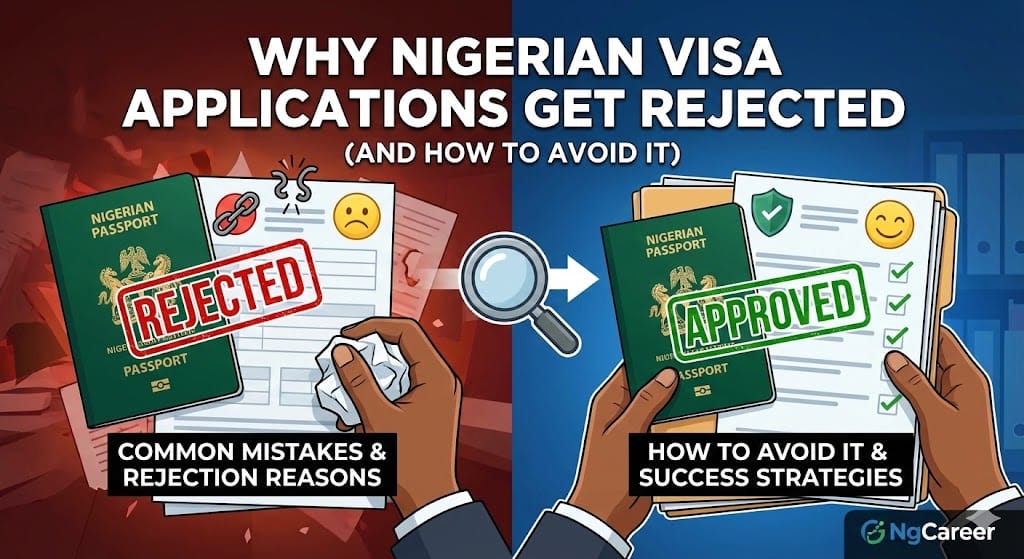
Visa rejection is one of the most frustrating experiences for Nigerian travelers. With Schengen visa rejection rates at 45.9% and U.S. visa refusals under Section 214(b) affecting thousands annually, understanding why applications fail is essential for success. The good news: most rejections are preventable.
My name is Babatunde Oladepo, and since 2019, I have been helping Nigerian applicants navigate visa processes. I have reviewed hundreds of rejection letters from Nigerian applicants. The most common phrase I see is “insufficient ties to home country,” yet many applicants had strong ties they simply failed to document properly. The difference between approval and rejection often comes down to presentation, not qualifications.
According to Nairametrics citing European Commission data published in May 2025, Nigeria recorded a 45.9% Schengen visa rejection rate in 2024, making it the country with the third-highest rejection rate globally, behind only Bangladesh (54.9%) and Senegal (46.8%). This guide breaks down every major rejection reason, what visa officers actually look for, and exactly how to strengthen your application.
Key Statistics: Nigerian Visa Rejection Rates
| Visa Type | Rejection Rate | Key Details |
|---|---|---|
| Schengen (2024) | 45.9% | 3rd highest globally; 4th in Africa |
| Schengen (2023) | 40.8% | 12.5% year-on-year increase |
| Global average | 14.8% | Nigerian rate is 3x higher |
| U.S. B1/B2 | High 214(b) refusals | Insufficient home ties cited |
| U.S. F1 Student (2023) | 36.25% | Up from 30% in 2021 |
| UK Visitor | Varies | Financial proof issues |
The Scale of Nigerian Visa Rejections
According to SchengenVisaInfo, Nigerian residents filed 111,201 visa applications in 2024, an increase of 4.98% compared to 2023. Of these, the Schengen States rejected 50,376 applications.
The financial impact is staggering:
- Nigerian residents spent €8,896,080 on Schengen visa applications in 2024
- Nigerian applicants lost €4,030,080 on rejected visas
- Since 2014, the EU has generated €72,550,160 from Nigerian visa applicants
According to Culture Custodian, the British government raked in over $24 million from Nigerian visa applications between June 2023 and June 2024, processing over 225,000 applications.
Global Context: Why African Applicants Face Higher Rejection
According to the Henley Africa Wealth Report, “The rejection rates for African applicants for Schengen visas are generally 10% higher than the global average, three times higher than the highest rejection rate from developed nations, and ten times higher than for US-Americans.”
Africa accounted for seven of the top 10 countries with the highest Schengen visa rejection rates in 2022. About three in ten African Schengen visa applicants were rejected, compared to one in ten applicants worldwide.
Top 10 Countries with Highest Schengen Visa Rejection Rates (2024)
According to AXA Schengen:
| Rank | Country | Rejection Rate |
|---|---|---|
| 1 | Bangladesh | 54.9% |
| 2 | Pakistan | 47.5% |
| 3 | Guinea-Bissau | 47.0% |
| 4 | Senegal | 46.8% |
| 5 | Haiti | 46.3% |
| 6 | Nigeria | 45.9% |
| 7 | Ghana | 45.5% |
| 8 | Congo (Brazzaville) | 43.0% |
| 9 | Mali | 42.9% |
Top 10 African Countries with Highest Rejection Rates (2024)
According to Vanguard Nigeria:
| Rank | Country | Rejection Rate |
|---|---|---|
| 1 | Comoros | 62.8% |
| 2 | Guinea-Bissau | 47.0% |
| 3 | Senegal | 46.8% |
| 4 | Nigeria | 45.9% |
| 5 | Ghana | 45.5% |
| 6 | Congo (Brazzaville) | 43.0% |
| 7 | Mali | 42.9% |
| 8 | Guinea | 41.1% |
| 9 | Burundi | 40.0% |
| 10 | Ethiopia | 36.1% |
The Most Common Reasons Nigerian Visa Applications Get Rejected
1. Insufficient Ties to Home Country
This is the primary reason for visa refusals, particularly under U.S. Section 214(b). According to Alonge Law Firm, consular officers assess whether the applicant’s life in Nigeria is strong enough to ensure their return.
What consular officers look for:
- Stable, documented employment
- Long-established business ownership
- Property or real estate
- Education commitments
- Dependent family members
- Long-term financial responsibilities
Why Nigerians often fail:
According to Alonge Law, “Weak, inconsistent, or poorly explained ties significantly increase refusal likelihood.” Common issues include:
- Informal employment without documentation
- No property in their name
- Single with no dependents
- Recently changed jobs or relocated
According to Culture Custodian, “Low trust that Nigerian travelers will return to Nigeria after their travels is a major reason for the high rate of visa rejections. As a result of the nation’s glaring economic woes which have led to an alarmingly high cost of living, 7 out of 10 Nigerians are willing to leave the country if given the opportunity.”
How to fix it:
According to The Nation: “Attach employment letters, CAC documents, school records, property proof or family ties.”
Specifically:
- Obtain detailed employment letter on company letterhead stating your position, salary, and approved leave period
- Provide CAC registration and business bank statements if self-employed
- Include property documents, land titles, or rental agreements
- Show evidence of family responsibilities (marriage certificates, children’s birth certificates)
- Document upcoming commitments that require your return
2. Weak or Inconsistent Financial Proof
According to Study Abroadly, “The most frequent cause of visa rejection for Nigerian students is inadequate financial documentation.”
The Nation confirms: “One-page balances, unexplained deposits or poor financial history often lead to rejection.”
Common mistakes:
- Submitting only current bank balance (one-page statement)
- Large, unexplained deposits shortly before application
- Balance that does not match stated income
- Missing source of funds explanation
- Poor financial history with irregular transactions
How to fix it:
According to The Nation: “Submit 3-6 months of bank statements, payslips and sponsor documents.”
Additionally:
- Ensure statements show a consistent income pattern
- Explain any large deposits with supporting documents
- Include salary slips, tax returns, or business income proof
- If sponsored, provide sponsor’s complete financial documentation including their employment letter
Red flag example:
An applicant with ₦200,000 monthly salary showing a ₦5 million balance deposited one week before application will raise immediate questions about fund authenticity.
3. Nigeria’s Reputation for Fraud and Cybercrime
According to Culture Custodian: “By now, electronic crime and fraud are almost synonymous with Nigeria. Known for its notorious ‘419’ scams, Nigeria continues to battle a reputation fraught with issues related to cyber fraud.”
The article notes that in 2023, Nigeria’s banks reported a significant increase in financial fraud, with cases rising by 65% from Q2 to Q3. The EFCC secured a record 4,111 convictions and recovered over ₦365.4 billion in 2024.
“This fraudulent reputation leads to increased scrutiny for visa applicants, causing delays and rejections, even for genuinely eligible individuals who have already gone through strict background checks.”
How to address this:
- Ensure all documents are verifiable and genuine
- Never use agents who offer to “help” with documentation
- Be prepared to provide additional verification if requested
- Maintain a clean online presence
4. Incomplete or Incorrect Application Forms
According to The Nation, “Small errors in names, dates or passport numbers trigger instant red flags.”
Common errors:
- Blank fields or missing information
- Inconsistent dates across documents
- Name spelling variations between passport and forms
- Wrong passport number or expiry date
- Using outdated application form versions
How to fix it:
According to The Nation: “Copy details straight from your passport and double-check every field.”
Additional steps:
- Triple-check every field before submission
- Use only the latest official application forms from embassy websites
- Have someone else review your completed forms
- Keep copies of everything submitted
5. Poor Interview Performance
According to Alonge Law, “The consular interview is brief, often less than three minutes. Officers make decisions quickly and rely heavily on clarity, confidence, consistency, and credibility.”
Common interview mistakes:
Alonge Law identifies these problems:
- Over-explaining or giving rehearsed, unnatural answers
- Contradicting information in your application
- Expressing uncertainty
- Appearing nervous or evasive
As the firm notes: “In a fast interview, clarity is more persuasive than volume.”
How to prepare:
- Practice answering common questions concisely
- Know your travel itinerary thoroughly
- Be prepared to explain your ties to Nigeria
- Answer directly without unnecessary elaboration
- Maintain calm, professional demeanor
Sample questions to prepare for:
- Why do you want to visit this country?
- What do you do for work?
- Who will fund your trip?
- When will you return?
- Do you have family there?
6. Unclear or Unconvincing Travel Purpose
According to Alonge Law, “Your plans must make sense in light of your background, finances, and circumstances. Officers assess whether your purpose of travel is practical, properly timed, financially supported, and consistent with your life in Nigeria.”
This appears on refusal letters as: “The purpose and conditions of the intended stay could not be ascertained.”
Why this happens:
- Vague explanation of travel reasons
- Itinerary does not match stated purpose
- No supporting documents for claimed purpose
- Purpose seems inconsistent with applicant’s profile
As Alonge Law notes: “Even truthful plans can seem unconvincing if not well articulated.”
How to fix it:
- Provide detailed, day-by-day travel itinerary
- Include supporting documents (conference invitations, hotel bookings, family invitation letters)
- Ensure accommodation and flight dates align with stated plans
- Write a clear cover letter explaining your specific reasons
7. Fake, Forged, or Altered Documents
According to The Nation: “Falsified papers cause immediate denial and can lead to bans.”
According to Culture Custodian, “When one person violates these principles, it impacts all of us. It makes it harder for the next applicant—someone who may be fully compliant—to be granted the same opportunity.”
Consequences:
- Immediate rejection
- Permanent flag on your file
- Potential multi-year or lifetime bans
- Criminal referral in severe cases
Common document fraud attempts:
- Fake hotel bookings
- Altered bank statements
- Forged employment letters
- Fabricated invitation letters
- Inflated salary figures
How to avoid:
According to The Nation: “Use only genuine documents and work with accredited centres like VFS or TLScontact.”
Never use agents who suggest “helping” with documents. Submit only what you can prove and verify.
8. Nigeria’s Security Situation
According to Culture Custodian: “Nigeria’s infamous insecurity rates are another reason several citizens would seize any opportunity to flee the country. Kidnappings make daily news; bandit attacks on villages are commonplace; and highways have become breeding grounds for bloodshed.”
The article notes that 91,740 lives were lost in Nigeria between 2011 and 2024 due to incidents of insecurity, and Nigeria’s placement at 7.575 on the Global Terrorism Index reaffirms its status as a terrorism epicenter in sub-Saharan Africa.
“Other than the fact that visa applicants from a region rife with insecurity can easily be seen as fleeing the country, such high insecurity numbers also paints a picture of instability and concern for other nations.”
How to address this:
- Focus on demonstrating strong personal ties to Nigeria
- Show stable employment and financial commitments
- Provide evidence of established life in Nigeria
- Be prepared to address concerns about your intentions honestly
9. Previous Visa Refusals or Immigration Violations
According to Alonge Law, past overstays, unauthorized work, visa refusals, or fraud findings “can heavily influence the outcome of a new application—even if the applicant’s current case is otherwise strong.”
How to address:
- Always disclose previous refusals truthfully
- Include a cover letter explaining what changed since last refusal
- Provide evidence of improved circumstances
- Show compliance history for any visas successfully used
- Never attempt to hide travel or immigration history
10. No Prior Travel History
According to The Nation: “First-time travellers are scrutinised more closely.”
An empty passport raises overstay risk concerns because there is no evidence of previous visa compliance.
How to compensate:
According to The Nation: “Strengthen your file with a clear itinerary, financial proof and strong home ties.”
Additionally:
- Provide extra documentation of home ties
- Consider building travel history with easier destinations first
- Write a compelling cover letter explaining your situation
Easiest and Hardest Schengen Countries for Nigerian Applicants
According to SchengenVisaInfo:
Easiest Countries for Nigerians (2024)
| Country | Approval Rate |
|---|---|
| Switzerland | 79.40% |
| Other countries | Varies |
Hardest Countries for Nigerians (2024)
| Country | Rejection Rate |
|---|---|
| Belgium | 62.32% |
| Denmark | 34.94% |
| France | 43.5% (24,301 of 55,833 rejected) |
France was the top destination for Nigerian residents with 55,833 applications, but also rejected the most Nigerian applications (24,301).
Schengen Countries with Lowest Overall Rejection Rates
According to AXA Schengen:
| Country | Rejection Rate |
|---|---|
| Iceland | 6.6% |
| Bulgaria | 9.4% |
| Romania | 9.4% |
| Slovakia | 9.9% |
| Latvia | 10.9% |
Schengen Countries with Highest Overall Rejection Rates
| Country | Rejection Rate |
|---|---|
| Malta | 38.5% |
| Estonia | 27.7% |
| Belgium | 24.6% |
| Slovenia | 24.5% |
| Sweden | 24.0% |
Understanding Section 214(b) Refusals (U.S. Visas)
According to Alonge Law Firm, “A 214(b) refusal is one of the most common outcomes in Nigeria. It is also one of the most misunderstood.”
What Is a 214(b) Refusal?
Section 214(b) applies to nonimmigrant visas, temporary visas issued to individuals who intend to visit the United States for a specific and limited purpose.
As Alonge Law explains: “By law, every applicant for a nonimmigrant visa is presumed to be an intending immigrant unless they successfully prove otherwise.”
Visa categories subject to 214(b):
- B1/B2 (Visitor/Tourist)
- F-1 (Academic Student)
- M-1 (Vocational Student)
- J-1 (Exchange Visitor)
- R-1 (Religious Worker)
- P-1 & P-3 (Athletes, Entertainers)
- Q-1 (Cultural Exchange)
- H-3 (Trainee)
What 214(b) Does NOT Mean
According to Alonge Law: “Many applicants misunderstand the legal meaning of 214(b).”
It is not:
- A permanent bar
- An allegation of fraud
- A criminal finding
- A denial that destroys future chances
- Lifetime ineligibility
As Alonge Law states: “It is a temporary refusal to issue a nonimmigrant visa because the officer was not convinced the legal standard was met.”
What It DOES Mean
According to Alonge Law: “A 214(b) refusal simply means the officer was not convinced—at that moment—that the applicant met the legal requirements.”
Applicants are allowed to reapply, but a new application must address the weaknesses of the first.
What Do Visa Officers Actually Look At?
According to Alonge Law, to overcome the presumption of immigrant intent, applicants must convince the consular officer that they:
- Have a legitimate, temporary purpose for travel
- Maintain strong and verifiable ties to Nigeria
- Will depart once their authorized stay is complete
| Assessment Area | What Officers Evaluate |
|---|---|
| Ties to home country | Employment, property, family, financial commitments |
| Financial capacity | Ability to fund trip without illegal work |
| Travel purpose | Logical, documented, consistent with profile |
| Immigration history | Previous visas, compliance record, refusals |
| Intent to return | Evidence suggesting temporary stay only |
| Document authenticity | Verification of all submitted materials |
| Interview credibility | Consistency, confidence, clarity |
How to Know Your Visa Rejection Reasons
Step 1: Read the Refusal Letter Carefully
Every rejection comes with a written explanation. Common phrases include:
| Refusal Phrase | Meaning |
|---|---|
| “Insufficient ties to home country” | Need stronger evidence of reasons to return |
| “Purpose of visit not established” | Travel plans unclear or undocumented |
| “Financial capacity not demonstrated” | Bank statements inadequate |
| “Information not reliable” | Documents appear inconsistent or fabricated |
| “Previous immigration violations” | Past overstays or non-compliance flagged |
Step 2: Identify the Specific Deficiency
Focus on exactly what was cited. Do not guess or assume additional problems.
Step 3: Plan How to Address Each Issue
Create a checklist of improvements needed before reapplying.
Can I Reapply Immediately After Visa Rejection?
Short answer: Yes, there is no mandatory waiting period for most visas.
According to Alonge Law: “Applicants are allowed to reapply—but a new application must address the weaknesses of the first.”
However:
- Reapplying with the same documents will produce the same result
- You must address the specific refusal reasons
- Multiple rejections create negative patterns
Before reapplying:
- Understand exactly why you were refused
- Gather new or additional evidence
- Address every issue mentioned in refusal letter
- Consider what has changed since last application
- If nothing has changed, wait until circumstances improve
How to Strengthen Your Application After Rejection
According to Alonge Law, “A better outcome requires a better presentation—both on paper and in the interview.”
Step 1: Strengthen Your Home-Country Ties
According to Alonge Law, your ties must clearly reflect a stable life in Nigeria. Examples include:
- Employment with documented, ongoing responsibilities
- A business with real operations and financial records
- Ownership of land or property
- Enrollment in long-term studies
- Marriage or children who depend on you
- Established financial commitments
“The stronger and more verifiable your ties, the more persuasive your case.”
Step 2: Practice for the Interview
According to Alonge Law: “Most refusals stem from unclear or poorly delivered answers—not from documents alone.”
Interview preparation should focus on:
- Answering directly
- Avoiding unnecessary details
- Speaking with confidence
- Explaining your situation in simple, accurate terms
- Ensuring your answers match your application
Step 3: Present a Clear, Credible Travel Purpose
According to Alonge Law, your reason for travel must be logical, realistic, well-supported, consistent with your financial situation, and aligned with your long-term life in Nigeria.
“Even tourism must be explained in a way that makes sense for your personal and financial profile.”
Step 4: Provide Relevant, High-Quality Documents
According to Alonge Law: “Avoid overwhelming the officer with unnecessary evidence. Instead, focus on documents that prove ties, demonstrate financial capacity, support your travel purpose, and show consistency.”
“Quality is more persuasive than quantity.”
Step 5: Seek Professional Guidance After Multiple Refusals
According to Alonge Law, a lawyer can:
- Analyze your previous interview
- Identify weaknesses in your profile
- Create a strategy to strengthen your ties and documentation
- Help design a more credible travel plan
- Prepare you for the next interview
“Professional guidance becomes especially important after repeated refusals.”
Tips to Impress a Visa Officer
| Do | Do Not |
|---|---|
| Answer questions directly and concisely | Ramble or over-explain |
| Maintain eye contact and calm demeanor | Appear nervous or evasive |
| Know your documents thoroughly | Fumble through papers |
| Be honest about your situation | Exaggerate or lie |
| Dress professionally | Appear too casual |
| Arrive early for appointment | Be late or rushed |
According to Alonge Law: “In a fast interview, clarity is more persuasive than volume.”
Understanding 221(g) Administrative Processing
According to Alonge Law: “A 221(g) notice signals ‘administrative processing.’ It means the officer needs more documents, or additional internal review is required, or security checks are pending.”
Important: “It is not a refusal. It is a temporary hold that requires applicants to follow the instructions on the notice carefully and promptly.”
Frequently Asked Questions
What is the most common reason for visa refusal?
Insufficient ties to home country is the most frequently cited reason, particularly for U.S. visas (Section 214(b)) and Schengen visas. Consular officers need evidence that your life circumstances, including employment, property, and family, ensure you will return after your visit.
What is Nigeria’s Schengen visa rejection rate?
According to European Commission data, Nigeria recorded a 45.9% rejection rate in 2024, up from 40.8% in 2023. This ranks Nigeria 3rd highest globally (behind Bangladesh and Senegal) and 4th in Africa (behind Comoros, Guinea-Bissau, and Senegal). The global average rejection rate is 14.8%, meaning Nigerian applicants are rejected at more than three times the global rate.
Can my visa be approved after rejection?
Yes. According to Alonge Law, “A 214(b) refusal is not a permanent bar.” Many applicants succeed on subsequent attempts by addressing the specific issues cited in their refusal letter and providing stronger documentation.
How do I know why my visa was rejected?
Your refusal letter contains the specific reasons. Read it carefully to identify exactly what was insufficient. Common reasons include weak home ties, inadequate financial proof, unclear travel purpose, or document inconsistencies.
Can I apply again immediately if my visa is rejected?
Yes, there is no mandatory waiting period for most visa types. However, reapplying with identical documents will likely produce the same result. Address the refusal reasons and strengthen your application before resubmitting.
What do visa officers look at?
According to Alonge Law, officers assess whether you have a legitimate temporary purpose for travel, maintain strong and verifiable ties to Nigeria, and will depart once your authorized stay is complete.
How can I improve my chances of visa approval?
Provide complete, consistent documentation. Demonstrate strong ties to Nigeria. Show genuine, accessible funds through 3-6 months of bank statements. Explain your travel purpose clearly. Prepare thoroughly for interviews. Never submit false or altered documents.
What evidence helps get my visa approved?
Strong evidence includes employment contracts with return dates, property ownership documents, family responsibility proof (marriage and birth certificates), 6 months of consistent bank statements, detailed travel itinerary, and invitation letters if visiting someone.
Which Schengen country is easiest for Nigerians?
According to SchengenVisaInfo, Switzerland had the highest approval rate for Nigerian applicants in 2024 at 79.40%. Belgium was the hardest, with a 62.32% rejection rate.
How much money have Nigerians lost to rejected visas?
According to SchengenVisaInfo, Nigerian applicants lost €4,030,080 on rejected Schengen visas in 2024 alone. Since 2014, the EU has generated €72,550,160 from Nigerian visa applicants.
Is there an appeal process for visa rejections?
For most nonimmigrant visas (tourist, student), there is no formal appeal. You reapply with a stronger application. For U.S. immigrant visa denials, you may have options through the Administrative Appeals Office or motions to reopen or reconsider.
What happens if I submit fake documents?
According to The Nation, falsified papers cause immediate denial and can lead to bans. This can permanently affect your ability to obtain visas in the future. According to Culture Custodian, document fraud also harms other Nigerian applicants by increasing scrutiny for everyone.
How long should my bank statements cover?
According to The Nation, you should submit 3-6 months of bank statements showing consistent income and legitimate transactions. One-page balances or statements showing sudden unexplained deposits often lead to rejection.
Destination-Specific Guides
For detailed requirements for specific destinations, see our comprehensive guides:
- Schengen Visa for Nigerians covers the 45.9% rejection rate and prevention strategies
- Australia Student Visa for Nigerians explains AUD 29,710 financial requirements and the Genuine Student statement
- Germany Student Visa for Nigerians covers the blocked account and WAEC legalization
- UK Student Visa Nigeria Application Guide explains UK requirements
- Canada Student Visa for Nigerians covers the study permit process
- US Visa Bond for Nigerians explains the new $5,000-$15,000 requirement
- How to Spot Fake Recruitment Agencies helps you avoid scams
Final Thoughts
Visa rejection is disappointing, but it is rarely the end of the road. Understanding why applications fail reveals that most rejections are preventable with proper preparation.
According to Alonge Law: “A 214(b) refusal can feel demoralizing, but it is not the end of the journey. Many applicants succeed on a second or third attempt when they understand the underlying legal standard and prepare more strategically.”
As the Henley Africa Wealth Report notes, “Access to Schengen visas corresponds to the economic and passport power of the applicant’s country of nationality. The poorer the country of nationality, the higher the rejection rate.” Nigerian applicants face systemic challenges, but individual preparation can make the difference.
Key takeaways:
- Document your ties to Nigeria thoroughly with employment letters, property documents, and family evidence
- Show consistent, verifiable financial capacity through 3-6 months of bank statements
- Make your travel purpose crystal clear with supporting documents
- Never submit fake or altered documents, as this harms both you and future Nigerian applicants
- Prepare thoroughly for interviews, focusing on clarity over volume
- Address previous refusal reasons completely before reapplying
As Alonge Law concludes: “Success depends on stronger ties, clearer explanations, credible documentation, and confident interview performance.”
This article reflects information from European Commission 2024 visa statistics published in May 2025 and verified through multiple sources. Visa requirements and processes can change. Always verify current requirements directly with the embassy or consulate you are applying to.